
8 Best Blue Yonder Alternatives and Competitors in 2026
Sorted by what you're actually replacing. Because if you only run transport, you don't need a lighter planning suite – you need a TMS built for it.

Bring structure, visibility, and compliance to your transport operations


Summary
Blue Yonder is among the best-known supply chain platforms, used by global retailers and manufacturers. But it isn't a single product. It's a large suite that covers planning, inventory, warehousing and transport. That's why the first question when looking for an alternative is a simple one: what are you actually trying to replace?
For some companies, the answer is the full planning suite. For others, it's only transport. In that case, an enterprise platform can be more than you need, both in price and in implementation time.
In this article, we compare eight alternatives, grouped by the situation each one fits best: companies already running a specific ERP, retailers, manufacturers with hard-to-predict demand, teams focused on warehouse and transport execution, and mid-market companies that simply need to manage their shipments. For each one, you'll find its strengths, its limits and a side-by-side comparison with Blue Yonder, so you can choose the right fit for your company.
If you're looking for Blue Yonder alternatives, the first thing to sort out is which Blue Yonder you're actually replacing.
Blue Yonder isn't one product. It's a giant enterprise supply chain suite that covers demand planning, inventory, warehouse management, transportation, and retail merchandising. So "alternatives" means very different things depending on the module you care about.
Most teams shopping this list are enterprises comparing the planning suite. For them, the real alternatives are SAP, Oracle, Kinaxis, o9, and a few others. But there's another group that gets pitched Blue Yonder when all they really run is transport, often at mid-market scale. If that's you, the honest answer is you're shopping in the wrong tier. A right-sized TMS does the job in a fraction of the time and cost.
We sorted these eight by what you're trying to replace, and which Blue Yonder alternative is the best for your specific use case. Read on to find the right fit.
TL;DR
- Blue Yonder is a Tier 1 enterprise supply chain suite (formerly JDA, now owned by Panasonic), built for global retailers and manufacturers.
- If you're replacing the planning suite and already run SAP, look at SAP IBP. On Oracle, look at Oracle SCM Cloud.
- For fast concurrent planning in volatile or manufacturing-heavy supply chains, Kinaxis fits. For AI-native integrated planning, o9 Solutions.
- For retail, especially grocery and fashion, RELEX is the retail-native pick.
- For warehouse and transport execution, Manhattan Associates is the best-of-breed choice. For industry-specific cloud SCM, Infor.
- If you're a mid-market European shipper who needs transportation management, not a billion-dollar planning platform, you don't need an enterprise suite. You need a right-sized TMS with EU compliance built in. That's Deliwell, live in days. Book a free demo with Deliwell.
Best Blue Yonder Alternatives: Side-by-Side Comparison
One thing to keep in mind as you scan the table. Seven of these are enterprise supply chain platforms in roughly the same tier as Blue Yonder, so they fit if you're replacing the planning suite at enterprise scale.
The last one is there for a different reader. A lot of companies only ever needed Blue Yonder for transportation, or got quoted the suite when they run a mid-market operation. If that's you, an enterprise platform is more than the job requires. Deliwell is in the table as the right-sized TMS for that case, so you can see the tier difference side by side.
What Blue Yonder Does Well
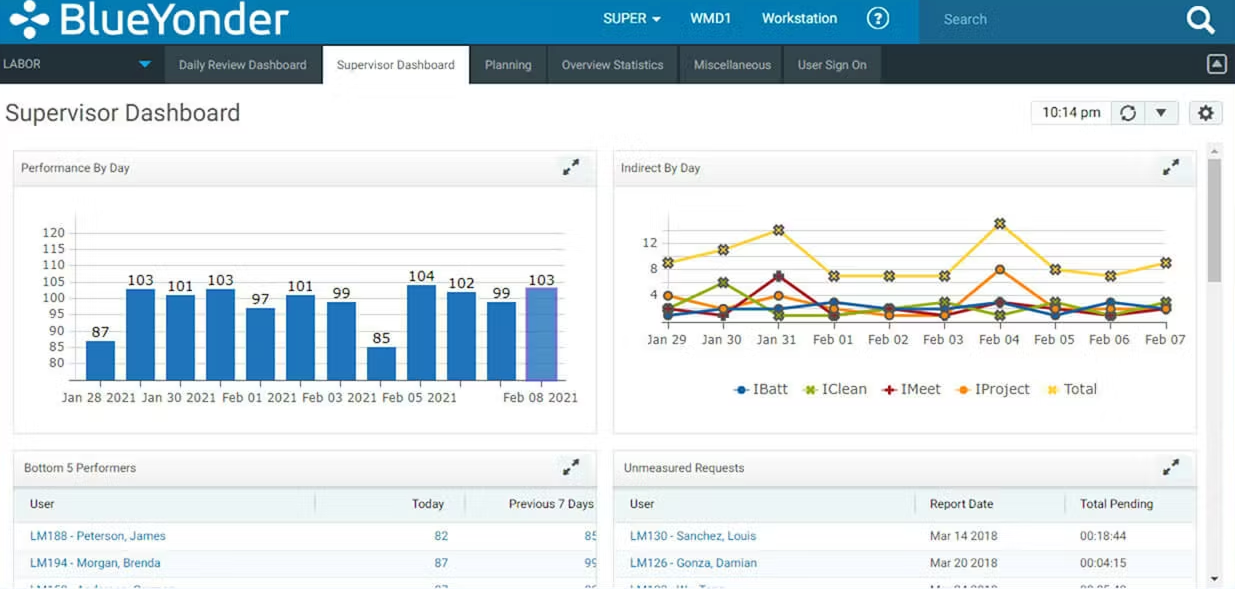
Blue Yonder is one of the most complete supply chain platforms in the market. It plans demand and supply, optimizes inventory, manages warehouses and transportation, and ties it all together with AI on a single connected platform. Gartner names it a Leader in supply chain planning, warehouse management, and transportation, and it's one of only two vendors that lead in all three.
It's built for the world's largest, most complex supply chains. Companies like Coca-Cola, DHL, and Walgreens run on it. If you're a global retailer or manufacturer that needs deep end-to-end planning and execution under one roof, Blue Yonder does that job at a scale almost nobody else matches.
Why Do Companies Look for Blue Yonder Alternatives?
Blue Yonder is powerful, but that power comes with trade-offs. The reasons teams go looking for an alternative usually come down to five things.
- Enterprise price tag - Deals commonly run into seven figures. If your business isn't enterprise-scale, the cost rarely maps to the value you'll use.
- Long, heavy implementations - Rollouts often take 12 to 18 months. The suite carries legacy JDA modules, so it needs real consulting, configuration, and process re-engineering to go live.
- Suite overkill - Most companies use a slice of what Blue Yonder offers. Paying for end-to-end planning when you need one module is a poor fit.
- The module you actually need - Plenty of buyers only want transportation or warehouse management, not the full planning platform. A focused tool serves that better.
- No native EU compliance - There's no Romanian e-Transport, no UIT generation, no e-CMR. A CEE operator handles all of that somewhere else.
SAP: Best Blue Yonder Alternative for Companies Already on SAP
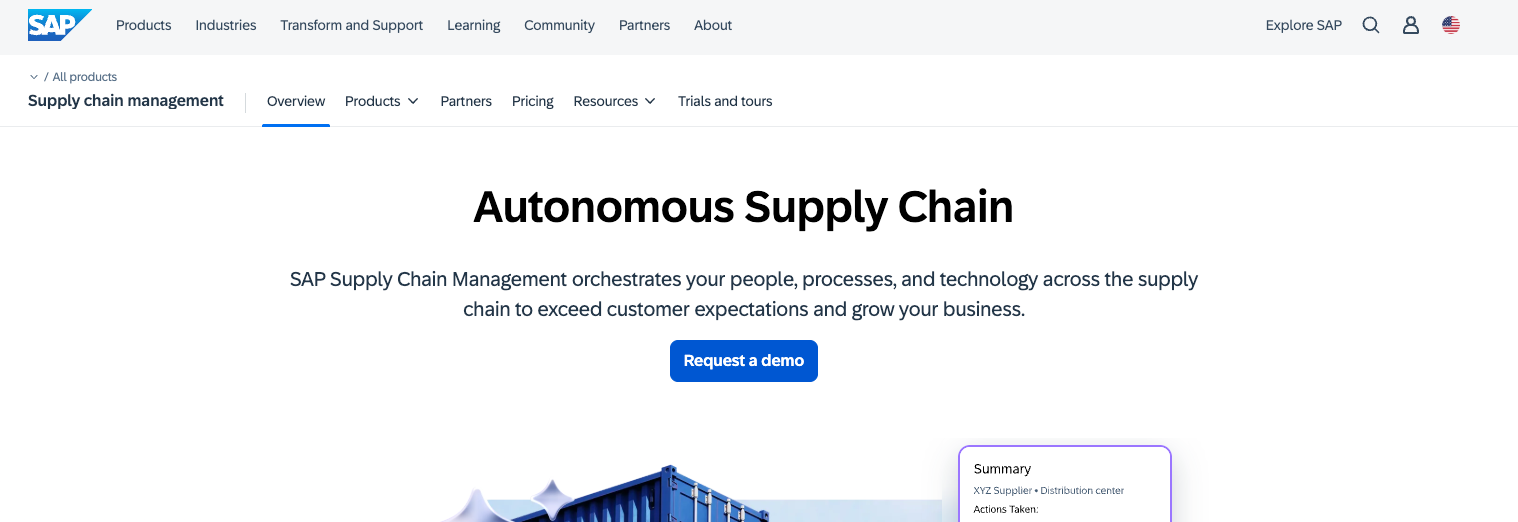
SAP is the default Blue Yonder alternative for any company already standardized on SAP. Its planning product, SAP Integrated Business Planning (IBP), runs in the cloud and connects demand, supply, inventory, and S&OP in one place.
Strengths:
- Tight integration with S/4HANA and the wider SAP ecosystem, so planning and execution share data with fewer handoffs.
- Strong demand sensing, scenario modeling, and inventory optimization.
- Backed by SAP's global support and partner network.
- A natural fit when finance and operations already live in SAP.
Shortcomings:
- The heaviest value comes only if you're already an SAP shop. Outside that, the integration effort climbs.
- Enterprise pricing and a long implementation cycle.
- Lighter on logistics execution than Blue Yonder's full suite.
Pricing:
Enterprise quote. Subscription priced by users, modules, and data volume. Typical enterprise deployments land in the six-figure annual range.
How does SAP compare to Blue Yonder?
SAP IBP wins on ecosystem consistency for SAP shops. Blue Yonder is often seen as the deeper best-of-breed planner with broader execution across WMS and TMS. The choice usually comes down to whether you want to stay inside the SAP stack.
Oracle SCM Cloud: Best Blue Yonder Alternative for Oracle-Aligned Enterprises
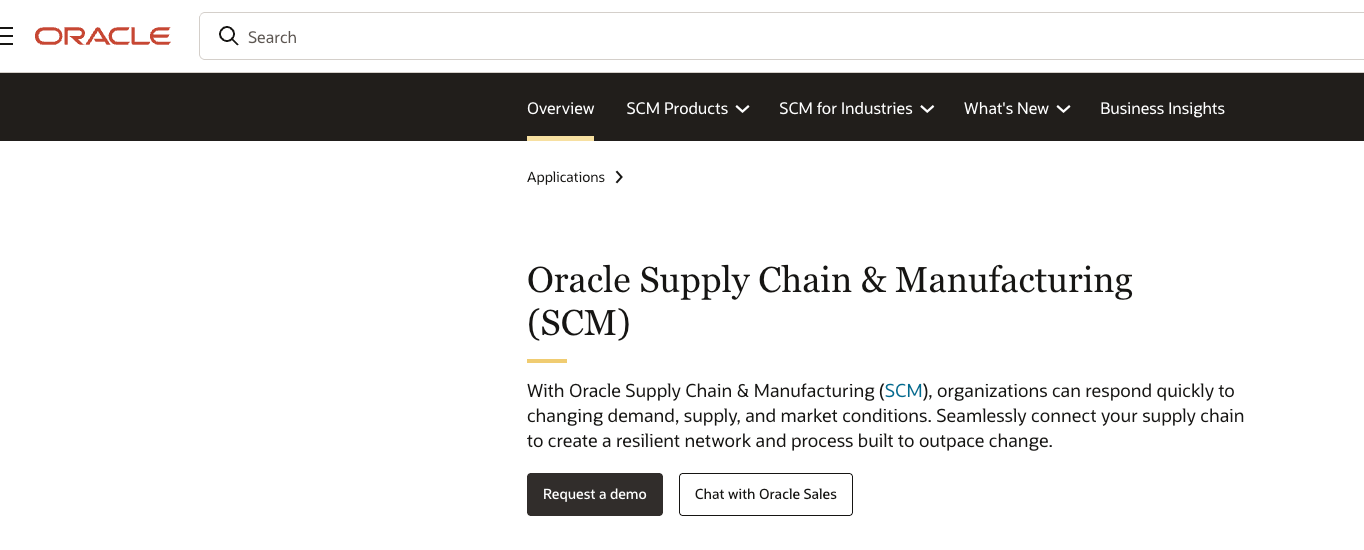
Oracle Fusion Cloud SCM is Oracle's answer to the full supply chain suite. It spans planning, logistics, inventory, manufacturing, and procurement, including Oracle Transportation Management.
Strengths:
- Broad, single-vendor cloud suite across planning and execution.
- Strong fit if you already run Oracle ERP and Fusion applications.
- Mature transportation and logistics modules for global operations.
- Regular cloud updates and a large implementation ecosystem.
Shortcomings:
- Best value depends on being inside the Oracle ecosystem.
- Enterprise pricing and multi-month rollouts.
- Breadth can mean complexity you don't need for a single function.
Pricing:
Enterprise quote, subscription-based.
How does Oracle SCM Cloud compare to Blue Yonder?
Oracle is the pick when you want a single cloud suite aligned with Oracle ERP. Blue Yonder tends to go deeper in supply chain planning and retail-specific capability. Both are enterprise-tier with similar cost and timeline expectations.
Kinaxis: Best Blue Yonder Alternative for Volatile, Manufacturing-Heavy Supply Chains
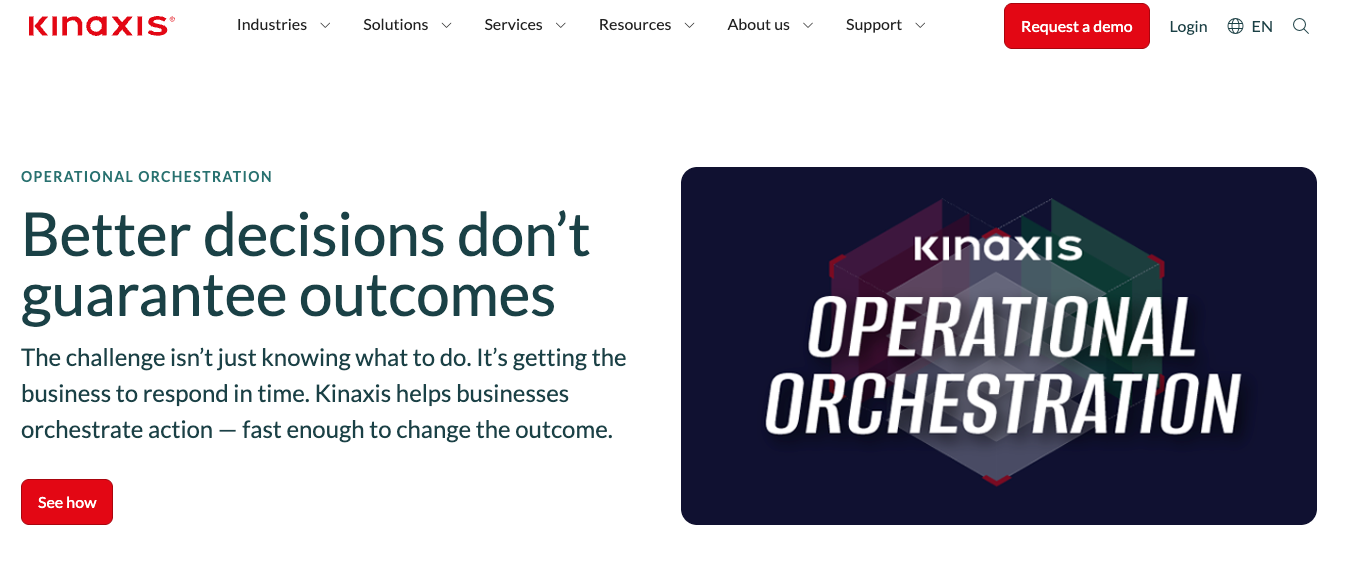
Kinaxis (its platform is now called Maestro) is built around concurrent planning. It recalculates demand, supply, and inventory together, so teams can run what-if simulations and react fast when conditions change.
Strengths:
- Concurrent planning that updates the whole chain at once.
- Fast, intuitive what-if scenarios for disruption response.
- Strong in automotive, electronics, pharma, and other complex manufacturing.
- Reputation for a cleaner planning experience than legacy suites.
Shortcomings:
- Planning-focused, so it doesn't cover warehouse or transport execution.
- Enterprise pricing aimed at large manufacturers.
- Implementation still needs real data and process work.
How does Kinaxis compare to Blue Yonder?
Kinaxis is the sharper tool if your priority is fast, concurrent planning and simulation. Blue Yonder covers more ground across planning and execution. Teams that only need planning often find Kinaxis simpler to live in.
o9 Solutions: Best Blue Yonder Alternative for AI-Native Integrated Planning

o9 is one of the newer names challenging the planning incumbents. Its platform centers on an "Enterprise Knowledge Graph" that connects demand, supply, and commercial planning in one model.
Strengths:
- Modern, AI-native architecture built for integrated business planning.
- Strong demand and supply modeling with scenario analysis.
- Connects commercial and supply chain planning in a single platform.
- Fast-growing with momentum among large global enterprises.
Shortcomings:
- Planning-focused, without Blue Yonder's warehouse and transport execution.
- Enterprise scale and pricing, so it's a heavy lift for smaller teams.
- Newer platform, so some niche capabilities are still maturing.
How does o9 Solutions compare to Blue Yonder?
o9 wins on modern AI-native planning and a connected data model. Blue Yonder brings a longer track record and broader end-to-end execution. The decision often comes down to fresh architecture versus proven breadth.
RELEX Solutions: Best Blue Yonder Alternative for Retailers
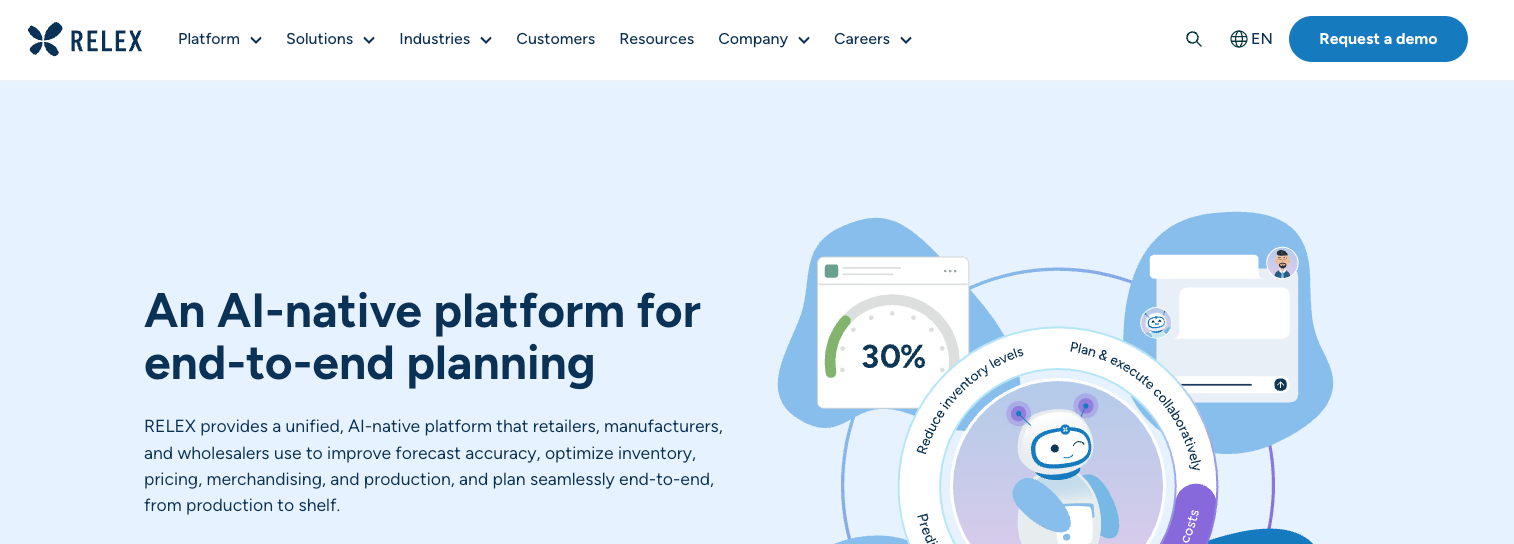
RELEX is a retail-native planning platform covering demand forecasting, replenishment, allocation, and space planning. It's a common pick for grocery and fashion chains.
Strengths:
- Built specifically for retail, with strong fresh and grocery handling.
- Unified demand forecasting, replenishment, and space planning.
- Good fit for store-level and omnichannel retail operations.
- Often faster to value for retailers than a horizontal suite.
Shortcomings:
- Retail focus means it's less suited to broad manufacturing planning.
- Enterprise pricing and implementation for large chains.
- Not an execution platform for warehouse or transport at depth.
How does RELEX compare to Blue Yonder?
RELEX is retail-native and tends to win on fresh and grocery, an area where Blue Yonder has historically been weaker. Blue Yonder is broader across industries beyond retail. For a grocery or fashion retailer, RELEX is often the more natural fit.
Manhattan Associates: Best Blue Yonder Alternative for Warehouse and Transport Execution
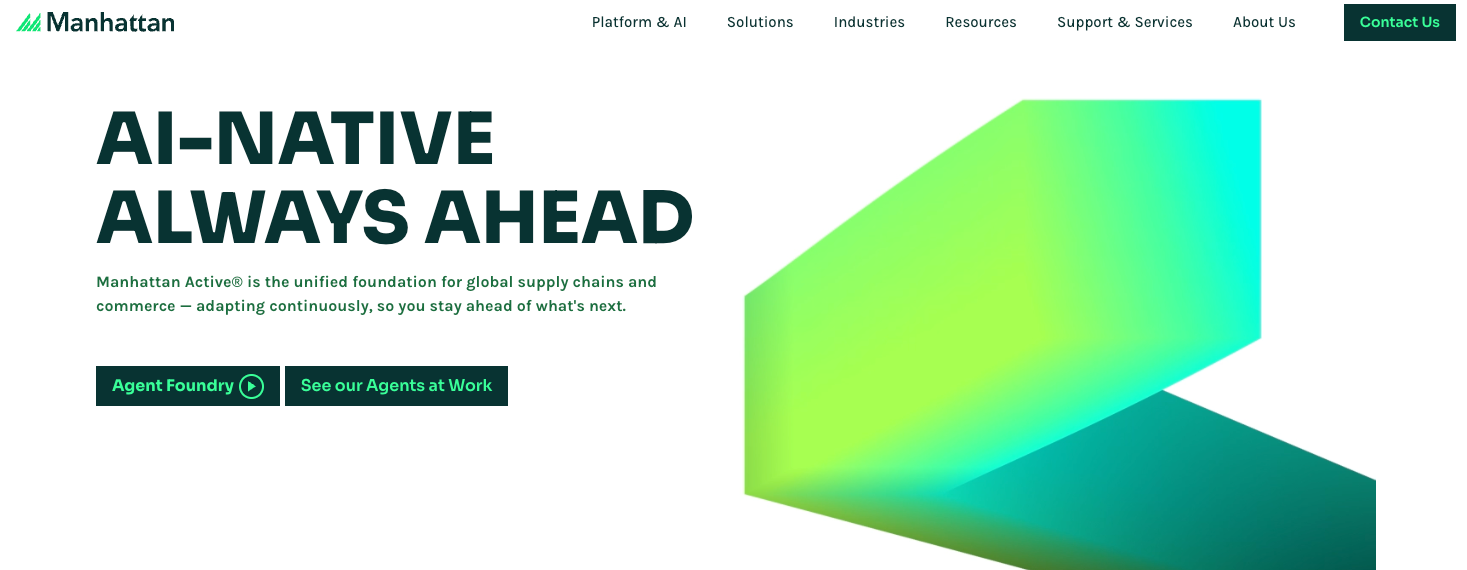
Manhattan is the execution-first option. Its Manhattan Active suite covers warehouse management, transportation, and order management on a cloud-native, microservices architecture.
Strengths:
- Best-of-breed WMS and TMS, both Gartner Leaders.
- Cloud-native microservices that update without disruptive upgrades.
- Strong fit for complex distribution and omnichannel fulfillment.
- Deep execution capability rather than planning-first design.
Shortcomings:
- Execution-focused, so it's not a demand and supply planning suite.
- Enterprise pricing and implementation timelines.
- Heavier than a mid-market operation usually needs.
How does Manhattan Associates compare to Blue Yonder?
For pure warehouse and transport execution, Manhattan is the sharper, cleaner choice, with a more modern architecture. Blue Yonder spans planning and execution in one suite. If execution is the job and planning isn't, Manhattan usually wins.
Infor: Best Blue Yonder Alternative for Industry-Specific Cloud SCM
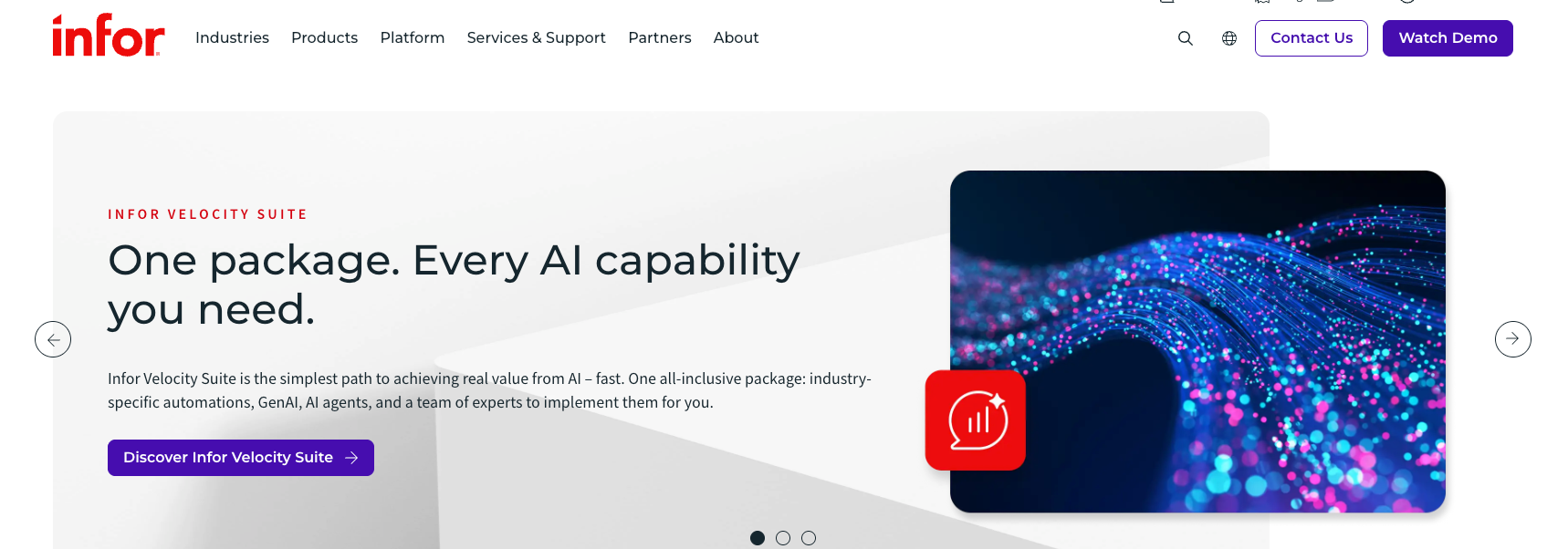
Infor takes a different route with industry-specific CloudSuites and the Infor Nexus supply chain network. It pairs SCM with ERP-adjacent capability tailored to specific verticals.
Strengths:
- Industry-specific CloudSuites for manufacturing, distribution, and more.
- Infor Nexus network for multi-party supply chain collaboration and visibility.
- Tighter fit for companies wanting an industry-tailored stack.
- Strong in process and discrete manufacturing verticals.
Shortcomings:
- Less of a pure best-of-breed planning leader than Blue Yonder.
- Enterprise pricing and rollout.
- Breadth varies by CloudSuite, so fit depends on your industry.
How does Infor compare to Blue Yonder?
Infor wins when you want an industry-tailored suite and network in one place. Blue Yonder is the deeper horizontal planning leader. The call comes down to industry-specific fit versus best-of-breed planning depth.
Deliwell: Best Blue Yonder Alternative for Mid-Market EU Shippers
Here's the pick for companies that don't need an enterprise supply chain suite at all. If you got pitched Blue Yonder for transportation, or you're a mid-market shipper still running transport on Excel and email, an enterprise platform solves a problem you don't have.
Deliwell is a cloud TMS built for mid-market shippers in Romania and the wider CEE region. It covers the full transport lifecycle in one place. You plan and allocate transports, dispatch carriers, track delivery, generate compliance documents, and validate invoices, all from the same system.
The part no enterprise US suite offers is native EU compliance. Deliwell generates Romanian e-Transport and UIT codes and handles e-CMR inside the workflow, so your team isn't bolting compliance onto a foreign platform.
Strengths:
- One system for planning, dispatch, tracking, compliance, and invoice validation, so teams stop juggling Excel, email, and WhatsApp.
- Native Romanian e-Transport, UIT generation, and e-CMR. No separate compliance workaround.
- Connects sales, warehouse, finance, and logistics around the same data instead of leaving them in silos.
- Affordable and value-based, aligned with mid-market budgets. All-in-one SaaS with no hidden IT costs.
- Go-live in days, and it integrates with your ERP (SAP, Navision, and others).
- Trusted by 30+ mid-market shippers across Romania and CEE, including names like Stihl, Sonepar, and Frigoglass.
Shortcomings:
- Not built for very small operations running under 50 shipments a month.
- Not the right fit if you rely on five or more GPS providers and need that many live integrations.
- Air and sea costing is supported on an all-in basis, so deeply itemized international freight costing isn't the target.
- Not designed for specialized freight like liquids, gas, or live animals.
Pricing:
Starting at €250/month. Contact Deliwell for a custom pricing proposal tailored to your needs. The model stays value-based and mid-market friendly, with no hidden IT costs.
How does Deliwell compare to Blue Yonder?
These two sit in completely different tiers. Blue Yonder is an enterprise supply chain suite for global retailers and manufacturers, priced and scoped to match. Deliwell is a right-sized TMS for a mid-market shipper, with EU compliance built in and go-live in days. If your real need is to run transport rather than plan a global supply chain, Deliwell does that job without the enterprise cost and timeline.
Book a strategy call with the Deliwell team to see how it fits your operation.
What's the Best Blue Yonder Alternative for You?
If you're already standardized on SAP, start with SAP IBP. If you run Oracle, Oracle SCM Cloud keeps you on a single stack.
If your priority is fast, concurrent planning in a volatile or manufacturing-heavy supply chain, Kinaxis is the focused choice. For modern AI-native integrated planning, o9 Solutions.
If you're a grocery or fashion retailer, RELEX is the retail-native fit.
If the job is warehouse and transport execution rather than planning, Manhattan Associates is the best-of-breed pick. For an industry-tailored cloud suite, Infor.
And if you're a mid-market European shipper who needs to run transport, not plan a global supply chain, skip the enterprise tier entirely. You need a TMS that plans, executes, and keeps you compliant, at a price that fits. That's Deliwell, and you can be live in days.
FAQ
Is JDA now Blue Yonder?
Yes. JDA Software rebranded to Blue Yonder in February 2020 after acquiring a company of that name. The product line many people still call JDA is now sold under the Blue Yonder name.
Is Blue Yonder a TMS?
Not only. Blue Yonder is a full supply chain suite that includes a transportation management module, along with planning, warehouse management, and order management. Its TMS is a Gartner Leader, but it's built for large, complex global supply chains. A mid-market shipper that only needs transport usually doesn't need the full platform.
Is Blue Yonder better than SAP?
It depends on your stack and your needs. Blue Yonder is often seen as the deeper best-of-breed supply chain planner with broad execution across warehouse and transport. SAP IBP is the stronger choice if you already run SAP, since planning and finance share one ecosystem. Neither is universally better.
How much does Blue Yonder cost?
Blue Yonder uses enterprise, quote-based pricing with no public tiers, and deals commonly run into seven figures with 12 to 18 month implementations. For comparison, a right-sized TMS like Deliwell starts at €250/month with a custom proposal, which makes it far more accessible for mid-market budgets.
Who is the parent company of Blue Yonder?
Blue Yonder is a wholly-owned subsidiary of Panasonic. Panasonic completed its acquisition in 2021 in a deal valuing the company at around $8.5 billion. Blue Yonder still operates under its own brand.
Case studies


Sonepar Romania centralises transport reporting and cost control with Deliwell



Inteva gains full transport visibility and eliminates manual work with Deliwell



Hamilton Central Europe reduced transports costs by 15% by replacing their old TMS with Deliwell
