
e-CMR Explained: What European Shippers Need to Know by 2026
Three dates, three legal instruments, one confusion. Here's what the e-CMR Protocol actually requires, what changes on 9 July 2027, and why the real work is getting your carriers onto the same procedure.

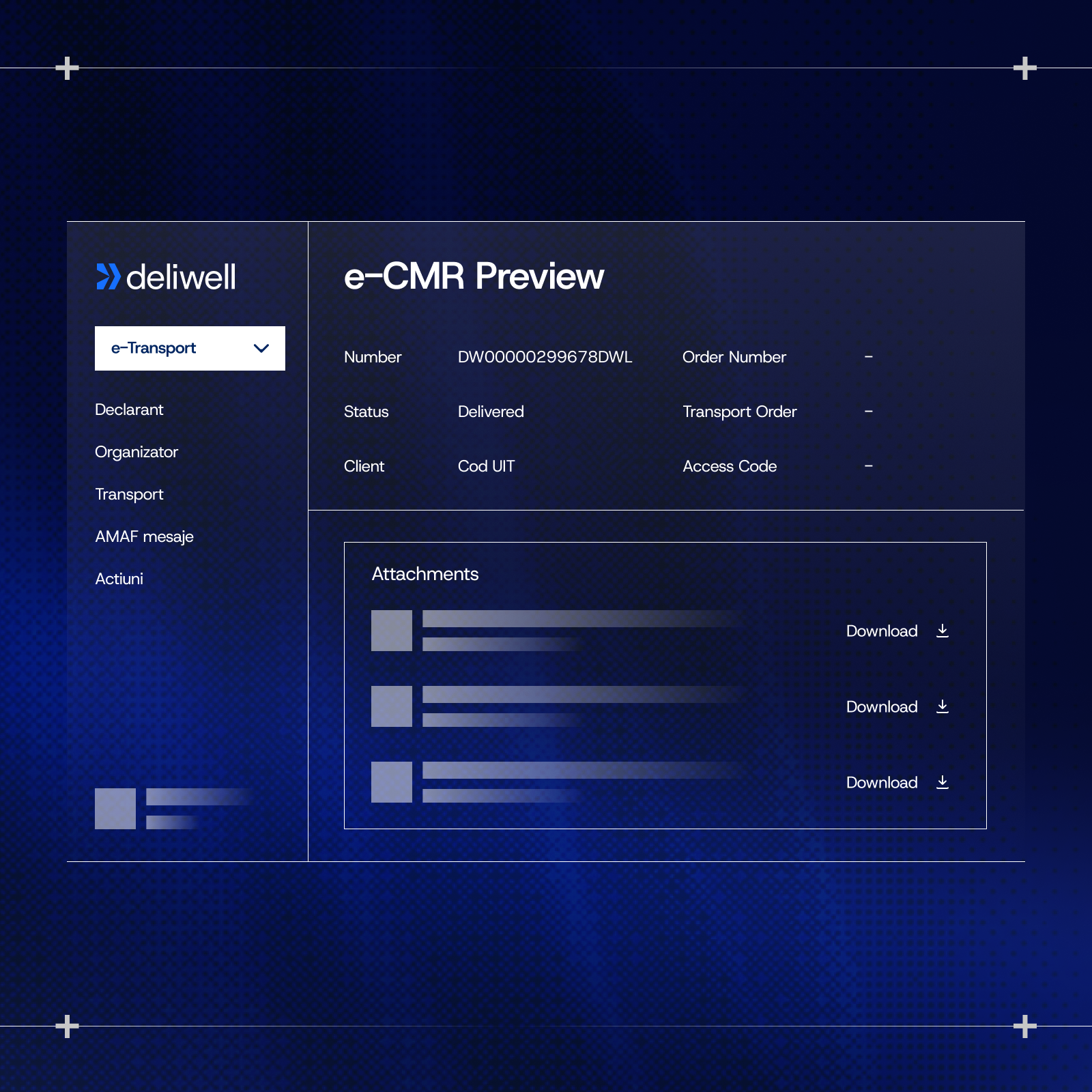
Bring structure, visibility, and compliance to your transport operations


Summary
Ask three logistics managers when e-CMR becomes mandatory and you'll get three answers: 2026, 2027, or "it already happened." All three point at something real, and none is quite right. The legal basis for a digital consignment note has existed since 2011. The EU rule that forces authorities to accept it applies from July 2027. The 2026 date comes from an industry report, not a statute. This guide separates the three. It then covers the part most guides skip: what has to be true before you can issue an e-CMR to a carrier you booked yesterday, when your order data still lives in a spreadsheet.
Ask three logistics managers when e-CMR becomes mandatory and you will get three answers. One says 2026, one says 2027, one says it already happened.
All three are pointing at something real, and none of them is quite right. The legal instrument that makes a digital consignment note valid has been in force since 2011. The EU regulation that forces authorities to accept electronic freight data applies from July 2027. The 2026 date everyone repeats comes from an industry report rather than a statute.
Separating those three is most of the work. The rest is the part nobody writes about, which is what actually has to be true before you can run an e-CMR on a Tuesday morning with a carrier you booked on Monday.
TL;DR
- An e-CMR is the electronic version of the CMR consignment note, given legal equivalence by an Additional Protocol to the 1956 CMR Convention that has been in force since 5 June 2011.
- Forty countries are parties to the Protocol, with eight more as signatories. Romania acceded through Law no. 29/2019.
- Using e-CMR is optional. The Protocol permits it and does not require it.
- Nothing legally obliges you to switch in 2026. The 2026 date circulating in the industry comes from a 2024 CargoON report on expected adoption, not from EU law.
- The date that does bite is 9 July 2027, when the eFTI Regulation obliges national authorities to accept freight information through certified eFTI platforms.
- The Protocol asks for two things most people miss: a reliable electronic signature meeting four specific tests, and a procedure the parties agree in advance and reference inside the note.
- The practical blocker is rarely the software. It is getting the carrier and the consignee onto the same procedure, and getting a driver to sign at a loading dock with no signal.
CMR, e-CMR and eFTI: Which One Applies to You?
What Is an e-CMR?
An e-CMR is a consignment note issued by electronic communication rather than on paper, covering the same contract of carriage under the CMR Convention.
Article 2(2) of the Protocol is the operative sentence. An electronic consignment note that complies with the Protocol is equivalent to the paper note, with the same evidentiary value and the same effects. So a claim argued on an e-CMR stands on the same footing as one argued on a stamped paper set.
Article 2(1) goes further than most summaries admit. It covers the note itself plus any demand, declaration, instruction, request or reservation relating to the carriage. A reservation the driver would have scrawled in box 18 can be made electronically and carries the same weight.
The word to hold onto is optional. The Protocol's preamble describes its purpose as facilitating the optional making out of the consignment note by electronic means. It creates a permission, and no obligation follows from it.
Is e-CMR Mandatory in 2026?
No. No European law requires a shipper to use an electronic consignment note in 2026.
The date has become common currency because a 2024 CargoON report, Deep Dive into eCMR, found that industry stakeholders expected 2026 to mark the start of large-scale implementation, with 2029 as full adoption. Małgorzata Wieleba-Walicka of the Polish employers' association TLP framed it as national implementation in 2026 and mandatory application in 2029. Trans.info, reporting the same figures, states plainly that these reflect industry expectations rather than formal EU deadlines.
So treat 2026 as a planning horizon your counterparties are already using. Your customers and carriers will increasingly ask whether you can receive an e-CMR, and being the one who says no starts to cost something. That is commercial pressure rather than legal obligation, and the two deserve different budget conversations.
What Changes on 9 July 2027?
From that date, national authorities across the EU must accept freight transport information in electronic form through certified eFTI platforms, under Regulation (EU) 2020/1056. The delegated and implementing acts that set the technical standards have been in force since January 2025.
The distinction that matters operationally: eFTI obliges the authority, not the shipper. You are not required to submit data electronically. You gain the right to have it accepted when you do, which is the piece that has been missing.
That gap explains the roadside inconsistency hauliers complain about now. Ramón Valdivia of the Spanish association ASTIC put it bluntly after Spain's own negotiations, saying there is no certainty that a French gendarme inspection will follow the same procedure as a Spanish one. Until 2027 forces a common standard, acceptance depends on which side of a border you are stopped.
Which Countries Accept e-CMR?
Forty countries are parties to the Additional Protocol, with eight further signatories, according to the UN Treaty Collection. Romania acceded through Law no. 29/2019.
For an international movement, both the country of departure and the country of delivery need to be parties before the Protocol governs your note. That single check rules out more lanes than most teams expect, and it is worth running against your actual lane list rather than assuming European coverage.
Legal accession is only half of it. Domestic use is well established in France, Spain and the Netherlands. Ireland, Austria and Croatia had no active national projects as of late 2025. Belgium has run pilots with its Benelux partners without full operational deployment. So a lane can be legally covered while the enforcement officer at one end has never processed a digital note.
What Does the e-CMR Protocol Actually Require?
Four requirements, and the fourth is the one that catches people.
A reliable electronic signature. Article 3(1) presumes reliability where the signature is uniquely linked to the signatory, is capable of identifying them, is created using means under their sole control, and is linked to the data so that any later change is detectable. Article 3(2) also allows any other authentication method permitted by the law of the country where the note was made out.
Accessibility. Under Article 3(3), the particulars have to be accessible to any party entitled to them. Sender, carrier and consignee all need to be able to see the note, which rules out a system where only one party holds the record.
Integrity. Article 4(2) requires the particulars to stay complete and unaltered from the moment the note was first generated in final form. Amendments are allowed where the Convention permits, and Article 4(3) requires the procedure to make any amendment detectable while preserving what was originally recorded. An audit trail is a legal requirement here rather than a nice feature.
An agreed procedure. This is Article 5, and it is missing from almost every explainer. Before you use an e-CMR, the parties have to agree how the note is issued and delivered, how integrity is assured, how a party demonstrates entitlement, how delivery confirmation is given, how amendments happen, and how the note gets replaced by a paper one if it has to be. Article 5(2) requires those procedures to be referenced in the note itself and readily ascertainable.
Article 5 is why e-CMR adoption stalls. A shipper can buy a platform in an afternoon. Getting a hundred carriers and two hundred consignees onto a procedure they have all agreed to, and that a driver can follow in a yard in the rain, is the actual project.
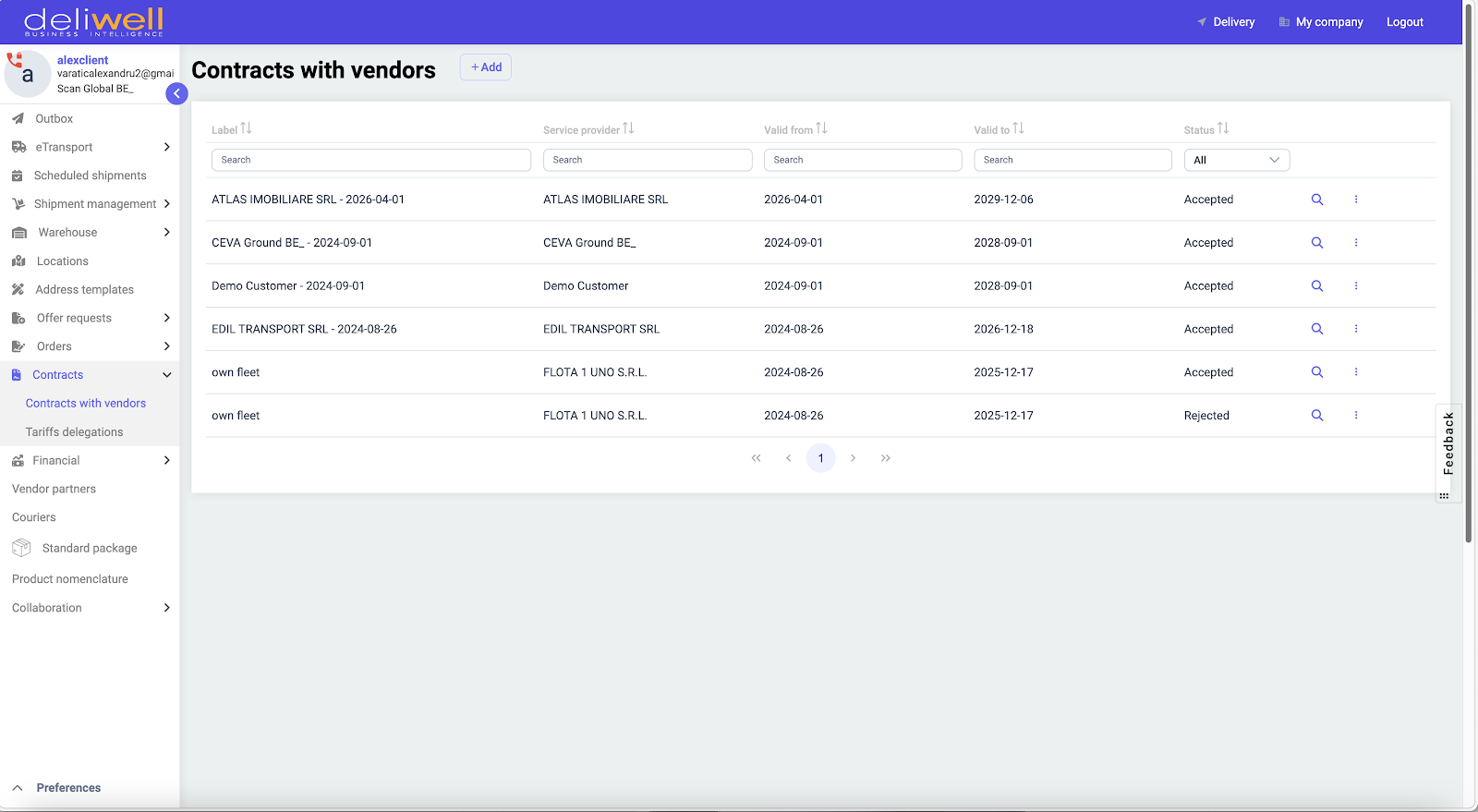
Article 5 agreement has to be tracked per carrier, not signed once. Deliwell holds a contract record against each vendor partner with validity dates and an accepted or rejected status, so it is visible which carriers have actually signed up to a procedure and which have declined.
What Do You Need Before Your First e-CMR?
Five things, in rough order.
- A lane check. Confirm both countries on the route are parties to the Protocol.
- Counterparty agreement. The carrier and the consignee have to accept the procedure. In practice this means their commercial and operations people, not only their IT.
- A platform that meets Articles 3 and 4. Signature that satisfies the four-part test, access for all three parties, tamper-evident amendment history.
- A way for the driver to sign. A phone or tablet, an app that works offline and syncs, and someone who has shown the driver how it works.
- A paper fallback. Article 5(1)(f) expects you to have planned for replacement by a note issued by different means. Corridors in transition still ask for paper, so plan the fallback rather than improvising it at a border.
How this runs in Deliwell. The e-CMR is generated inside the platform from the transport order, signed by sender, carrier and recipient, and archived against that transport. Carriers reach it through the carrier portal on token access with no software to install and no sign-up to complete, and Deliwell handles carrier onboarding rather than leaving it with your team. The driver closes the e-CMR from the mobile app after confirming delivery, with GPS timestamp, photo proof of delivery and signature capture, which puts proof of delivery in front of the logistics team and the customer in real time. Document templates can differ by carrier, by route and by goods type, so a procedure agreed with one carrier does not have to be renegotiated for the next. The archive stays searchable with audit-ready retention, which is what Article 4 asks for in practice.
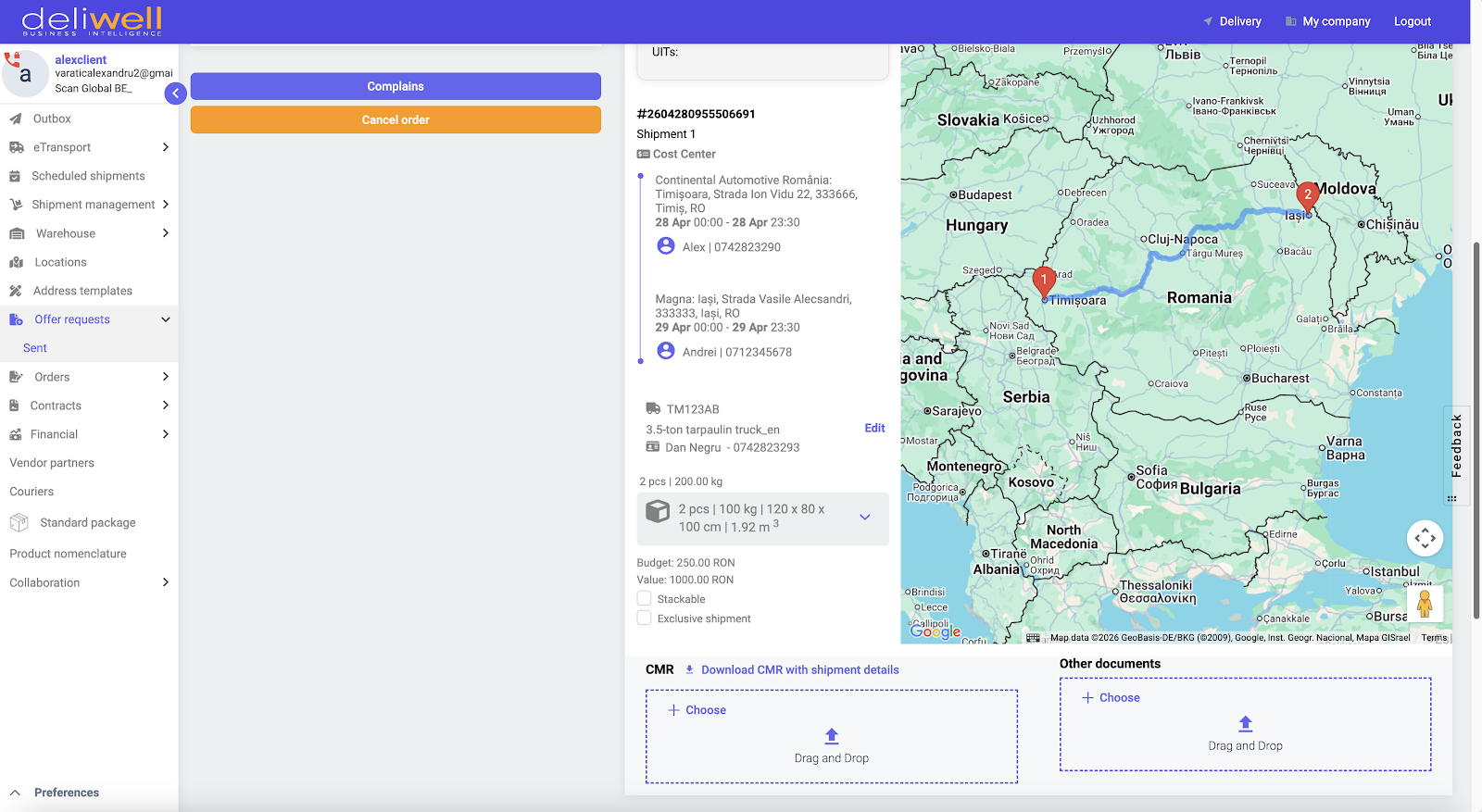
The consignment note is an output of the transport order rather than a separate document to assemble. On shipment #2604280955506691 the CMR is generated with the shipment details already populated, and it sits in the same record as the vehicle, the driver, the route and the rest of the transport file.
Getting carriers onto the same procedure is the hard part. Deliwell onboards your carrier base as part of implementation rather than leaving you to chase it. Ask how that works on your carrier list.
What Does Moving to e-CMR Actually Save?
The Europe-wide numbers are large and worth quoting carefully, since they describe the continent rather than your operation. The IRU estimates the switch could save 75 to 102 million working hours a year across Europe, equivalent to as many as 50,000 full-time administrative roles. The European Commission puts the paper saving at around 160 million sheets annually.
At company level the effect shows up in three places. Proof of delivery arrives when the driver signs rather than when the paperwork comes back, which is the difference between invoicing this week and invoicing next month. Disputes get argued from a timestamped record rather than a scanned photocopy. And the archive stops being a filing cabinet, which matters the first time an auditor asks for eighteen months of delivery confirmations.
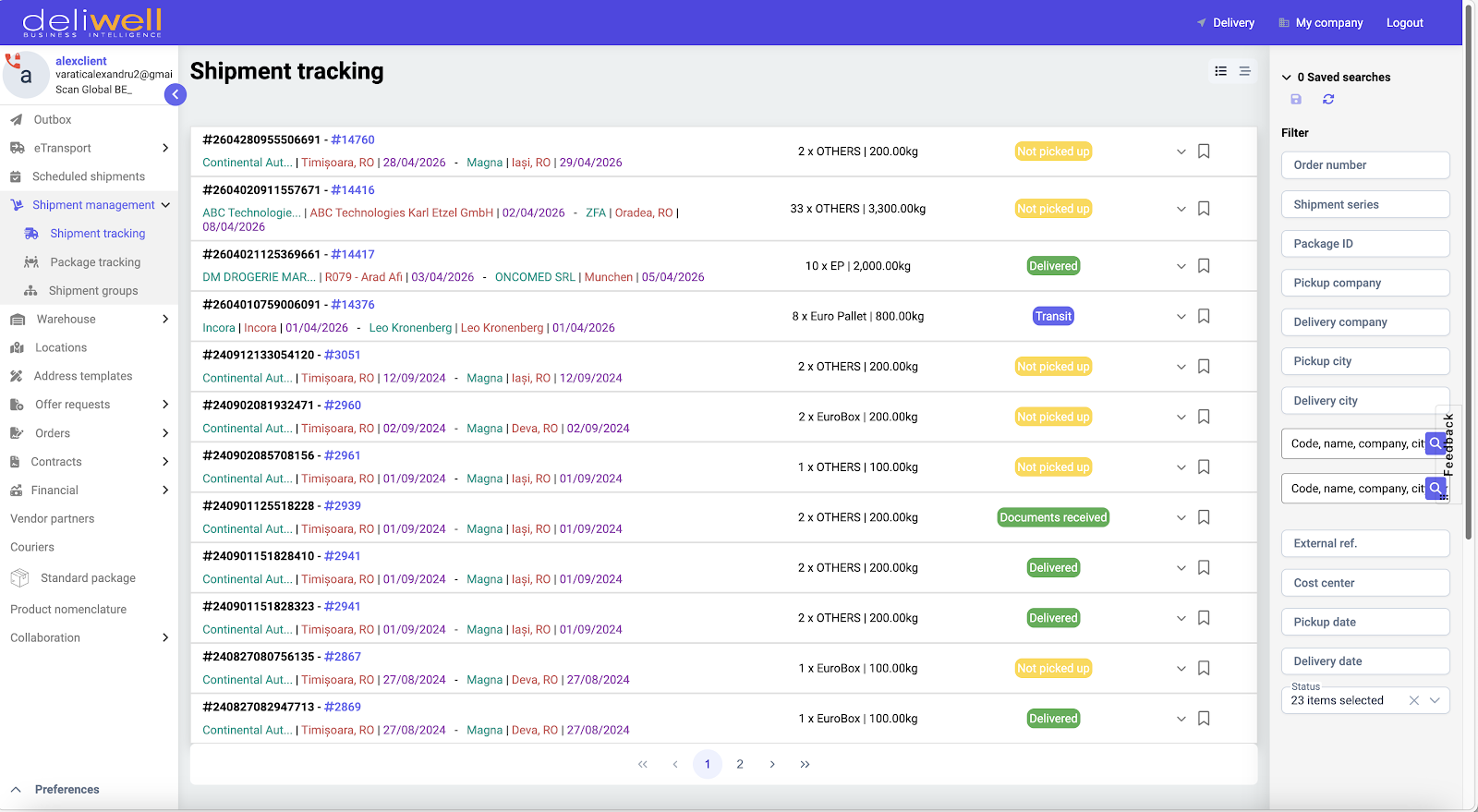
Document state becomes a tracked status rather than a question for the transport desk. Each shipment shows where it is, including whether the paperwork has come back, so finance can see which loads are ready to invoice without chasing a folder.
Deliwell reports roughly 50 to 70% less time spent on finance reconciliation across its customer base, which is the same mechanism seen from the finance side.
Where Does e-CMR Still Break?
Four places, and being honest about them saves a failed rollout.
Roadside acceptance varies. Until July 2027 there is no common obligation on inspectors, and the ASTIC point about differing procedures between two neighbouring countries still stands.
Interoperability is unfinished. Raluca Marian of the IRU has described the lack of interoperability between stakeholders as a key limit on adoption. The eFTI acts are designed to fix that, and they are not fully applied yet. Two counterparties on two platforms can still find themselves unable to exchange a note.
Non-party countries. Lanes touching a country outside the forty parties fall back to paper for the international leg.
Carriers who are not ready. A small subcontractor with one truck and an ageing phone is a legitimate part of most carrier bases, and a rollout that assumes otherwise stalls on its second week.
Should You Move to e-CMR Now?
Match the answer to where your volume sits.
Start now if a meaningful share of your lanes run inside France, Spain, the Netherlands or between Protocol parties, your carrier base is concentrated enough that agreeing procedures is realistic, and your finance team is waiting on paper POD to invoice. The payback here is cash-flow timing rather than compliance.
Run a pilot if your lane mix is mixed and your carrier base is long-tailed. Pick one corridor and one carrier group, agree the Article 5 procedure properly, and learn what breaks before you scale it. This is the common case for mid-market shippers, and it is a better use of 2026 than waiting for a deadline that is not coming.
Wait, deliberately if your freight is mostly domestic in a country with no active e-CMR practice and your carriers have no digital capability. Spend the time on the underlying problem instead. Teams in this position are usually running transport on spreadsheets, email threads and a WhatsApp group, and no consignment note format fixes that.
That last case is where the honest answer sits for a lot of operations. e-CMR is a document layer. If the data underneath it lives in fifteen spreadsheets, digitising the note moves the paperwork without moving the problem.
Deliwell is a road-freight TMS for mid-market European shippers, covering planning, allocation, dispatch, tracking, documents, compliance, invoice validation and KPIs. e-CMR sits inside that as one output of a transport order rather than as a separate product, alongside Romanian e-Transport with direct ANAF integration. It fits operations running 50 to 500 transports a month across several sites. Below 50 shipments a month it is more platform than the job needs, and it is a poor fit for operations with five or more GPS providers, for complex air and sea costing beyond an all-in basis, and for specialised freight such as liquid, gas, petroleum, dairy and live animals. About 30 mid-market shippers run on it today, including Stihl, Sonepar and Frigoglass. Pricing starts at €250/month. Contact Deliwell for a custom pricing proposal tailored to your needs.
Bring your lane list and your carrier list. Deliwell will tell you which lanes are Protocol-covered today and what a realistic first e-CMR corridor looks like for you, then scope a 3-week POC on it. Book a demo.
FAQ
What is an e-CMR?
An e-CMR is a consignment note for international road carriage issued electronically instead of on paper. Under Article 2(2) of the Additional Protocol to the CMR Convention, an e-CMR that complies with the Protocol has the same evidentiary value and the same effects as the paper note. It covers the same particulars and can carry the same declarations, instructions and reservations.
What is the e-CMR protocol?
The Additional Protocol to the CMR Convention concerning the Electronic Consignment Note, agreed in Geneva on 20 February 2008 and in force since 5 June 2011. It sets out how an electronic note is authenticated, how its integrity is preserved, and what the parties have to agree before using one. Forty countries are parties to it.
Is e-CMR mandatory in Spain, or anywhere else?
No country currently requires shippers to use e-CMR. Spain is one of the markets where domestic e-CMR use is well established, alongside France and the Netherlands, so acceptance is routine there. From 9 July 2027 the eFTI Regulation obliges authorities across the EU to accept electronic freight information through certified platforms, which is an obligation on the authority rather than on you.
How do I create a digital CMR?
Confirm both countries on the lane are parties to the Protocol, agree the procedure with your carrier and consignee as Article 5 requires, then issue the note through a system that provides a reliable electronic signature, gives all three parties access, and keeps an amendment history. The note has to reference the agreed procedure, and the driver needs a device to sign on at delivery.
Does an e-CMR need a qualified electronic signature?
The Protocol does not use the eIDAS term. Article 3(1) presumes a signature is reliable where it is uniquely linked to the signatory, identifies them, is created by means under their sole control, and is linked to the data so any change is detectable. Article 3(2) also permits any other authentication method allowed by the law of the country where the note was made out.
Is Romania a party to the e-CMR Protocol?
Yes. Romania acceded through Law no. 29/2019. That covers the consignment note. Romanian shippers also have a separate national obligation under the RO e-Transport system, which requires a UIT code for covered transports and is a different instrument with different rules.
What happens to paper CMR after 2027?
Paper remains valid. The CMR Convention is unchanged and the Protocol is optional, so nothing invalidates a paper note. What changes is that authorities lose the ability to refuse an electronic one, which is expected to shift practice rather than outlaw paper. Industry forecasts point to 2029 before paper genuinely fades.
Case studies


Sonepar Romania centralises transport reporting and cost control with Deliwell



Inteva gains full transport visibility and eliminates manual work with Deliwell



Hamilton Central Europe reduced transports costs by 15% by replacing their old TMS with Deliwell
