
How to Choose a TMS: A Mid-Market Buyer's Decision Framework
Seven decisions, taken in order, that remove the wrong vendors before you open a feature matrix – and tell you when a spreadsheet is still the right answer.

Bring structure, visibility, and compliance to your transport operations


Summary
Most TMS evaluations fail before the feature comparison, because the shortlist mixes tool categories and scores them against one checklist. This framework orders seven decisions: the job you're buying for, volume and users, compliance geography, integrations, implementation ownership, pricing meter and a pilot. Early answers remove whole categories. It also applies the framework to Deliwell, including where the answer points elsewhere.
The shortlist usually arrives as a spreadsheet. Five vendors across the top, forty feature rows down the side, and a column for scores.
Look closely at the five and they are often not comparable. One is a freight broker platform. One is a visibility layer that sits on top of a TMS rather than replacing it. One is an enterprise suite priced for a company ten times your size. One is a parcel tool. Only one or two are actually built for a mid-market shipper buying road freight.
Scored against the same forty rows, the winner is whichever vendor said yes most often. That is how mid-market operations end up eighteen months into a platform nobody uses.
A better approach sequences the decisions so that early answers remove options before you ever open a feature matrix.
Key Takeaways
- Most TMS evaluations fail before the feature comparison, because the shortlist mixes tool categories and scores them against one checklist.
- Seven decisions, taken in order, narrow the field faster than any criteria list. The first one eliminates whole categories.
- The decision that predicts your timeline is who owns the data cleansing and carrier onboarding, not which platform you pick.
- Quotes are not comparable until you know what each vendor meters. Per seat, per load and capped tiers produce very different bills on the same operation.
- Prove it on a narrow scope before signing. A pilot on one route cluster with a measured baseline tells you more than any reference call.
Why Most TMS Evaluations Go Wrong
Three things go wrong, and they compound.
The shortlist mixes categories. A search for TMS software returns freight broker tools, carrier dispatch systems, visibility platforms, parcel shipping tools and enterprise suites. All of them will answer a demo request. Only some solve the problem you have.
The checklist rewards breadth. A feature matrix scores presence rather than fit. A vendor with ocean freight, air freight, customs and yard management outscores a vendor that does road freight properly, even when you only move road freight. Breadth you do not use is cost and configuration work you pay for twice.
The criteria are unordered. Most published TMS selection criteria are flat lists: consider integration, consider cost, consider support, consider scalability. Nothing eliminates anything. You end up evaluating every vendor against every criterion, which is expensive and produces a score rather than a decision.
The fix is sequence. Some questions, answered honestly, remove three vendors from the list before you book a single demo.
The Seven Decisions before you buy a Transport Management Software (TMS)
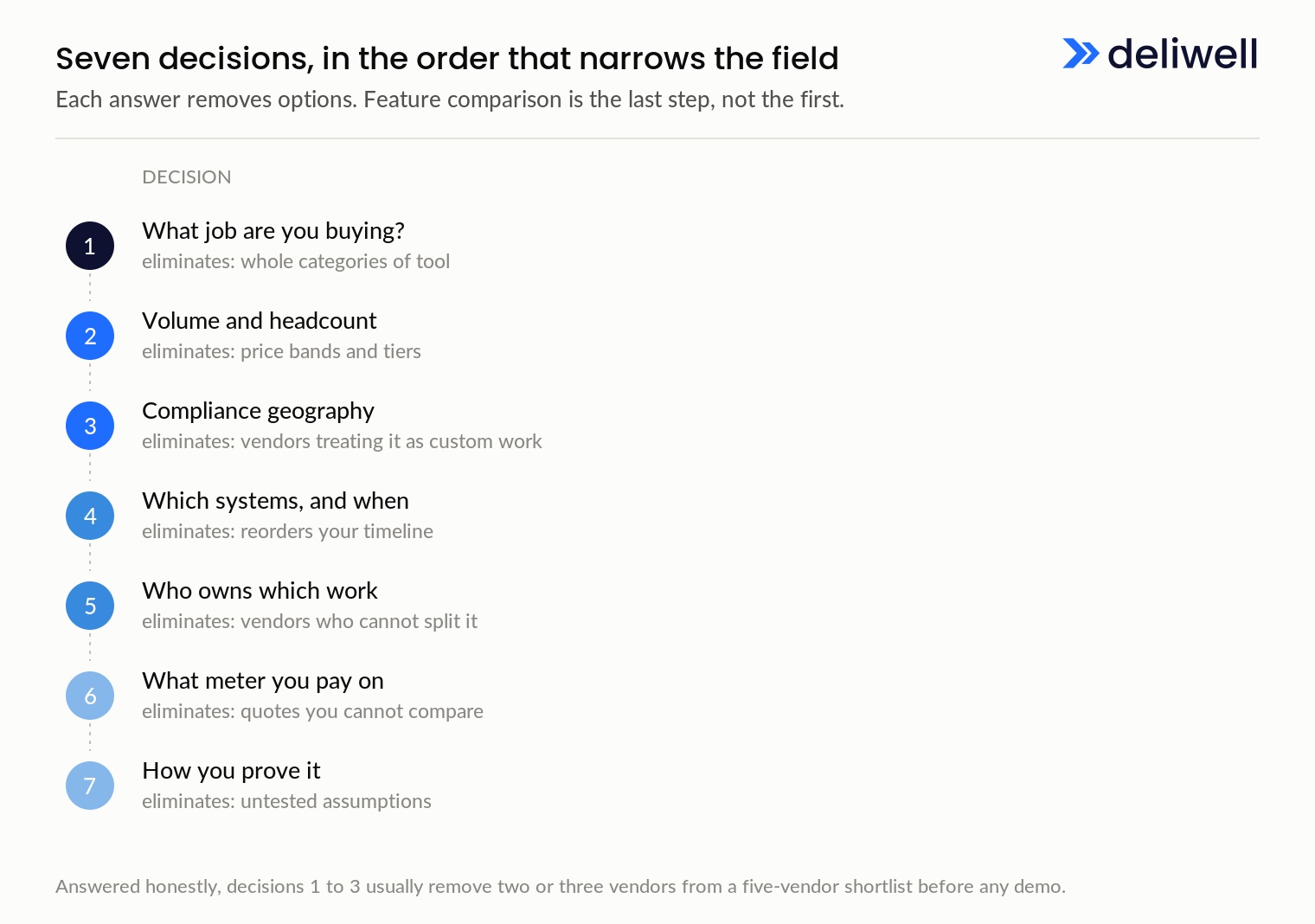
Decision 1: What Job Are You Buying?
The single highest-leverage question, and the one skipped most often.
Four different jobs get called "TMS":
- Buying and executing road freight. You purchase capacity from carriers, allocate loads, track them, handle documents and validate invoices.
- Running your own delivery operation. You own vehicles and drivers, and you need route planning, dispatch and proof of delivery.
- Tracking a global multimodal network. Ocean, air and road across dozens of carriers, with one operating picture over all of it.
- Clearing customs and managing global trade. Classification, declarations, duty and export controls.
Answer this first. If you buy road freight from carriers, a route optimisation product for private fleets is the wrong category no matter how good it is, and a visibility layer will not give you a system to run the operation in.
What it eliminates: entire categories, usually two or three of your five shortlisted vendors.
Decision 2: What Is Your Volume and Headcount?
Three numbers: transports per month, people who need daily access, and people who need read-only visibility.
That third number catches buyers out. Sales, purchasing, warehouse and finance all want to see transports without touching them. Under a per-seat model those read-only users cost the same as a dispatcher, which quietly triples a quote.
Deliwell is built for the 50 to 500 transports a month band. Below fifty, the savings from automating planning and invoice validation do not cover a subscription, and a well-organised spreadsheet is a reasonable answer. Above a few thousand a month with a global footprint, you are in enterprise territory and the platforms built for it will serve you better.
What it eliminates: price bands and tiers, plus vendors whose smallest tier is larger than your whole operation.
Decision 3: What Compliance Geography Are You In?
For a Romanian entity, a UIT code has to exist before goods move. Across the EU, Regulation (EU) 2020/1056 reaches full application on 9 July 2027, when Member State authorities must accept regulatory information through certified eFTI platforms. If you move goods across CEE borders, digital consignment notes are part of the operation rather than a future project.
The question to ask a vendor is not whether they support it. It is whether they file it, and whether the update arrives with the subscription when the rules change.
Deliwell files e-Transport declarations directly with ANAF through an API integration, generating the UIT from transport order data already entered, and generates and signs e-CMR in-platform as part of the standard subscription. When ANAF changes the rules, the change ships with the subscription rather than becoming a change request.
If you move goods only within a single Western European country and have no CEE exposure, this decision eliminates nothing and you should weight it at zero. Plenty of good platforms have no reason to have built ANAF filing.
What it eliminates: vendors who treat regional compliance as custom development, when you need it working on day one.
Decision 4: Which Systems Must It Touch, and When?
List the systems: ERP, WMS, EDI trading partners, any existing tracking tool. Then ask a different question about each one. Must this connection exist before go-live, or can it follow?
Integration is the largest single multiplier on an implementation timeline. Treating it as a phase-two decision rather than a prerequisite is one of the few choices that shortens a project without cutting scope.
Deliwell runs fully standalone, with validated connectors to SAP, Oracle, Microsoft Dynamics and Navision available through REST API, EDI or flat-file import when you want them. That makes ERP integration a sequencing choice rather than a gate.
If your operation genuinely cannot function without live ERP order flow from day one, say so early, because it changes every vendor's timeline and it should change how you read their estimates.
What it eliminates: nothing directly, but it reorders your timeline expectations and exposes which vendors have thought about sequencing.
Decision 5: Who Owns Which Side of the Work?
Ask every vendor to mark up their own project plan showing which lines they own and which lines you own.
The answer predicts your timeline better than their estimate does. Master data cleansing, business rule decisions, internal approvals and developer time all sit on your side, and they are where projects slip. Carrier onboarding is the one that varies most between vendors, and it is worth getting in writing.
Deliwell runs carrier onboarding rather than handing you a list to chase. Carriers receive a token, see the job in a browser, accept it and update status without signing up or installing anything, which is what makes the long tail of small hauliers reachable. Data cleansing and your own team's availability stay yours, and no vendor can fix that.
What it eliminates: vendors who cannot produce the split, which tells you they have not thought carefully about your timeline.
Decision 6: What Meter Are You Paying On?
Per seat, per load, a capped tier, per integration, or a share of identified savings. The meter changes your cost more than the headline rate does, and two quotes are not comparable until you know which meter each one runs.
Give every vendor the same scenario using your real volume, your real user count including read-only access, and your real carrier count. Ask each to quote that. Then ask for the overage rate as a number.
Deliwell starts at €250/month, and pricing is usually anchored to roughly 10 to 15% of the annual savings identified during scoping, agreed before you sign. Contact Deliwell for a custom pricing proposal tailored to your needs.
Worth being straight about a limit here. Deliwell publishes a starting figure rather than a full tier list, so you still need a conversation to reach your number. If comparing published tier matrices without talking to anyone is important to you, some vendors do publish them in full.
What it eliminates: quotes you cannot compare, and vendors who will not put the overage rate in writing.
Decision 7: How Will You Prove It Before Signing?
References tell you a vendor has happy customers. A pilot tells you whether this works in your operation.
Design it before you negotiate. Pick one route cluster, carrier group or business unit. Record the baseline first: time to answer a status question, share of transports with complete documents at invoicing, hours a week spent chasing status. Agree what success looks like and what would make you walk away.
Deliwell runs a structured three-week proof of concept on a defined scope with live KPI measurement against your baseline. Whatever vendor you pick, insist on something equivalent.
What it eliminates: vendors who will only demo, and assumptions you have not tested.
Which TMS Category Fits Which Job
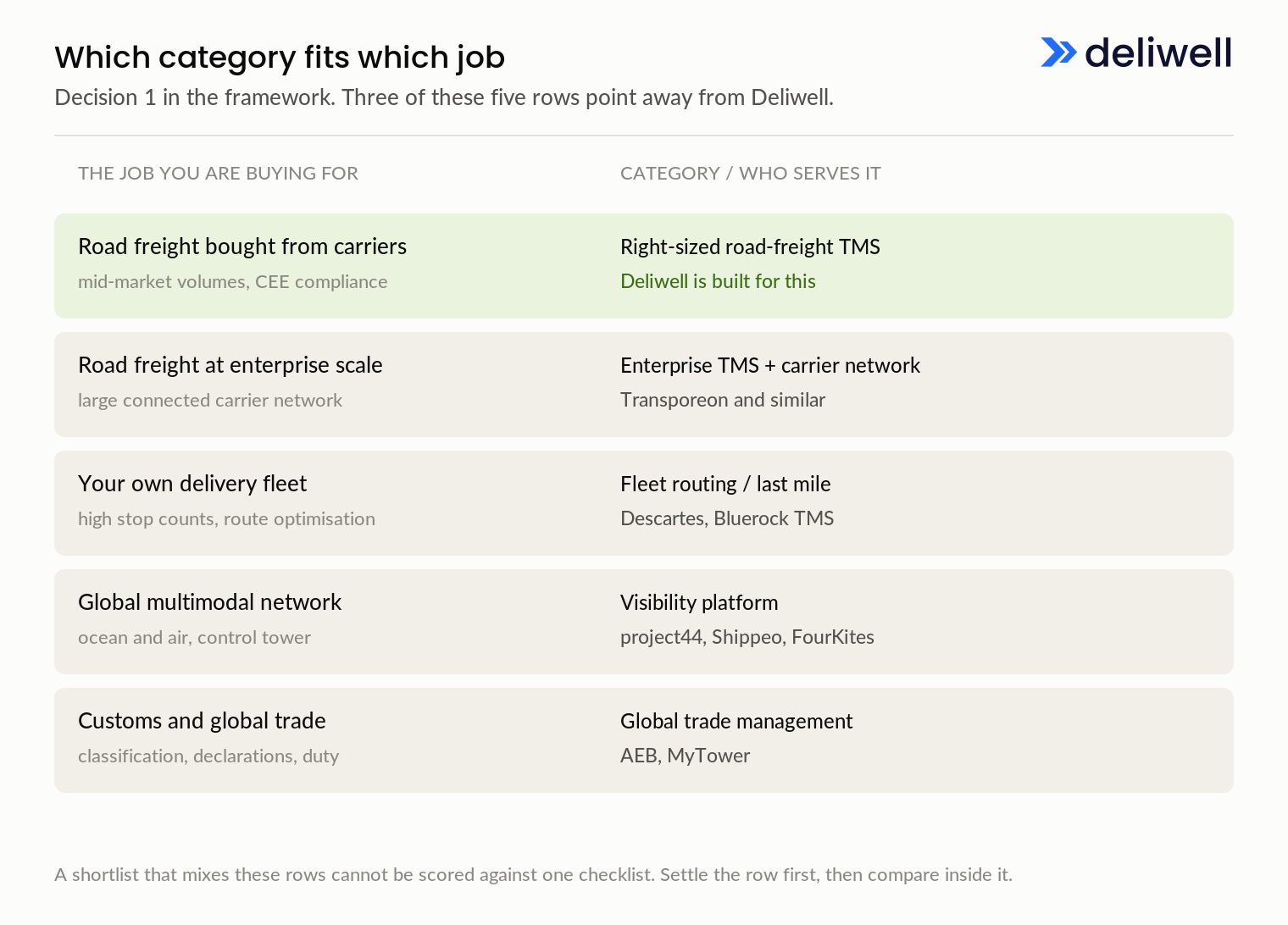
Two of these rows point away from Deliwell, and that is the point of having the table.
One combination comes up often enough to name. A group headquarters mandates a visibility platform across all entities while a local subsidiary still runs its road freight on spreadsheets. Those are two problems, not one purchase. Deliwell integrates with project44, so the group keeps its reporting layer while the local entity gets a system to run the operation in.
The Questions to Put in Your RFP
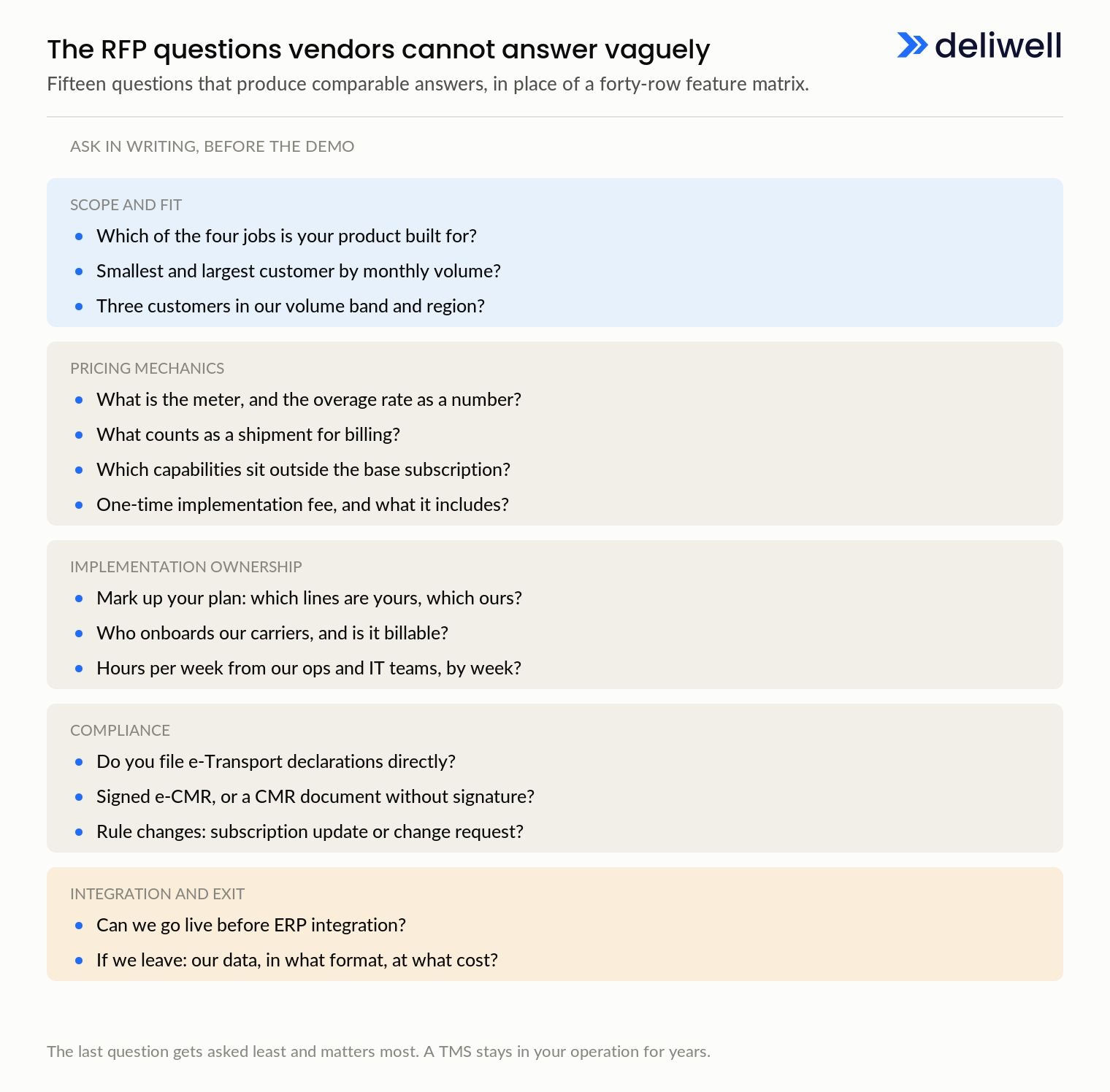
Most TMS RFPs are feature checklists, which is why vendors can answer yes to everything. These questions are harder to answer vaguely.
Scope and fit
- Which of the four jobs is your product built for, and which do you serve as an adjacent capability?
- What is your smallest and largest customer by monthly transport volume?
- Name three customers in our volume band and our region.
Pricing mechanics
- What is the meter, and what is the overage rate as a number?
- What counts as a shipment or a load for billing purposes?
- Which capabilities sit outside the base subscription?
- What is the one-time implementation fee, and what does it include?
- Is each ERP, WMS or EDI connection priced separately?
Implementation ownership
- Mark up your project plan showing which lines you own and which we own.
- Who onboards our carriers, and is it billable?
- How many hours per week do you expect from our operations team and our IT team, and in which weeks?
- What is your go-live definition, and what are the criteria for declaring it?
Compliance
- Do you file e-Transport declarations directly, or do we file them elsewhere?
- Do you generate a signed e-CMR, or a CMR document without authenticated signature?
- When a national rule changes, does the update arrive with the subscription or as a change request?
Integration and exit
- Can we go live without ERP integration and add it later?
- What happens to our data if we leave, in what format, and at what cost?
That last question gets asked least and matters most, because a TMS stays in your operation for years.
What a Good Vendor Answer Looks Like
Three contrasts to help you score responses.
On carrier onboarding. A weak answer says carriers are easy to onboard and the portal is intuitive. A strong answer says who does the work, how a haulier with no IT capability participates, and how long it took for the last customer with a comparable carrier base.
On pricing. A weak answer gives a monthly figure. A strong answer gives the figure, the meter, the caps, the overage rate and the one-time fees, then asks for your volume to sanity-check its own quote.
On timeline. A weak answer gives a number of weeks. A strong answer gives a number of weeks plus the assumptions it depends on, and names what would break it.
Vagueness is information. A vendor who cannot be specific about implementation ownership before you sign will not become specific afterwards.
Where Deliwell Fits, and Where It Does Not
Running the framework openly on Deliwell, since a framework you cannot apply to its author is not worth much.
Where the answers point to Deliwell. You buy road freight from carriers rather than running your own fleet. You move 50 to +5000 transports a month. Several departments beyond logistics need to see transports. You have Romanian or CEE compliance exposure and want filing inside the system. You want to go live before ERP integration rather than after it. Deliwell covers planning, allocation, dispatch, tracking, documents, compliance, invoice validation and KPIs in one platform, with a standard setup live in days and the first transport request possible within thirty minutes of account creation.
Where the answers point elsewhere. Under 50 shipments a month, where the savings do not cover the subscription. Five or more GPS providers in your carrier base, where integration work grows faster than the value it returns. Complex air and sea costing, which Deliwell handles on an all-in basis only. Specialized freight, with heavy, oversized and hazmat handled through an add-on module rather than the core platform. And any of the three adjacent categories in the table above.
Deliwell works with 100+ mid-market shippers, including Stihl, Sonepar and Frigoglass. Hosting is EU-region only with a DPA in every contract, and Deliwell is on the ISO 27001 path with a security documentation pack available on request.
Deliwell runs a 3-week proof of concept on one route cluster, carrier group or business unit, measuring time saved per transport, document completeness and cost delta against your current baseline. Book a demo
FAQ
What should you look for when choosing a TMS?
Start with fit rather than features. Establish which of the four jobs you are buying for, then your volume and user count, then your compliance obligations, then which systems must connect and when. Feature comparison is the last step, not the first, because it only becomes meaningful once the shortlist contains comparable tools.
How long does TMS selection take?
For a mid-market shipper, four to eight weeks from first shortlist to signature is realistic if requirements are clear and a decision-maker is named. It stretches when a committee owns the decision, when internal requirements are still being debated, or when quotes cannot be compared because each vendor meters differently.
Do you need a formal RFP to choose a TMS?
Not always, but you need the questions. A short structured document asking about pricing mechanics, implementation ownership, compliance filing and data exit gets you further than a forty-row feature matrix. The feature matrix rewards breadth, and breadth is what you overpay for.
What do mid-market shippers get wrong most often when choosing a TMS?
Comparing tools from different categories against one checklist. The second most common mistake is underestimating internal effort, since data cleansing, business rule decisions and IT availability sit on the buyer's side and are where most timelines slip.
Should you buy a TMS or use a managed transportation service?
It depends on whether you want to own the process. A managed service outsources the work and the system. A TMS keeps both in-house and builds internal capability. Mid-market shippers with five or more people in logistics and a desire for cost visibility usually want the system.
How do you compare TMS quotes that use different pricing models?
Give every vendor the same scenario with your real monthly volume, your real user count including read-only users, and your real carrier count, then ask each to quote that scenario. Ask for the overage rate as a number and for every one-time fee. A quote built on your numbers is the only version that compares.
Case studies


Sonepar Romania centralises transport reporting and cost control with Deliwell



Inteva gains full transport visibility and eliminates manual work with Deliwell



Hamilton Central Europe reduced transports costs by 15% by replacing their old TMS with Deliwell
