
Proof of Delivery Software: 9 Tools Compared for 2026
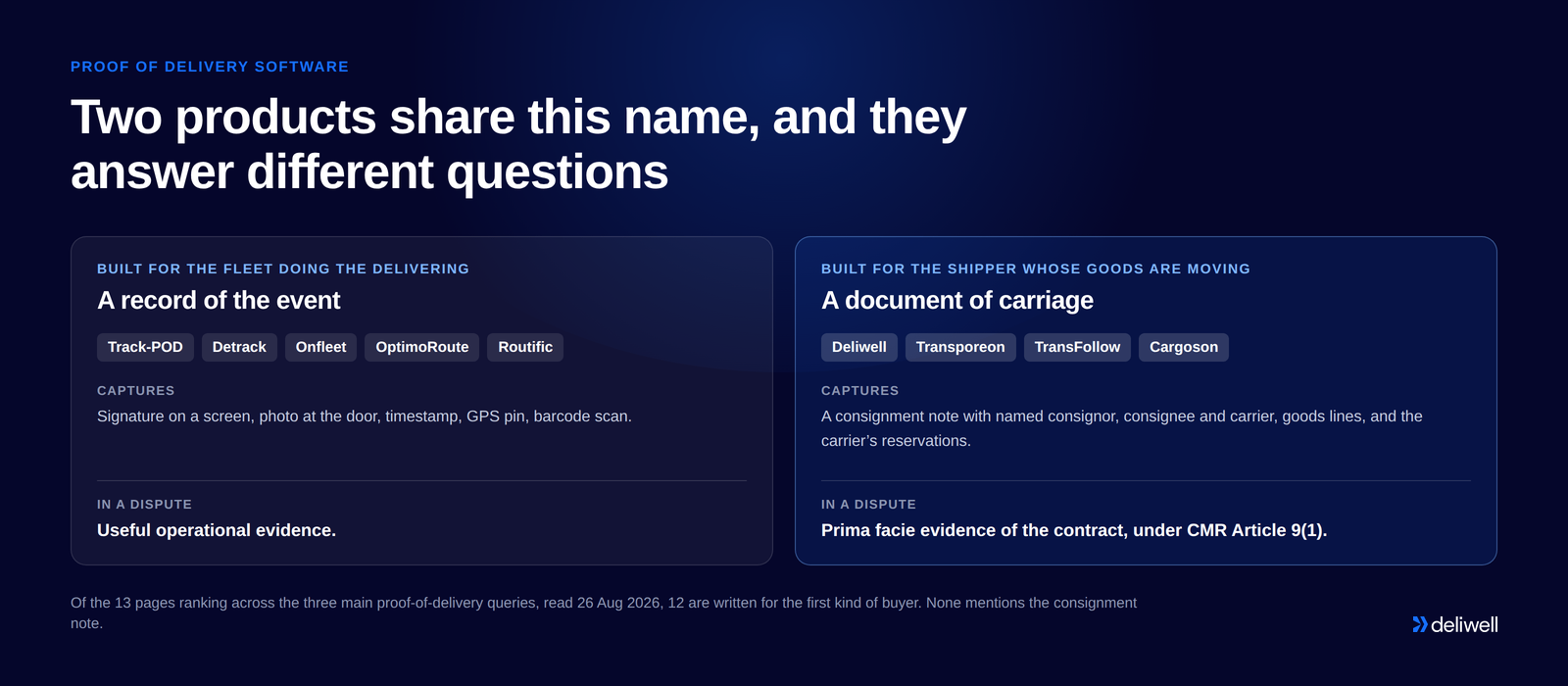
Two products share one name. A delivery app proves the drop happened; a consignment note proves what the carrier took, in what condition and under which contract — and only one of them holds up in a freight claim.


Bring structure, visibility, and compliance to your transport operations


Summary
A practical guide to proof of delivery software for 2026, split by the side of the transaction each tool was built for. It compares nine tools — five last-mile ePOD apps (Track-POD, Detrack, Onfleet, OptimoRoute, Routific) and four shipper-side platforms (Deliwell, Transporeon, TransFollow, Cargoson) — on what the proof is, compliance coverage and published pricing. It explains why a CMR consignment note carries evidentiary weight a driver's signature does not, what the e-CMR Protocol, eFTI, Spain's DeCA and RO e-Transport/UIT each require, and four questions to decide which product you need.
Search for proof of delivery software and you get route planners. We read the thirteen pages ranking across "proof of delivery software", "electronic proof of delivery" and "proof of delivery app" in August 2026. Twelve of them were written for the company doing the delivering, and the same five apps carry most of the lineups: Track-POD, Onfleet, OptimoRoute, Detrack and Routific.
Those apps are good at the job they were built for. That job is running your own drivers.
If you own the goods and hire carriers to move them, the proof you need is a different artefact with a different legal weight. None of the thirteen pages mentioned the CMR consignment note, e-CMR or eFTI. Gartner's own Digital Proof of Delivery category lists about fifteen vendors, and almost all of them are route optimisers.
So the first decision is which of the two products called proof of delivery software you are shopping for. Everything else follows from that.
TL;DR
- If you operate the vehicles, buy last-mile ePOD. Detrack ships proof of delivery on its cheapest tier at $29 per driver per month. Track-POD is the strongest all-round option and publishes both per-driver and per-order pricing. Routific has a genuine free tier up to 100 orders a month.
- If you own the goods and tender loads to carriers, an ePOD app leaves you short. You need the consignment note itself: named consignor, consignee and carrier, the goods lines, and the carrier's reservations. Under CMR Article 9(1) that document is prima facie evidence of the contract and of the carrier's receipt of the goods, which is an evidentiary standing a signature captured on a driver's phone does not carry.
- The document regime matters more than the capture screen. An electronic consignment note has the same evidentiary value as paper only between countries that have ratified the e-CMR Protocol. Forty-two have, per the UN depositary record. Croatia and Serbia have not.
- Two dated obligations are already on the calendar. EU authorities must accept electronic freight information from 9 July 2027 under Regulation (EU) 2020/1056. Spain's DeCA becomes mandatory for domestic and cabotage movements on 5 October 2026.
- Romanian shippers have a third clock, and it is running now. RO e-Transport/UIT penalties have been fully applicable since 1 January 2026, and the obligation to declare the UIT sits with the shipper rather than the carrier.
Deliwell runs a proof of concept on your own lanes and your own carriers. Book a demo to see the consignment note and the UIT come out of the same transport order.
Which Proof of Delivery Software Compares to Which?
Nine tools, split by the side of the transaction they were built for. Prices are the vendors' published figures read on 26 August 2026, and they are not directly comparable: these products bill by driver, by order, by task, by credit and by subscription tier.
DETAILED COMPARISON 2026
9 proof of delivery tools compared
| Tool | Built for | What the proof is | Compliance coverage | Pricing model |
|---|---|---|---|---|
| Shipper side: the goods owner tendering loads | ||||
| Deliwell mid-market pick | Mid-market European shippers, 50 to 5,000 transports a month | Consignment note generated, signed and archived in the platform | RO e-Transport/UIT via ANAF API, e-CMR, included in the subscription | From €250/mo — custom pricing |
| Transporeon (Trimble) | Enterprise and upper-mid shippers and retailers | eCMR inside Digital Transport Documents, eIDAS Advanced signature | eCMR, Spanish Carta de Porte and DCA | Not published |
| Trans | Any party to the carriage: shipper, carrier, consignee | Pure-play e-CMR and digital POD, community platform | e-CMR across 20+ countries | Credit per loading and delivery pair, rates not published |
| Cargoson | Small and mid-market shippers, Baltics and CEE | CMR and e-Waybill generated from the transport order | CMR generation and e-mailing, e-Waybill, POD management with carriers | $199 to $1,000/month, published |
| Fleet side: the operation that runs the drivers | ||||
| Track-POD | Couriers and in-house delivery fleets | Signature, photo, geotag, timestamp, barcode, branded PDF | None found | $49/driver/month or $285/month for 1,500 orders |
| Detrack | Delivery operations wanting ePOD before routing | Signature, up to 10 photos, GPS pin, 5-year archive | None found | $29/driver/month |
| Onfleet | Dispatch-heavy last mile, healthcare and food | Signature, contactless SMS signature, barcode, proof of age | None found | From $619/month for 2,500 tasks |
| Optimo | Delivery and field-service scheduling | Custom POD forms, signature, photo, barcode | None found | $44.10/driver/month on Pro, the first tier with POD |
| Routific | Small delivery operations, SMB budgets | Signature and photo, offline caching, failed-delivery reasons | None found | Free to 100 orders/month, then $150/month |
What Does Proof of Delivery Software Cover?
Proof of delivery software captures evidence that goods arrived, and the two versions of it capture different evidence. The last-mile version records the event. The freight version records the document that governs the carriage.
A last-mile ePOD app puts a capture screen in the driver's hand. The driver collects a signature, takes photos at the door, scans a barcode, and closes the task. The record carries a timestamp and a GPS pin, and the customer gets a notification with a tracking link. For a retailer running its own vans, that record answers the question that costs money: did the drop happen, and can we show it.
A freight consignment note does something else. Its structure is fixed by the Convention, and each field carries a specific job:
- Boxes 1, 2 and 16 name the sender, the consignee and the carrier.
- Boxes 3 and 4 record where and when the carrier took the goods over, and where they are to be delivered.
- Boxes 6 to 12 list the marks, the packages, the nature of the goods and the weight.
- Box 18 carries the carrier's reservations and observations, which is what the driver found.
- Boxes 22, 23 and 24 carry the three signatures: sender, carrier, and consignee on receipt.
The reservations box is the one that decides claims. It is where the driver writes what the goods looked like on arrival, and its absence is what makes a clean signature expensive later.
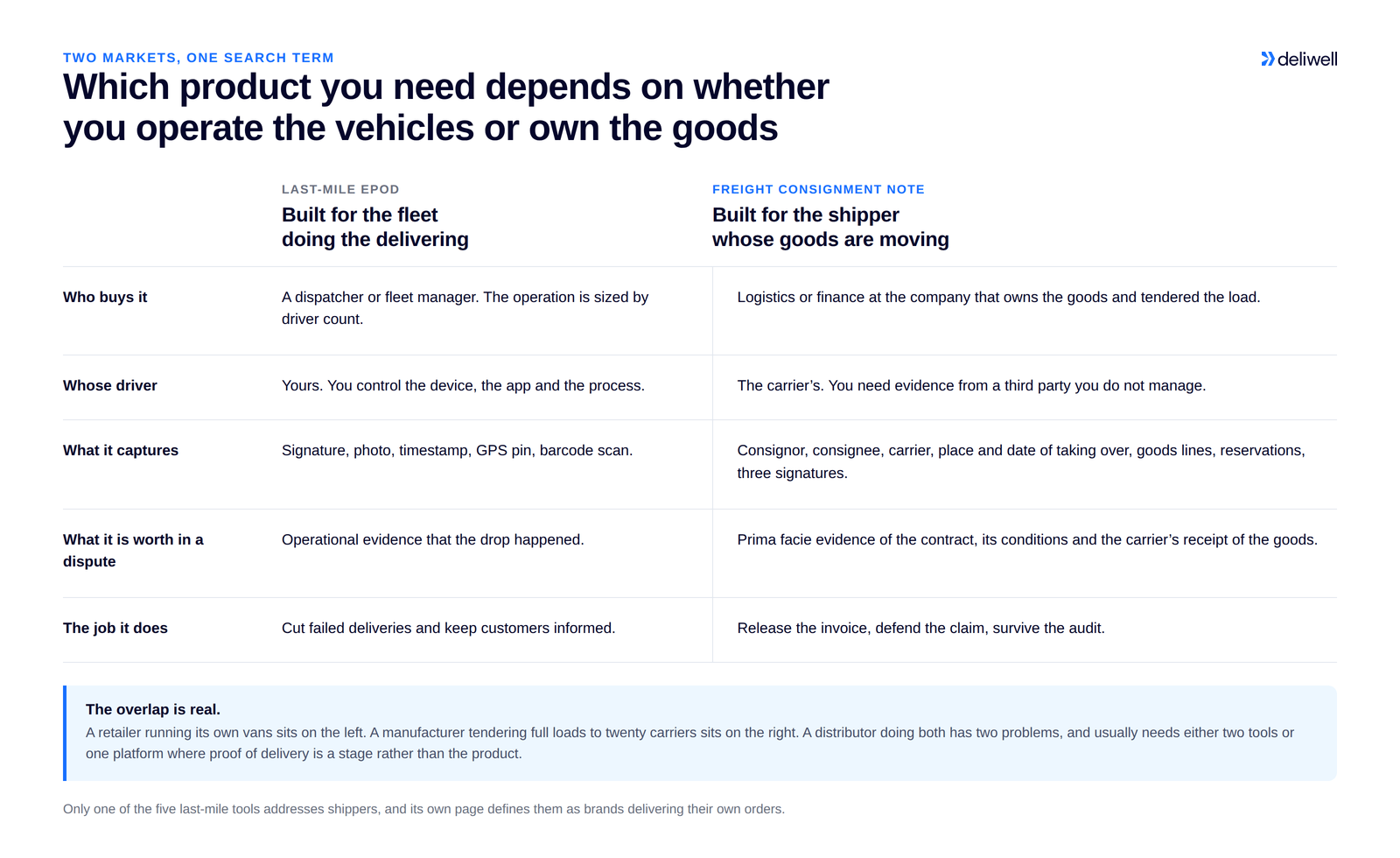
The overlap is real. A distributor with its own vans for city drops and contracted carriers for pallet lanes has both problems at once, and usually needs either two products or one platform where proof of delivery is a stage in the transport rather than the whole product.
One of the five last-mile tools does address shippers. Onfleet runs a page for them, and its own wording defines a shipper as a brand or retailer fulfilling its own orders "with your own fleet, third party providers, or both". That is a different buyer from the manufacturer tendering full loads under a consignment note.
Why Does the Shipper Side Need a Different Product?
Because the shipper's proof has to survive a claim against a third party the shipper does not manage, and the document regime it lives under is specific.
CMR Article 9(1) makes the consignment note prima facie evidence of the making of the contract of carriage, of the conditions of the contract, and of the receipt of the goods by the carrier. The Additional Protocol to the CMR, adopted in Geneva on 20 February 2008 and in force since 5 June 2011, extends exactly that evidentiary value to an electronic consignment note. Article 2(2) makes the electronic note equivalent to paper. Article 3 requires a reliable electronic signature linked to the note. Article 5 leaves the parties to agree the procedures between themselves.
Equivalence holds only where both states have ratified. The UN depositary record for the Protocol currently shows 42 parties and 8 signatories, against the 58 contracting parties to the CMR Convention that IRU counts. Romania acceded on 14 March 2019 and the Protocol entered into force for it on 12 June 2019 under Law 29/2019.
Two lanes a CEE shipper runs regularly are outside it. Croatia and Serbia are not parties, so those movements still need paper.
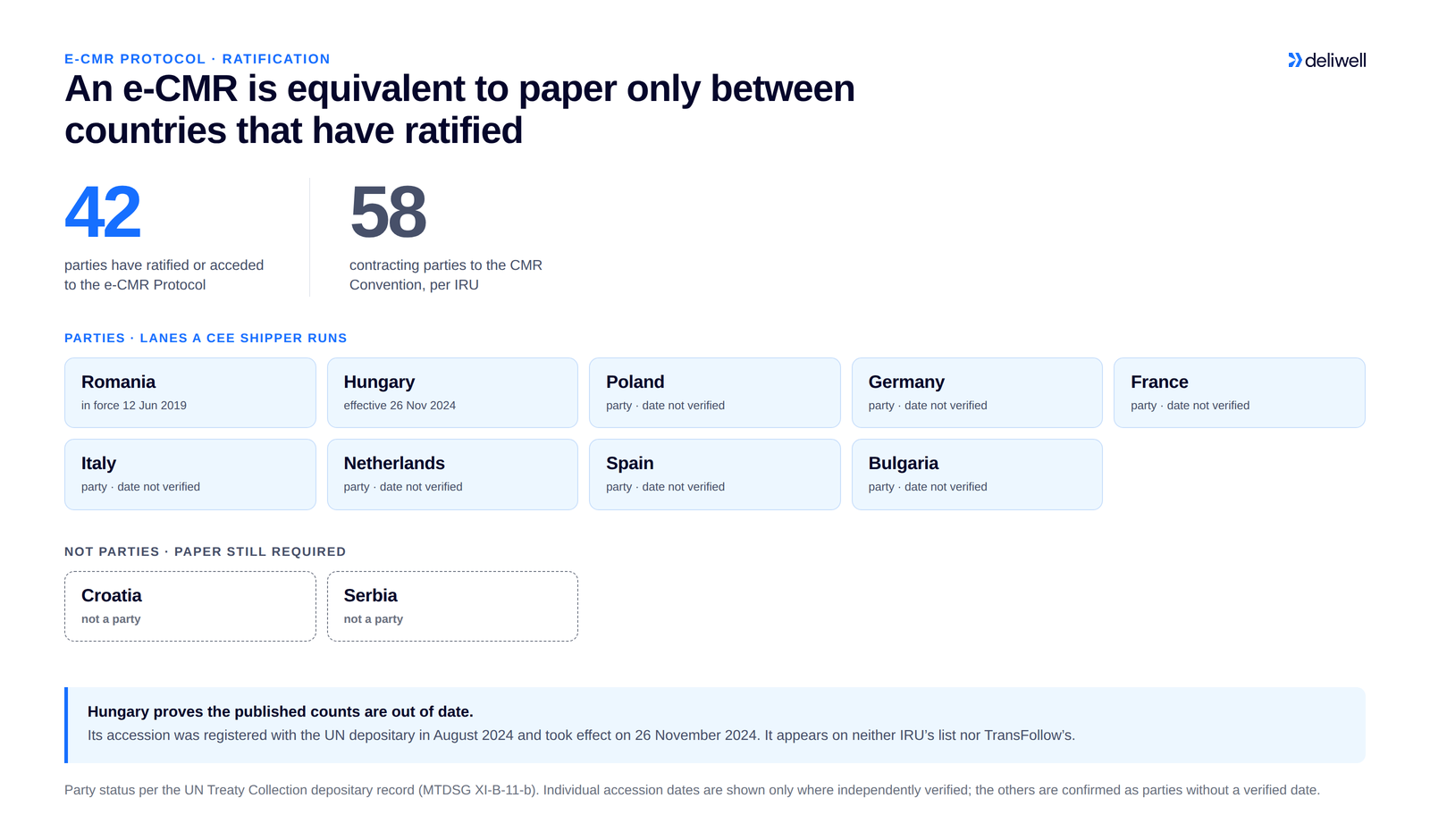
The published counts lag. IRU's CMR page and TransFollow's ratification list both still say 39, and Hungary proves that is out of date: its accession was registered with the UN depositary in August 2024 and took effect on 26 November 2024, and it appears on neither list. Cite the depositary rather than a vendor page when the number goes into a contract or a tender.
What Do the CMR Protocol, eFTI, DeCA and RO e-Transport Each Bind?
Four regimes get conflated in vendor content, and none of them replaces the others.
The most common error in vendor content is treating the CMR Protocol as an obligation on roadside inspectors. The Protocol's obligations run only to the parties to the carriage contract, which is why a driver can hold a valid e-CMR and still be asked for paper at a check.
That is the gap eFTI closes. Regulation (EU) 2020/1056 requires member state authorities to accept regulatory information supplied electronically via certified eFTI platforms from 9 July 2027, and to confirm receipt electronically. Operators keep the right to use paper, because Article 4 is conditional: where an operator chooses to go electronic, the data has to sit on a certified platform. Any vendor telling you e-CMR becomes mandatory in 2027 has read the regulation backwards.
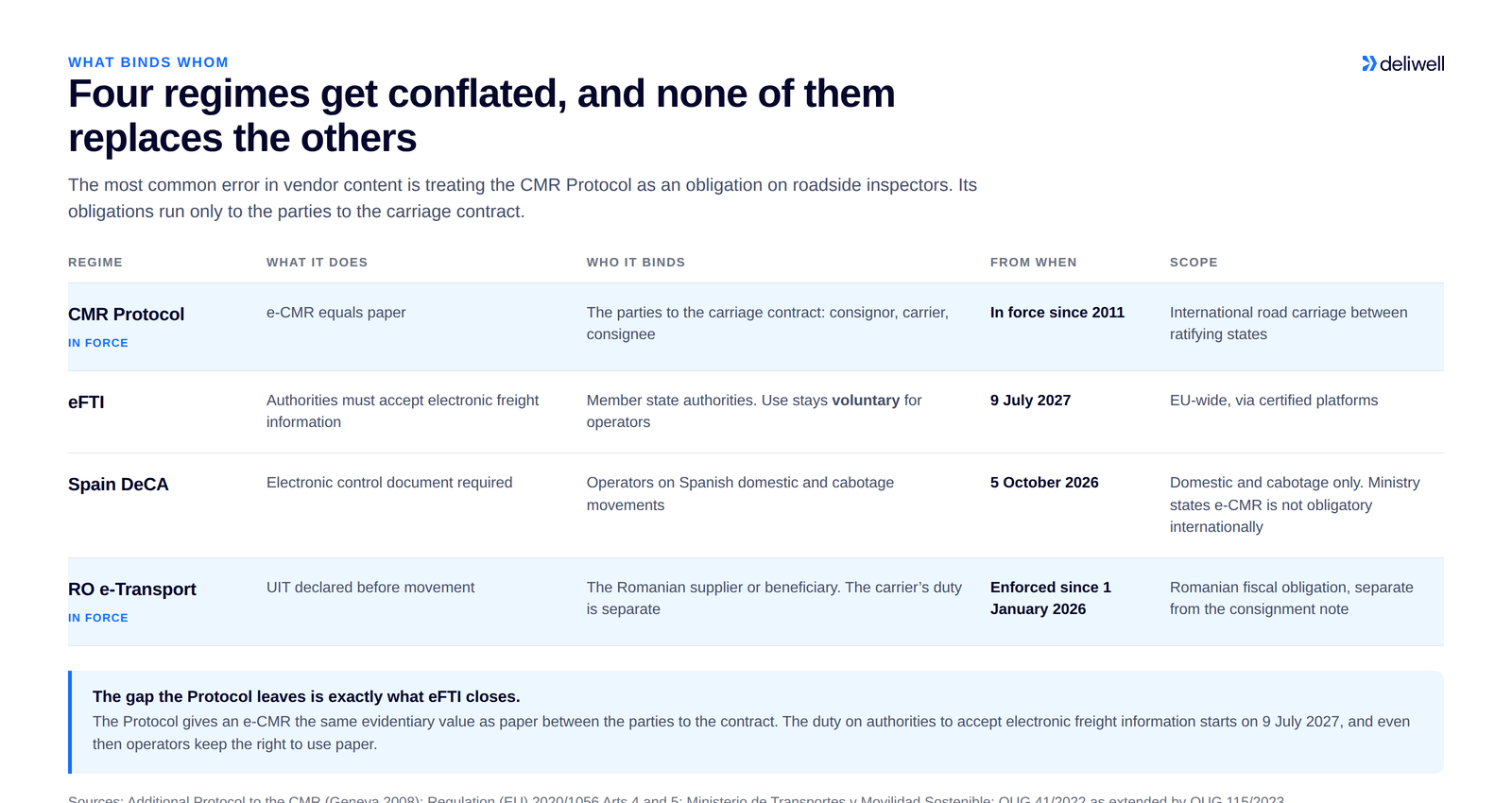
Spain arrives first. The Documento electrónico de Control Administrativo becomes mandatory on 5 October 2026 under Ley 9/2025, and it covers domestic and cabotage movements only. The Ministry's own guidance states that e-CMR is not obligatory for international transport, and the earlier requirement for providers to register a domain has been removed.
Romania's clock is separate and already running. RO e-Transport/UIT, created by OUG 41/2022 and extended to all international road movements of goods by OUG 115/2023, requires a UIT code declared before the vehicle moves. The declaration duty sits with the Romanian supplier or beneficiary rather than the carrier. The sanctions grace period ended on 31 December 2025, so from 1 January 2026 the penalties apply in full, and for legal entities they run from 20,000 to 100,000 lei. The UIT is valid for five calendar days from the declared start, or fifteen for intra-EU acquisitions.
None of these is a substitute for the others. A Romanian shipper moving goods to Germany needs the UIT because Romanian tax law says so, and needs the consignment note because CMR does.
What Kind of Proof of Delivery Software Do You Need?
Four questions separate the two lineups, and answering them takes about five minutes.
- Whose driver captures the proof? Yours means the fleet-side lineup, because you control the device, the app and the training. The carrier's driver means the shipper-side lineup, because your evidence has to come out of a process you do not run.
- What does the proof have to prove? That the drop happened is an operational question, and a photo with a timestamp answers it. That the carrier took the goods in a given condition under agreed terms is a contractual question, and only the consignment note answers it.
- Who reads it after the fact? Customer service reads a delivery record. Finance reads the note to release the invoice, and an auditor or an insurer reads it to test a claim.
- Which lanes and which countries? Domestic drops in one city put no document regime in play. Cross-border road movements put CMR, the Protocol, eFTI and any national regime along the route in play at once.
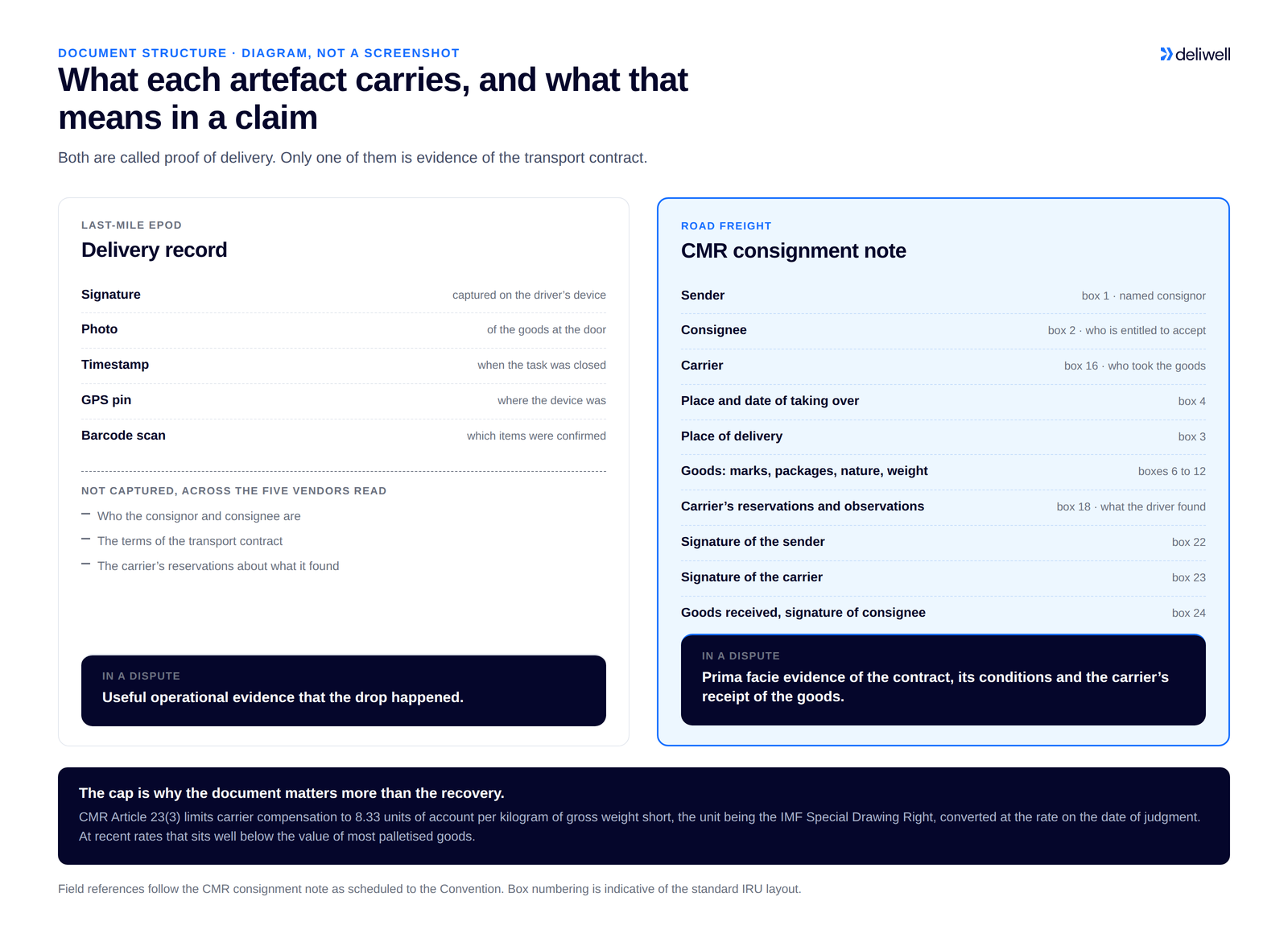
The reason the document beats the record is the liability cap. CMR Article 23(3) limits carrier compensation to 8.33 units of account per kilogram of gross weight short, the unit being the IMF Special Drawing Right, which puts recovery around €9 to €10 per kilo. That is far below the value of most palletised goods, so the paperwork that establishes condition on handover is worth more than the compensation you can claim without it.
For most mid-market shippers the incumbent here is no software at all. The current process is a shared mailbox, a folder of scanned CMRs, a spreadsheet tracking which ones came back, and a WhatsApp group for chasing the rest. Replacing that process is the real project, and any vendor demo should be judged against it.
Track-POD: Proof of Delivery Software for Own-Fleet Delivery Operations
Track-POD is the strongest all-round choice for an operation that runs its own drivers, and it is the one tool that appears in every roundup we read.
Strengths:
- Offline capture stated on the marketing page, so PODs survive a dead zone and sync later.
- Mass POD closes many drops to one client against a single signature, which suits wholesale runs.
- Actual-quantity capture records the difference between planned and delivered goods, plus rejection reasons.
- Branded PDF ePOD with your logo and configurable placeholders.
- An EU legal home. Europe and the UK are served by Geros Technologijos in Vilnius.
Shortcomings:
- Per-driver plans carry a three-driver minimum, twenty for Enterprise, so a two-van operation cannot buy the entry plan as listed.
- No CMR or e-CMR anywhere on the vendor site. Its freight-document writing covers the US Bill of Lading.
- Capterra reviewers report the mapping does not support truck routes and that phone support can take days.
Pricing: from $49 per driver per month on annual billing, minimum three drivers, or from $285 a month for 1,500 orders on the per-order model. Free trial, no permanent free tier.
Best for: couriers and in-house fleets that want ePOD and routing in one product.
Detrack: Proof of Delivery Software for Fleets That Want ePOD Before Routing
Detrack is the closest of the five to an ePOD specialist that later added delivery management, and its packaging reflects that.
Strengths:
- Proof of delivery ships on the cheapest tier, which inverts the usual gating.
- Up to ten photos per job, GPS verification and timestamps on every delivery.
- Offline mode stated on the vendor page.
- Five-year searchable ePOD archive, useful when a dispute surfaces late.
- Detrack states it has been ISO 27001 certified since 2021, and it has the strongest named ERP and accounting bench of the five.
Shortcomings:
- Route optimisation is gated to the Advanced tier, so the $29 plan is ePOD and tracking only.
- The integration bench is ANZ and South-East Asia mid-market ERPs, with no SAP, Dynamics or Oracle connector named.
- Its own logistics-abbreviations glossary runs to 50-plus terms and omits CMR.
- Capterra reviewers report recurring schedules are confusing and that orders cannot be added mid-day without deleting assigned deliveries.
Pricing: $29 per driver app per month for Pro, $39 for Advanced, billed monthly. Annual saves 10%.
Best for: fleets that want proof of delivery first and can add routing later.
Onfleet: Proof of Delivery Software for Dispatch-Heavy Last Mile
Onfleet is built around dispatch, and its POD module reflects the verticals it sells into: pharmacy, food, grocery and cannabis.
Strengths:
- Contactless signature by SMS link, plus proof of age and ID scanning where a vertical requires it.
- Attachments can be made mandatory, so a task cannot be closed without the photo or the signature.
- Barcode scan events are recorded in the task and order history with timestamps.
- Task-based billing with unlimited users, which suits a large dispatch team.
Shortcomings:
- The cheapest published plan is $619 a month, so there is no small-fleet entry point.
- Offline capture is not documented on the vendor site, and neither is a branded PDF delivery note.
- SMS and voice are billed separately at variable per-country rates.
- Hosting is US-East with no EU data residency stated.
- G2 reviewers report unreliable optimisation results and slow page performance.
Pricing: from $619 a month for 2,500 tasks, $1,349 for 5,000, Enterprise from $3,099. Courier Suite add-on from $299.
Best for: dispatch operations in regulated verticals that need chain-of-custody at the door.
OptimoRoute: Proof of Delivery Software for Delivery and Field Service
OptimoRoute is a scheduling and route optimisation product first, and it is the only one of the five that treats field service as a first-class audience.
Strengths:
- Custom proof-of-delivery forms, so a completion process can carry more than a signature.
- Barcode confirmation in the driver app.
- A 30-day trial with no credit card, the longest of the five.
- SSO with Microsoft Active Directory, and route export to Garmin and TomTom.
Shortcomings:
- Proof of delivery is excluded from the Lite plan entirely, along with analytics and live order tracking.
- Offline behaviour is described as tolerance for small data plans and weak signal rather than an offline queue.
- No named third-party integrations. Everything runs through the API.
- Capterra reviewers report the map stops enumerating orders above about 100 routes and that changing one stop can reshuffle a whole route.
Pricing: Lite $35.10 and Pro $44.10 per driver per month on annual billing, with a 10% annual discount applied. Confirm the monthly rate in your own quote.
Best for: mixed delivery and field-service teams that need scheduling depth.
Routific: Proof of Delivery Software for Small Delivery Operations
Routific is the SMB entry point, and the only one of the nine with a permanent free tier.
Strengths:
- Free up to 100 orders a month, with unlimited drivers and dispatchers on every plan.
- Offline behaviour documented: actions taken in the app are cached on the device and the route stays usable without a connection.
- Drivers mark each order Delivered, Re-attempt or Failed, so a partial stop leaves a record of what happened.
- Barcode scanning with colour-coded validation for mismatches.
Shortcomings:
- Pricing scales with order volume rather than fleet size, so a high-drop operation pays more as volume grows.
- The free tier excludes SMS notifications.
- GPS geotagging and timestamps on the POD record are not documented on the vendor pages.
- No named ERP, TMS or WMS integration.
- Capterra reviewers report there is no admin app for phones.
Pricing: free to 100 orders a month, $150 a month for 101 to 1,000, then per-order additions from 15c down to 3c at volume.
Best for: small delivery operations testing whether ePOD is worth paying for.
Transporeon: Proof of Delivery Software for Enterprise Shippers and Retailers
Transporeon, part of Trimble since a €1.88B acquisition, delivers eCMR through a module called Digital Transport Documents, inside its Dock and Yard Management hub. It has distinct shipper and retailer variants.
Strengths:
- A real eCMR product rather than a document store. Transporeon describes the module as a container for logistics documents in digital form, with eCMR the first document shipped.
- eIDAS Advanced electronic signatures and a blockchain audit trail.
- A QR flow at the loading point: the driver authenticates by SMS or email, the consignor scans and authenticates, then the driver records findings and signs.
- Spanish Carta de Porte and DCA support, which matters ahead of 5 October 2026.
- Public API for TMS integration.
Shortcomings:
- Built for the enterprise end of the market, so the rollout and the change management are sized accordingly.
- Whether Digital Transport Documents is bundled into Dock and Yard Management or licensed separately is not stated publicly.
- No published pricing, so a mid-market buyer cannot size the commitment without a sales cycle.
Best for: enterprise shippers and retailers already running Transporeon for dock and yard.
TransFollow: Proof of Delivery Software as a Pure-Play e-CMR Platform
TransFollow is the closest thing the market has to a neutral e-CMR utility, and it sells to every party to the carriage: shippers, carriers, consignees, drivers and subcontractors.
Strengths:
- Pure-play focus. e-CMR and digital POD are the product rather than a module.
- Coverage across more than 20 countries, with 40-plus software partners integrating it, including Simacan, Frotcom, Trimble and LIS.
- A community-platform model, so a carrier already on TransFollow for another customer needs no new onboarding.
Shortcomings:
- Owned by IRU through its subsidiary Viatrans, while IRU's own FAQ states it does not favour any one e-CMR platform. Worth knowing when you read IRU material about interoperability.
- A document platform rather than a TMS, so planning, allocation, invoice validation and cost control sit elsewhere.
- Pricing is a credit model, one credit per loading and delivery pair, and the unit price depends on the volume purchased. No rates are published.
Best for: shippers who need e-CMR alone and already have a TMS they intend to keep.
Cargoson: Proof of Delivery Software for Small and Mid-Market Baltic and CEE Shippers
Cargoson is a shipper-side transport management platform from Estonia, and one of the few vendors in this set that publishes prices.
Strengths:
- Published pricing from $199 a month, which makes it the easiest of the shipper-side options to evaluate.
- CMR generation and e-mailing, plus POD, invoice and packing-list management with carriers, listed as included from the Basic tier.
- An e-Waybill flow that Cargoson describes as digitally signed and logged with name, location and timestamp at the collected and delivered milestones.
Shortcomings:
- The vendor's own pages disagree on whether the CMR tool is an add-on or included. The blog calls TailorCMR an add-on feature and the pricing page lists CMR generation from Basic upward. Confirm in writing.
- Cargoson states that its e-Waybill can integrate with the eFTI gate system and complies with the eFTI Regulation. Under Regulation (EU) 2020/1056 Articles 11 to 13, eFTI conformity is certified by accredited bodies, and no certificate is cited. Treat it as a vendor claim and ask for the certificate.
- Cargoson's own alternatives content describes go-live as measured in weeks.
- No native RO e-Transport/UIT generation found on the vendor site.
Pricing: Basic from $199 a month on annual billing for 100 shipments and 2 users. Standard from $399 for 1,000 shipments, Advanced from $599 for 3,000, Enterprise from $1,000.
Best for: small and mid-market shippers in the Baltics and CEE who want published pricing and CMR generation.
Deliwell: Proof of Delivery Software for Mid-Market European Shippers
Deliwell is a right-sized road-freight TMS for mid-market European shippers, and proof of delivery sits inside it as a stage of the transport rather than as the product. The platform covers planning, allocation, dispatch, tracking, documents, compliance, invoice validation and KPIs, so the consignment note comes out of the transport order that is already in the system.
That matters for the artefact you end up holding. The transport order can be downloaded as a PDF signed electronically by both parties and certified by the platform. The CMR is attached against that same order, so the note, the status history and the invoice line stay on one record instead of in three systems.
Strengths:
- Digital consignment notes generated, signed by sender, carrier and recipient, and archived in the platform, included in the standard subscription rather than sold as a module.
- Native RO e-Transport/UIT through a direct ANAF API integration. The UIT is generated from the transport order data already entered, so nobody logs into the ANAF portal with a separate per-user token. Sonepar raised that token confidentiality problem specifically.
- Up to 1,000 product lines per UIT on every tier, with a full e-Transport audit trail exportable for ANAF inspections.
- A carrier portal reached by token, so a carrier updates status and attaches the CMR from an email link with no sign-up and nothing to install. Mixed carrier bases matter here, because a shipper cannot mandate an app across 200 partners.
- Cross-department by design. Sales, purchasing, warehouse, finance and logistics work off the same record, and purchasing is the persona no competing TMS speaks to.
- Compliance updates ship with the subscription when ANAF or the EU changes the rules.
- 100+ mid-market shippers, including Stihl, Sonepar and Frigoglass.
Shortcomings:
- Under 50 shipments a month, the platform is more than the operation needs.
- Five or more GPS providers in the carrier base makes integration work heavier.
- Complex air and sea costing is supported on an all-in basis only. Deliwell is road-first.
- Specialized freight is a poorer fit, and special transport for heavy, oversized and hazmat loads is an add-on module rather than core.
- ERP integration is optional and Deliwell runs standalone, but where it is in scope it adds time to go-live.
Pricing: Deliwell pricing is fixed, starting at €250/month and scaling with your transport volume — delivered as an all-in-one SaaS subscription with no hidden IT costs. Contact Deliwell for a pricing proposal tailored to your operation.
Best for: mid-market European shippers running 50 to 5,000 road transports a month with a mixed carrier base, especially where a Romanian entity puts e-Transport/UIT in scope.
Standard go-live is measured in days, and the first transport request usually goes out inside 30 minutes. Book a demo and run a proof of concept on your own lanes before you commit.
What's the Best Proof of Delivery Software for You?
Start from the side of the transaction you sit on, then from the lanes you run.
You operate the vehicles. Detrack if proof of delivery is the priority and routing can wait, at $29 per driver. Track-POD if you want both from day one and can meet the three-driver minimum. Routific if the volume is under 100 orders a month and the budget is zero. Onfleet if dispatch volume and a regulated vertical justify $619 a month. OptimoRoute if field service and delivery share the same schedule.
You own the goods and hire carriers. Cargoson if published pricing and CMR generation are enough and the lanes are Baltic and CEE. TransFollow if you need e-CMR as a utility alongside a TMS you intend to keep. Transporeon if you are already enterprise and already running its dock and yard modules.
You own the goods, run 50 to 5,000 transports a month, and have a Romanian entity. Deliwell is built for that shape. The consignment note, the UIT and the invoice check come off one transport order, and the carrier does not have to install anything to take part.
Whichever way you go, ask the vendor two questions in writing. Which countries does your e-CMR cover, given that equivalence stops at the ratification line. And who is accountable when a national regime changes, which is the difference between a platform that ships the update and a platform that sends you a changelog.
Deliwell's compliance coverage is native and included rather than quoted as an add-on. Book a demo and bring your two hardest lanes.
FAQ
Is an electronic consignment note legally valid?
Between the parties to the carriage contract, yes, where both states have ratified the Additional Protocol to the CMR and the signature meets Article 3. Article 2(2) gives the electronic note the same evidentiary value as paper. The UN depositary record shows 42 parties as of August 2026, so check the specific lane: Croatia and Serbia are not among them.
Does the CMR Protocol mean roadside inspectors have to accept an e-CMR?
No. The Protocol binds only the consignor, the carrier and the consignee, and it places no duty on enforcement authorities. The duty on member state authorities to accept electronic freight information comes from Regulation (EU) 2020/1056 and starts on 9 July 2027, and even then operators keep the right to use paper.
Can I use a last-mile ePOD app for road freight?
You can capture a signature and a photo with one, and for internal operational purposes that may be enough. What an ePOD app does not produce is the consignment note itself, with the named parties, the goods lines and the carrier's reservations, which is the document a freight claim turns on. None of the five last-mile tools in this comparison mentions CMR or e-CMR on its site.
Does proof of delivery software cover RO e-Transport/UIT?
Rarely, and the two obligations are separate. RO e-Transport/UIT is a Romanian fiscal monitoring regime requiring a UIT code declared before the vehicle moves, created by OUG 41/2022 and extended by OUG 115/2023, with penalties fully applicable since 1 January 2026. Check whether a vendor generates the UIT through the ANAF API or expects you to keep using the portal.
What does proof of delivery software cost in 2026?
Fleet-side ePOD runs from free at very low volume to about $49 per driver per month, or $619 a month and up on task-based plans. Shipper-side platforms mostly quote: Cargoson publishes $199 to $1,000 a month, Deliwell has fixed pricing from €250/month, scaling with your transport volume, and Transporeon and TransFollow do not publish rates. The billing units differ by product, so compare on total cost for your own volume rather than on headline price.
Case studies


Sonepar Romania centralises transport reporting and cost control with Deliwell



Inteva gains full transport visibility and eliminates manual work with Deliwell


Hamilton Central Europe reduced transports costs by 15% by replacing their old TMS with Deliwell
