
Supply Chain Visibility: A Practical Guide for Mid-Market Shippers
Four problems share one name. For mid-market road freight the gap is rarely technical: six departments touch every transport, and none of them sees the same version of it.

Bring structure, visibility, and compliance to your transport operations


Summary
A practical guide to supply chain visibility for mid-market shippers running road freight. It separates the four problems the term covers: supplier, inventory, transport and cross-department visibility. It then shows the five points where transport visibility breaks and sets out six steps to close the gap by putting transports, documents and compliance status in one record. The guide also covers what Deliwell shows and what it does not, when a dedicated visibility platform is the right purchase, and five numbers that tell you whether visibility improved.
A customer calls at 11am asking where their delivery is. To answer, a dispatcher has to check three places: an email thread with the carrier, a spreadsheet with the loading date, and a phone call to the driver. Nine minutes later the customer has an answer that is already an hour old.
That is a supply chain visibility problem, and almost nothing written about supply chain visibility will help you solve it.
Most of what you find on the topic was written for an enterprise supply chain director thinking about tier-two suppliers, ocean containers and carbon reporting. Useful work, different problem. A mid-market shipper moving anywhere from 50 to a few thousand road transports a month has a narrower problem, and the fix looks nothing like buying a visibility platform. It starts with getting every transport, its documents and its compliance status into one record.
Key Takeaways
- Supply chain visibility means at least four different things, and most content treats them as one. Sorting out which one you have decides which tool you need.
- For mid-market road freight, the gap is usually internal rather than technical. Six departments touch a transport and none of them sees the same version of it.
- "Real time" almost always means carrier-reported status at intervals rather than continuous tracking. Ask what the interval is.
- You can close a transport visibility gap without buying a visibility platform, by putting transports, documents and compliance status in one record.
- Multi-tier supplier mapping, inventory across sites and ocean container tracking are genuinely different problems. A road-freight TMS will not solve them, and platforms built for them are the right answer.
What Is Supply Chain Visibility?
Supply chain visibility is the ability to see where your goods, orders and documents are at any point in the chain, and to act on what you see. The second half of that sentence carries the weight. A dashboard that tells you a delivery is late without letting you do anything about it has produced information rather than visibility.
The term gets applied to four distinct problems, which is why so much writing about it feels vague. Separating them is the fastest way to work out what you are missing.
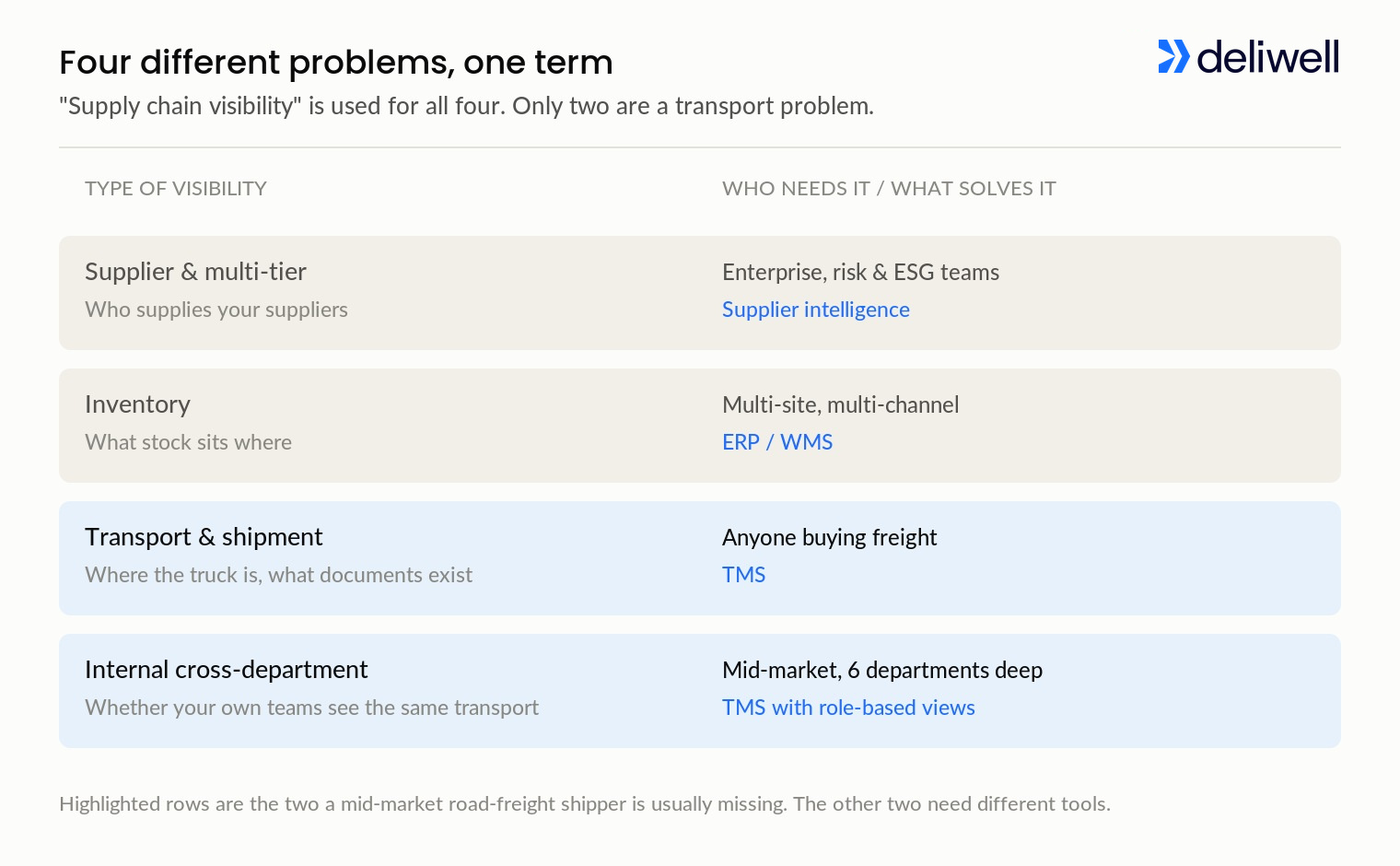
The Four Things People Mean by Supply Chain Visibility
Supplier and Multi-Tier Visibility
Knowing who your suppliers are, and who supplies them. This is the version driving most enterprise interest, pushed along by disruption risk and by regulations on due diligence and sustainability reporting.
It matters when a component shortage four tiers down stops your line. It is a supplier data and risk problem rather than a transport problem, and a TMS is the wrong tool for it.
Inventory Visibility
Knowing what stock sits where, across warehouses, sites and channels. This lives in an ERP and a warehouse management system.
Transport data feeds it, since goods in transit are inventory you cannot sell yet. But if your problem is that nobody knows how many pallets are in the Cluj warehouse, transport visibility will not fix it.
Transport and Shipment Visibility
Where the truck is, when it will arrive, what condition the goods are in, and which documents exist. This is the version most mid-market shippers mean when they say they want visibility.
A word on "real time", because the phrase is used loosely. Most transport visibility is carrier-reported status at intervals, or a driver updating a status in an app, or a GPS ping every fifteen to thirty minutes. Continuous telemetry on every vehicle exists but usually requires the carrier to share a live feed, which most small hauliers will not do. When a vendor says real time, ask what the update interval is and where the data comes from.
Internal Cross-Department Visibility
Whether the people inside your own company see the same transport. Nobody writes about this one, and in mid-market operations it causes more pain than the other three combined.
Why Mid-Market Shippers Have a Different Visibility Problem
Six departments touch a single transport. Sales promised a delivery date. Purchasing ordered the goods. The warehouse has to load or receive them. Dispatch booked the carrier. Finance will pay the invoice. Logistics owns the whole thing on paper.
Each one holds a piece. None of them holds the same piece, and nothing reconciles the pieces automatically.
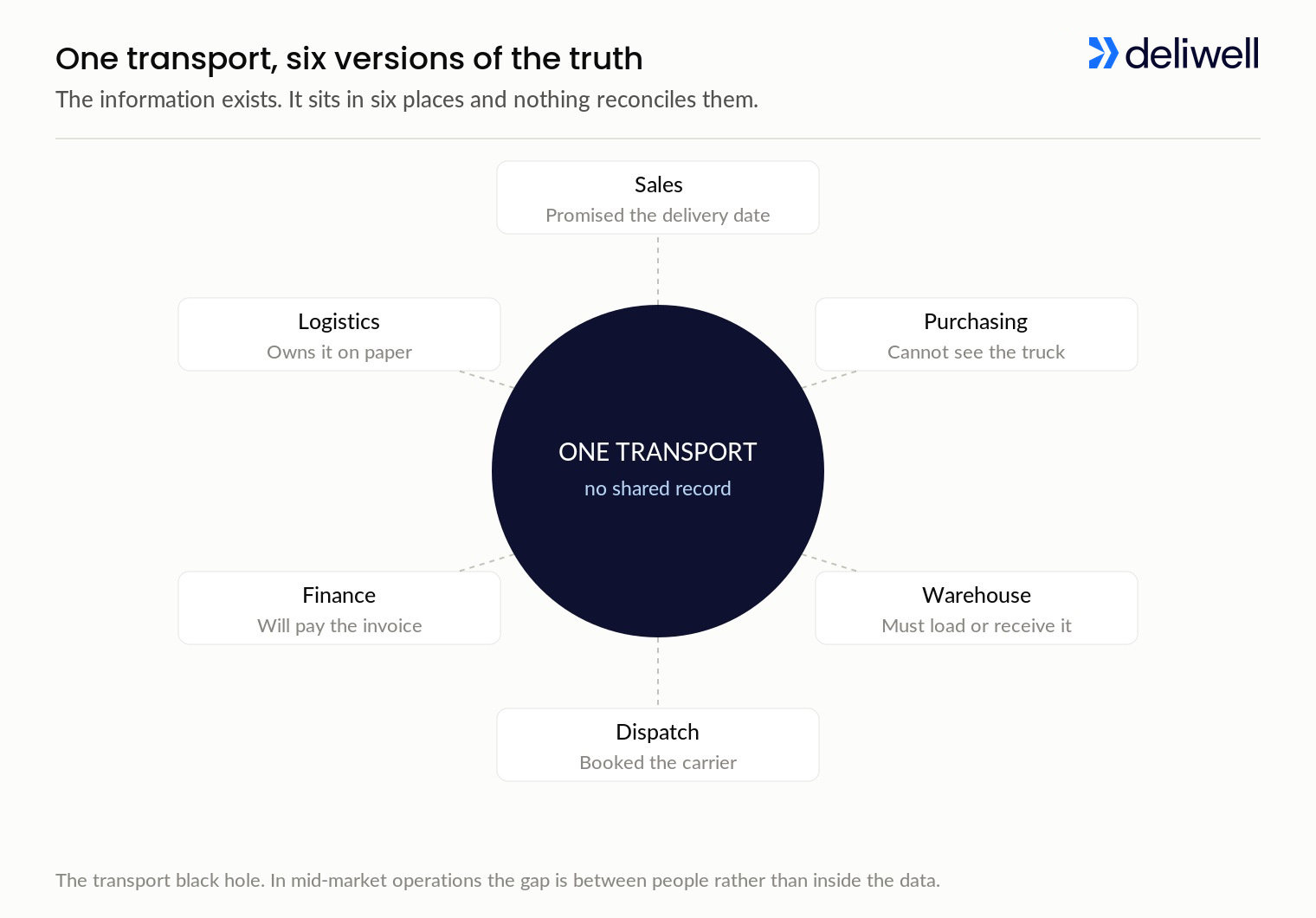
That is the transport black hole, and it is a white-space problem rather than a data problem. The information exists. It sits in an inbox, a spreadsheet tab, a WhatsApp thread and someone's memory of a phone call. Purchasing is the department that suffers most and gets served least, because almost every TMS on the market connects the logistics team to carriers and stops there.
The status quo in most of these businesses is Excel, email, WhatsApp and ERP exports. Before you evaluate any visibility product, be clear that this is what you are replacing. You are not adding a tracking layer to a working system. You are replacing fifteen spreadsheets and a group chat with one record.
Where Supply Chain Visibility Breaks
Five failure points, each with a consequence you can measure.
Status lives in a carrier's inbox. The carrier knows the truck is delayed. That knowledge reaches you when someone asks, which is usually after the customer has already noticed.
Documents arrive after the invoice. A CMR gets photographed, emailed and filed somewhere. Finance receives an invoice referencing a delivery it cannot match to a signed document, so payment stalls and the dispute takes three weeks.
Inbound is invisible until the truck is at the gate. Purchasing raised the order and has no view of the transport. The warehouse discovers a delivery when it arrives, with no staff scheduled to receive it. This is the version of the problem people search for as inbound supply chain visibility, and it is the one that stops production lines.
Nobody can answer "where is it" without a phone call. If the answer to a status question requires a human to contact another human, you do not have visibility. You have a person whose job is being a lookup table.
Compliance status is tracked separately. For a Romanian entity the UIT code has to exist before the goods move. If that lives in a different system from the shipment, you have two records to reconcile and one of them is a legal requirement.
How to Get Transport Visibility Without Buying a Visibility Platform
The useful realisation is that transport visibility is mostly a by-product. Run the operation in one place and visibility falls out of it. Bolt a tracking layer onto a fragmented operation and you get a prettier version of the same confusion.
Six steps, in the order that pays back fastest.
Put Every Transport in One Record
One record per transport, holding the route, the dates, the carrier, the goods, the cost and the documents. Not one spreadsheet per site or per person.
This sounds obvious and it is the step most operations skip, because the spreadsheets grew organically and nobody owns the decision to kill them.
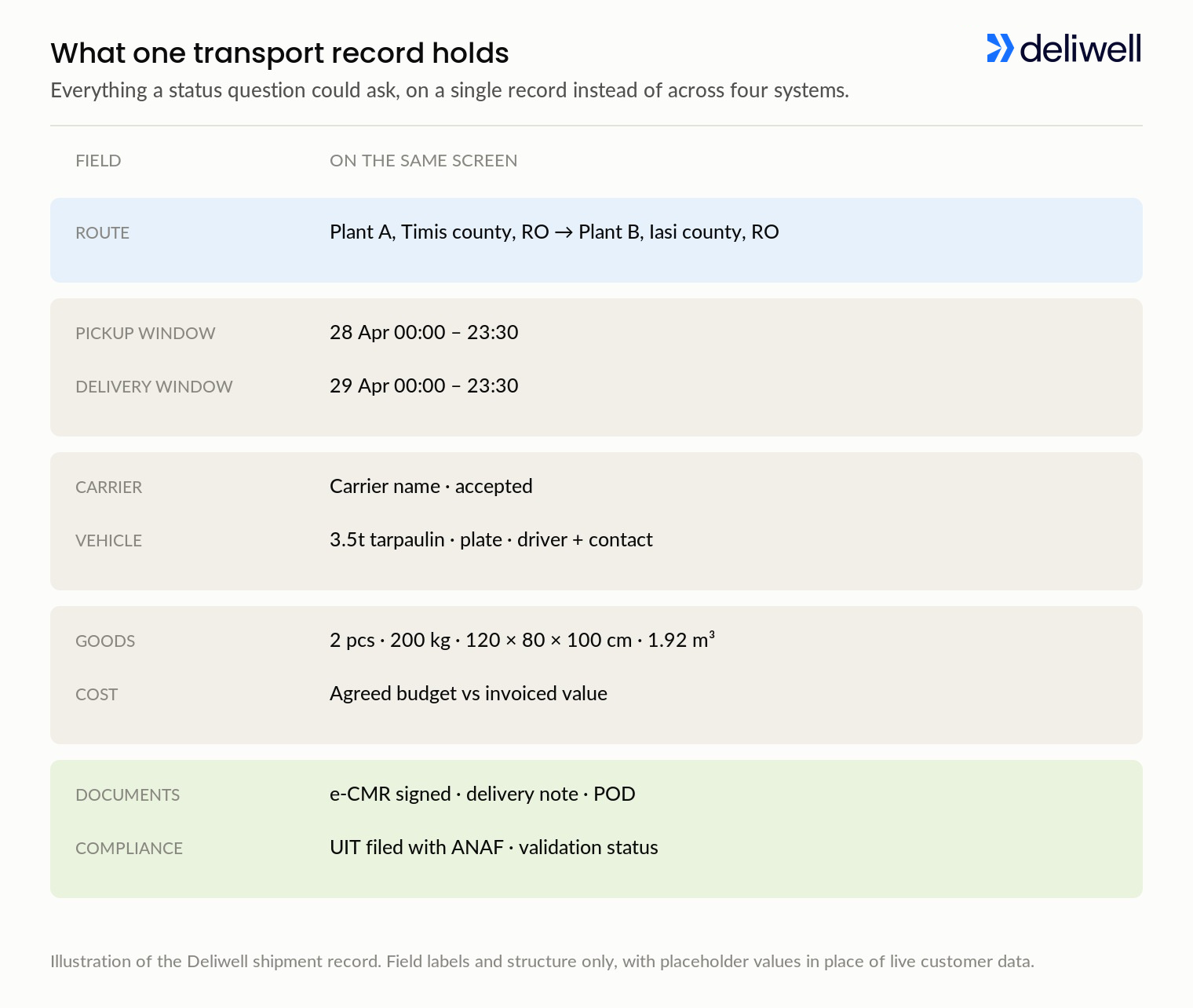
In Deliwell this is the shipment record. Pickup and delivery windows, the assigned vehicle and driver with contact details, the goods with weights and dimensions, the agreed cost, and the documents, all on one screen with the route drawn on a map. Inbound and outbound sit in the same view, which is what lets purchasing see a supplier delivery without asking dispatch.
Give Carriers a Way to Update Status That Costs Them Nothing
Your visibility depends on carriers telling you things. Any system that requires a small haulier to buy software, install an app or maintain a login will fail with the long tail of your carrier base, and the long tail is where the surprises come from.
Deliwell handles this with a token. The carrier receives a link, sees the job, accepts or declines it, and updates status and uploads proof of delivery through the browser. No sign-up, nothing to install, and Deliwell runs the onboarding rather than leaving you to chase thirty hauliers.
Make Documents Part of the Shipment
A document that lives in an email attachment is not visible. Attach it to the transport it belongs to, so the CMR, the delivery note and the invoice are one click from the shipment rather than one search from a mailbox.
Deliwell generates the e-CMR, captures signatures from sender, carrier and recipient, and archives it against the shipment. It is included in the standard subscription rather than sold as a module, which matters because compliance features are frequently priced separately elsewhere.
Give Purchasing and Finance Their Own View
Same data, different question. Purchasing wants to know when inbound material lands. Finance wants to know whether a delivery has a signed document before an invoice gets approved. Neither needs a dispatcher's screen.
Role-based views are what turn a logistics tool into something the rest of the business uses. This is the step that closes the black hole, and it is the reason a TMS with cross-department design beats a tracking layer for this particular problem.
Put Compliance Status on the Shipment
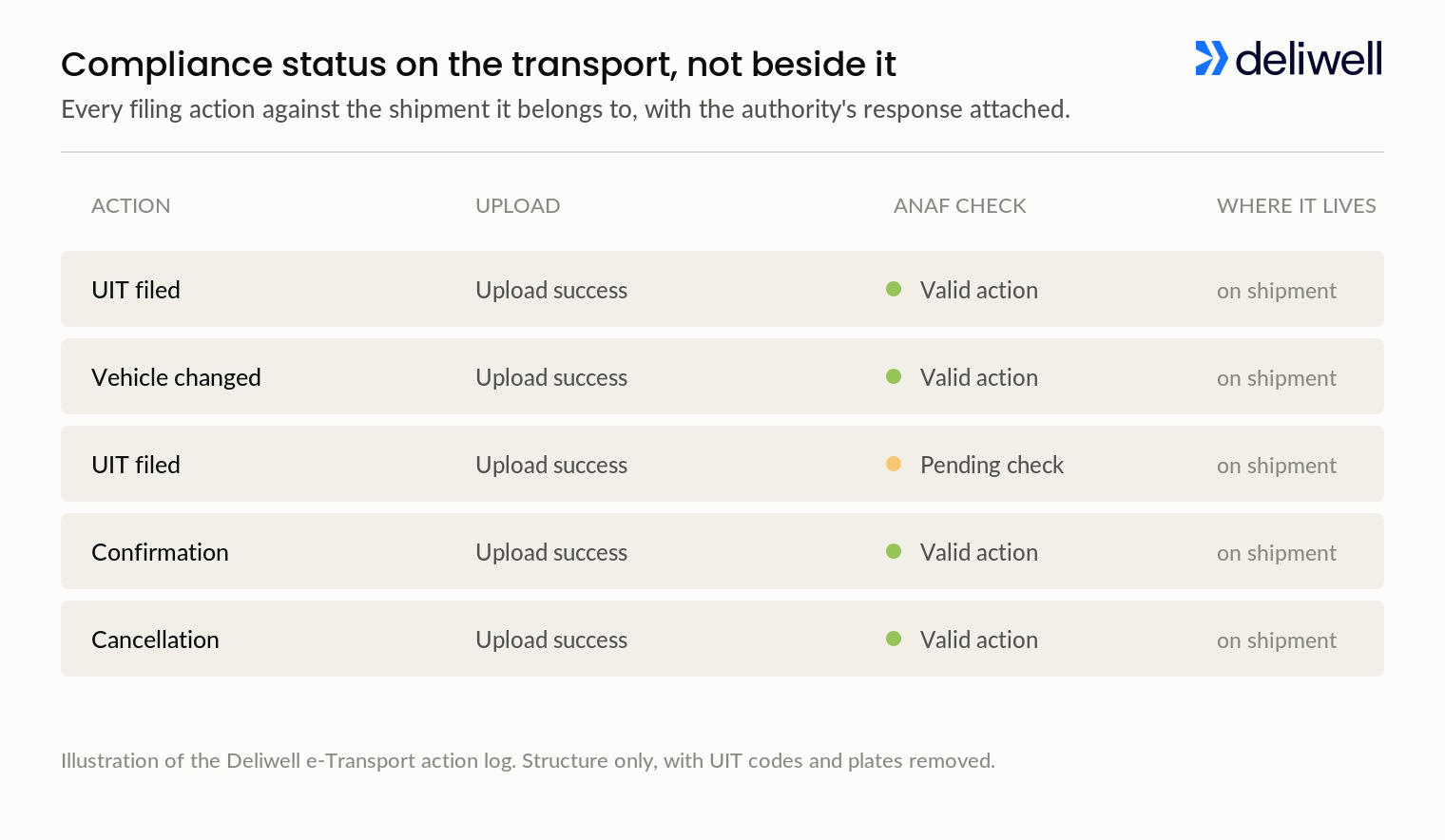
If you move goods in or through Romania, the UIT declaration is part of the transport, so it belongs on the transport record.
Deliwell files directly with ANAF through an API integration, generating the UIT from the transport order data already entered and showing the filing and validation status on the shipment itself. Nobody logs into a separate portal, and there is no second record to reconcile.
Measure the Gap Before You Close It
Time how long it takes to answer a status question today. Count how many invoices are waiting on a missing document. You will want the baseline later, and the numbers are usually worse than anyone expects.
Want to see what one transport record looks like against your own operation? Deliwell runs a 3-week proof of concept on one route cluster, carrier group or business unit, measuring time saved per transport, document completeness and cost delta against your current baseline. Book a demo
What Deliwell Shows You, and What It Does Not
Being specific about scope is more useful than claiming coverage, so here is both halves.
What it shows. Transport status across inbound and outbound in one view. The assigned vehicle and driver on each shipment. Documents including a signed e-CMR. UIT filing and validation status from the direct ANAF integration. Cost per transport, and KPI dashboards with cost broken down by site. Predictive ETA and anomaly detection on shipments, plus status-triggered notifications so the people who need to know are told rather than having to look.
What it does not. Multi-tier supplier mapping. Inventory levels across warehouses. Ocean and air container tracking, since Deliwell handles air and sea on an all-in costing basis as the road leg and last mile of intermodal flows. And continuous vehicle telemetry: driver GPS is scoped to the active shipment rather than running as ongoing monitoring, which is a deliberate design choice around driver privacy rather than a missing feature.
Deliwell is also the wrong purchase under 50 shipments a month, where the savings do not cover the subscription. The same applies with five or more GPS providers in your carrier base, where integration work grows faster than the value it returns, for complex air and sea costing, and for specialized freight. Special transport, meaning heavy, oversized and hazmat, is an add-on module rather than part of the core platform.
Deliwell works with 100+ mid-market shippers, including Stihl, Sonepar and Frigoglass.
When You Do Need a Visibility Platform
Sometimes the answer is a dedicated visibility product, and it is worth being clear about when.
If you need to map suppliers several tiers deep for risk or due-diligence reporting, that is a supplier intelligence problem and no TMS will do it.
If you run a global network with ocean and air freight across dozens of carriers and need one operating picture across all of it, a visibility platform is the right category. project44, Shippeo and FourKites are built for exactly that, with the carrier integration breadth and the multimodal coverage the job requires.
There is also a common middle case worth naming. A group headquarters mandates a visibility platform across all entities, and a local subsidiary still runs its own road freight on spreadsheets underneath it. Those are not competing purchases. Deliwell integrates with project44, so the group gets its reporting layer while the local entity gets a system to actually run the operation in. If your situation looks like that, you are solving two problems and you need two answers.
How to Tell Whether Visibility Improved
Feelings are not a measure. Five numbers that are:
- Time to answer a status question. From "where is it" to a confident answer, measured in minutes.
- Share of transports with complete documents at the point of invoicing. The best single predictor of finance friction.
- On-time delivery, measured against the promised window rather than the planned one.
- Invoice disputes per month, and how long each takes to close.
- Hours per week spent chasing status. Ask a dispatcher to keep a tally for one week.
Across Deliwell's customer base the typical shifts are 30 to 50% less manual work in planning and validation, and 50 to 70% less time spent on finance reconciliation. Use your own baseline rather than those figures, because the starting point varies enormously between operations that look similar on paper.
FAQ
What does visibility mean in supply chain?
Visibility means being able to see where goods, orders and documents are across the chain, and being able to act on it. In practice the word covers four separate problems: supplier and multi-tier mapping, inventory across locations, transport and shipment status, and whether departments inside your own company see the same information.
How do you improve supply chain visibility?
Start by identifying which of the four types you are missing. For transport visibility, put every transport in a single record, give carriers a zero-friction way to update status, attach documents to the shipment rather than to emails, and give purchasing and finance their own view of the same data. Measure your baseline first so you can tell whether it worked.
What does supply chain visibility require?
Three things: a single place where transport data lives, a way for external parties like carriers to contribute status without friction, and role-based access so each department sees what it needs. Technology alone is not enough. If carriers have no easy way to report status, no platform will show you where the truck is.
What is the difference between supply chain visibility and transparency?
Visibility is operational and internal. It means you can see where things are and act on it. Supply chain transparency is about disclosure, usually to customers, regulators or investors, covering where products come from and under what labour and environmental conditions. Visibility supports transparency, and the two are often driven by different departments with different deadlines.
Is real-time supply chain visibility actually real time?
Rarely in the strict sense. Most transport visibility relies on carrier-reported status updates, driver app confirmations, or GPS pings at intervals of fifteen to thirty minutes. Continuous telemetry requires the carrier to share a live feed, which many smaller hauliers will not do. Ask any vendor what the update interval is and where the data originates.
Do mid-market shippers need supply chain visibility software?
Often what they need is a transport management system rather than a visibility product. If the underlying problem is that transports live in spreadsheets and status lives in email, a tracking layer on top of that will not fix it. If the problem is genuinely multimodal coverage across a global network, a visibility platform is the right purchase.
Case studies


Sonepar Romania centralises transport reporting and cost control with Deliwell



Inteva gains full transport visibility and eliminates manual work with Deliwell



Hamilton Central Europe reduced transports costs by 15% by replacing their old TMS with Deliwell
