
TMS Implementation: Why Some Shippers Go Live in Days and Others Take Months
Published timelines run from two weeks to eighteen months. The platform rarely decides where you land — your data, your carriers, your ERP and your team's hours do.


Bring structure, visibility, and compliance to your transport operations


Summary
Every published TMS implementation timeline comes from a vendor describing its own typical project. This guide breaks down the four factors that actually set the clock: data readiness, carrier onboarding, ERP integration and internal availability. It shows which of them sit on your side of the table, and the compliance work EU shippers need to scope that most guides skip.
Ask three TMS providers how long implementation takes and you get three answers that do not overlap. One says two to six weeks. One says twelve to fourteen. One says nine to eighteen months for anything complex.
All three are describing real projects. They are describing different projects.
The platform you pick is rarely the variable that moves a TMS implementation from weeks to quarters. Four other things do that, and three of them sit on your side of the table rather than the vendor's. Working out which four, and who owns each, tells you more about your own timeline than any vendor's average will.
Key Takeaways
- Published transportation management system implementation timelines run from two weeks to more than eighteen months. Every figure in circulation comes from a company that sells or delivers a TMS, quoting the deployments it does most often.
- Four things set the clock: data readiness, carrier onboarding, ERP integration and how many hours a week your team can give the project.
- Internal IT availability is one of the most reliable predictors of duration.
- Most overruns come from work on the buyer's side of the table, in decisions and data a vendor cannot make or clean for you.
- European shippers carry a compliance workstream that North American implementation guides do not scope at all.
How Long Does TMS Implementation Take?
Published TMS implementation timelines run from two weeks to more than eighteen months. Where you land depends on scope and internal readiness far more than on which platform you buy.
Here is what the providers themselves publish. Read the source column as carefully as the range.
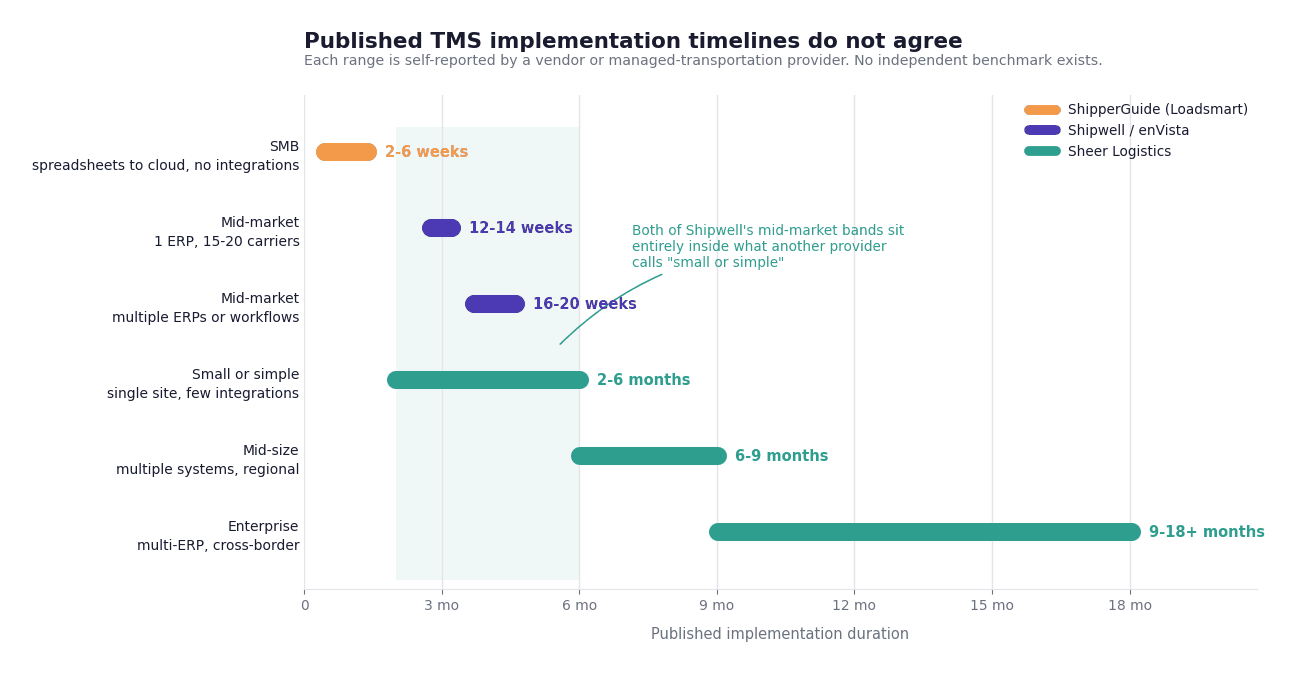
Published TMS implementation timeline ranges, plotted on one axis. Both of Shipwell's mid-market bands sit entirely inside what Sheer Logistics calls "small or simple".
Look at what happens when you line those up. One provider's ceiling of six weeks sits under half of another's floor of twelve weeks. Both of them fall inside a third provider's band for "small and simple". The ranges cannot all be describing the same market.
No independent benchmark for TMS implementation duration surfaced anywhere in this research. Every number above traces back to a vendor or a managed-transportation provider. That is worth knowing before you put any of them in a business case.
Why Published TMS Implementation Timelines Disagree
Published timelines disagree because each one describes the deployments that particular company does most often, and those books of business look nothing alike.
A vendor selling to small shippers moving off spreadsheets sees projects with no integrations and one site. Six weeks is honest for that work. A provider running enterprise programmes across multiple ERPs and several countries sees eighteen months, and that is honest too. Neither figure travels.
The second problem is that "typical" hides its own assumptions. A twelve-week quote usually assumes one ERP, a standard workflow and a carrier base in the mid-teens. Change any of those three and the number moves, but the number is what gets published and the assumptions are what get left out.
The third problem runs underneath both. None of these figures separate the work the vendor does from the work you do. A vendor can only commit to its own half. Deliwell publishes its own go-live figures too, and the same caveat applies to them.
What Sets Your TMS Implementation Timeline
Four things set a TMS implementation timeline: how clean your data is, how many carriers you need to onboard, whether you integrate an ERP, and how many hours a week your team can give the project.
Data Readiness
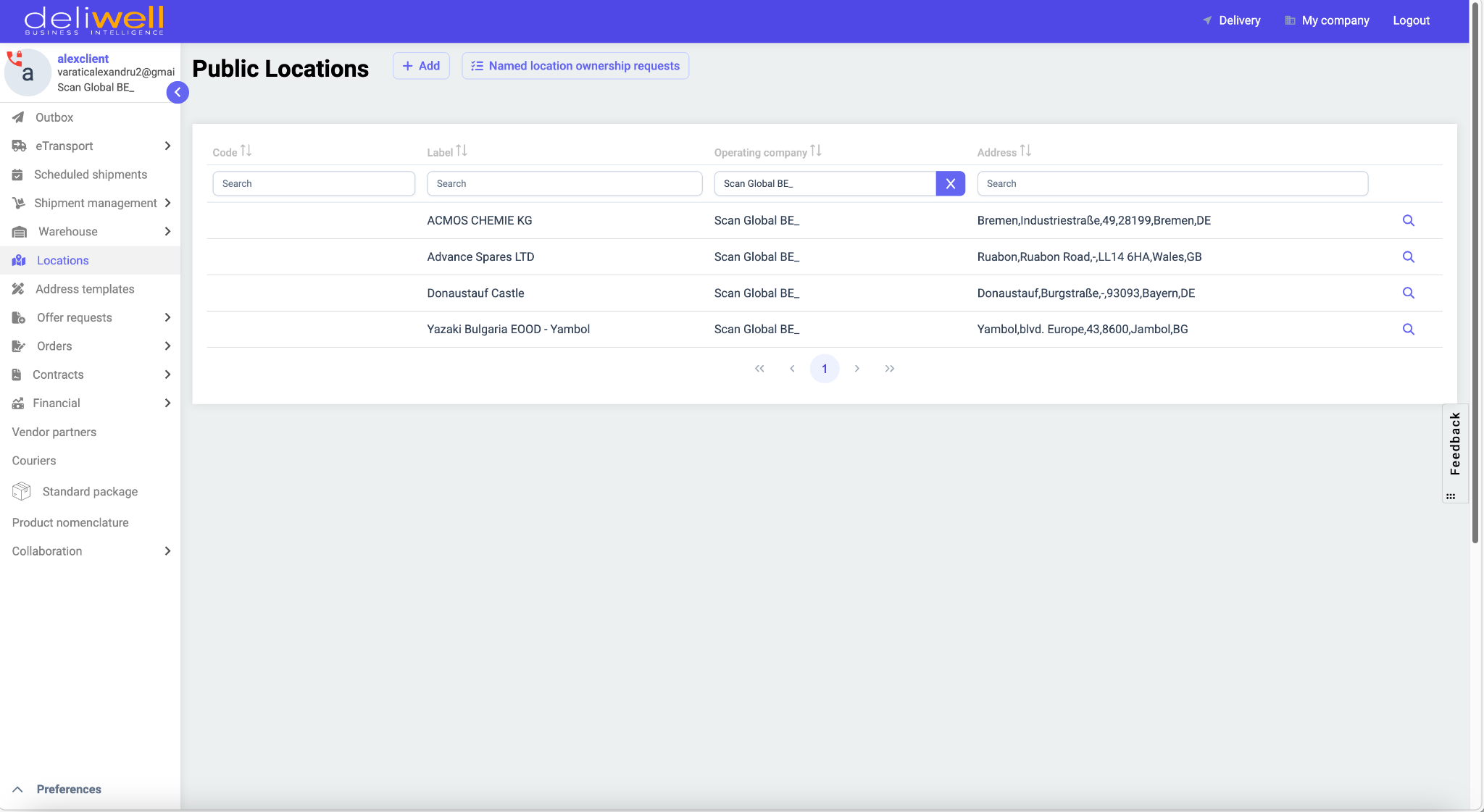
What clean location master data looks like once it lands: one record per site, with a code, an operating company and a complete address. Getting from three competing address records to this is the work that happens before kickoff.
Carrier rate files arrive in inconsistent formats. Ship-from and ship-to locations are incomplete or duplicated. Lane data has no recent shipment history attached to it. Both Shipwell and ShipperGuide name data readiness among their top delay causes.
The reason it hurts is a matter of sequence. Bad master data does not slow configuration down, because configuration proceeds on assumptions. It slows testing down, because the errors only surface once real shipments run through the system, and by then you are already in the phase that was supposed to prove everything worked.
Carrier Onboarding

The carrier base as structured records rather than a contact list: fiscal ID, country, payment terms and tags against each partner. This is the list an onboarding workstream has to get through, and its length predicts your timeline better than the platform you chose.
Only two of the eight pages currently ranking for this term treat carrier onboarding as a workstream at all. One of them mentions carriers once, as a data set to clean. That is a strange blind spot, because onboarding is where a lot of the calendar goes.
Carriers do not arrive at the same technical level. Shipwell splits them three ways, and the split is useful: large carriers connected by EDI, mid-tier carriers uploading files manually, and regional carriers working from email or a mobile app. Each tier needs a different path, and the slowest tier sets the pace for the whole group.
The question to settle before you sign anything is whose job the onboarding is. Some contracts put it on the vendor. Some leave it with you, which means chasing thirty hauliers for rate cards while also running daily dispatch.
ERP Integration
ERP integration is the largest single multiplier on the list. Sheer Logistics calls multiple ERPs "a major multiplier", and the effort curve backs that up.
Shipwell publishes an IT commitment of two to four hours per week during the first four weeks, rising to four to six hours per week once the build phase starts in weeks five to nine. Those are modest numbers on paper. They are less modest when the same developers own every other integration in the business.
There is a sequencing choice here that most guides skip. Integration does not have to happen before go-live. A platform that runs standalone can go live on manual or file-based order entry and take the ERP connector afterwards, which moves the largest multiplier out of the critical path.
Internal Availability
Sheer Logistics puts it more bluntly than anyone else on the topic: "internal IT availability is one of the most accurate predictors of timeline".
The operations side carries a load too. Shipwell reports customers allocating six to eight hours per week for the first four to six weeks. That is most of a working day, every week, from people who already have jobs.
A project that lands on top of quarter-end close or peak season does not run slightly slower. It stalls, because the people who have to make decisions are unavailable, and the vendor cannot proceed without those decisions.
Which Parts You Own, and Which Parts the Vendor Owns
Most TMS implementation delays sit on the customer's side of the table, in decisions and data a vendor cannot make or clean on your behalf. No implementation guide currently ranking for this term draws that line, so here it is.
When a vendor quotes twelve weeks, that quote assumes you hit your side of the table on schedule. Sheer Logistics reports overruns running 25 to 30% beyond the original vendor quote, driven by underestimated integration cost, unaccounted internal resource time and scope discovered mid-project. Two of those three are customer-side.
Which gives you a useful test for any implementation proposal. Ask the vendor to mark up its own project plan showing which lines it owns and which lines you own. A vendor that cannot produce that split has not thought about your timeline carefully enough to be quoting one.
What EU Shippers Have to Scope That Most Guides Skip
European shippers carry a compliance workstream in a TMS implementation that most published guides do not cover.
The gap is measurable. Of the eight pages currently ranking for this term, none mention EU or CEE regulatory work as implementation scope. Two of them are European vendors publishing the same page in seven languages, including Polish, with no regulatory content in any of them. The only regulatory sentence anywhere on the SERP is a single unelaborated clause, and its "cross-border" means the United States to Mexico.
Three items belong in a European scoping conversation. Each is configuration work with a duration attached, rather than a legal question to hand to counsel.
RO e-Transport. A UIT code has to be obtained before goods move, under OUG 41/2022 as supplemented on 15 December 2023 and administered by ANAF. The implementation work is partner master data, declaration mapping, and deciding whether filing runs inside the TMS or beside it in a separate portal.
e-CMR. Digital consignment notes under the UNECE protocol. The work is the signature flow across sender, carrier and recipient, plus capture on the driver's side. Several platforms generate a CMR document without capturing a legally authenticated signature, which is a scoping question worth asking directly rather than a defect.
e-FTI. Regulation (EU) 2020/1056 has applied in partial form since 21 August 2024, with full application on 9 July 2027. From that date, Member State authorities must accept regulatory information submitted through certified eFTI platforms. Note the direction of the obligation: the regulation requires authorities to accept electronic submission and gives businesses the option to use it. Check your own position with the regulation text and your advisers.
The practical consequence is the part that affects your timeline. A platform that treats these as configuration adds days to the project. A platform that treats them as custom development adds a phase.
The TMS Implementation Process, Phase by Phase
A TMS implementation runs through six phases, and several of them overlap rather than running end to end.
- Goals and requirements. Document current workflows and decide what the system has to do differently. Vendors are unanimous that skipping this is the expensive mistake.
- Team and sponsor. Cross-functional, with someone senior enough to unblock decisions. Assign tasks to named people rather than to departments.
- Configuration and integration. Platform setup, business rules, and connectors to ERP, WMS and carriers.
- Testing and UAT. Run the awkward cases, not the clean ones. Multi-stop, returns, restricted delivery windows.
- Training. Role-specific, split between key users who go deep and end users who need their own screens.
- Go-live and post-launch support. Cutover, then a support period while volume ramps.
Reading that as a straight line is where projects go wrong. Data cleansing runs alongside configuration. Carrier onboarding starts before testing and finishes after it. Training overlaps user acceptance testing. The critical path usually runs through the ERP connector and the slowest tier of carriers, which means those two deserve attention long before the phase they nominally belong to.
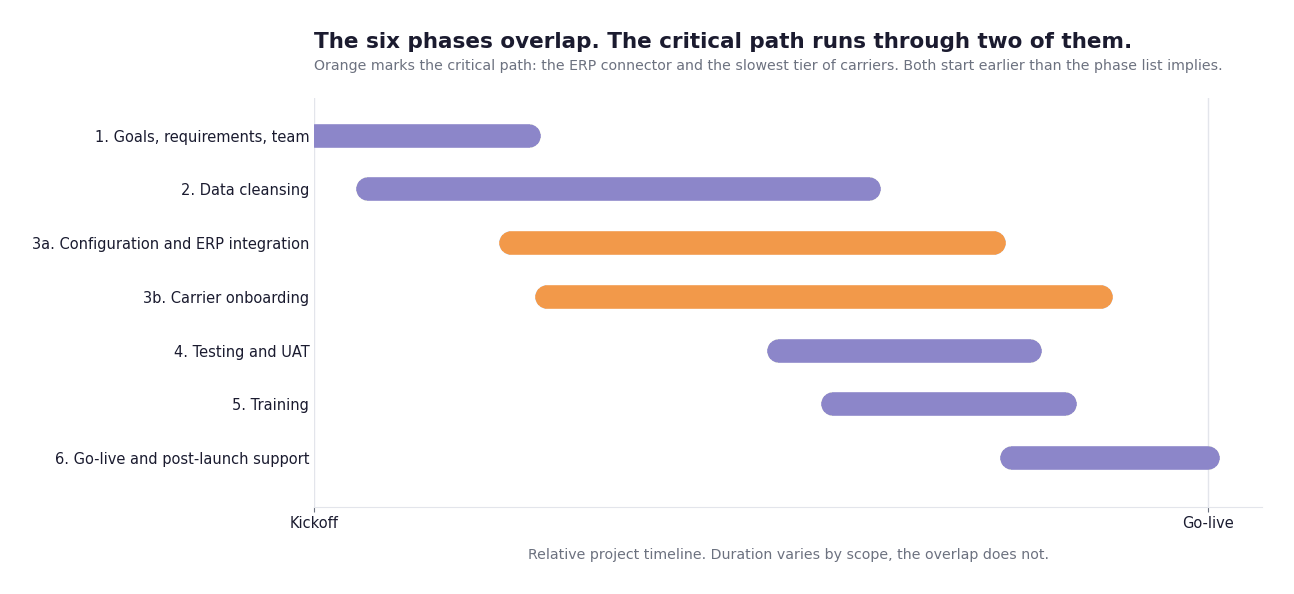
The same six phases drawn as they actually run. Configuration and carrier onboarding are marked as the critical path, and both begin well before the phase list suggests.
Two mechanics are worth insisting on, and only two of the eight ranking pages cover either. Parallel running means booking real shipments in the new system while existing processes stay live as a fallback. Explicit go-live criteria means writing down what "ready" means before you get there: rates match expectations, tendering flows without errors, and core workflows hold up under a normal day's volume.
How to Shorten a TMS Implementation
The fastest way to shorten a TMS implementation is to clean master data before kickoff, decide business rules early, and sequence ERP integration after go-live rather than before it.
Six things that move the date, in rough order of leverage:
- Clean carrier, rate and location master data before kickoff. This is the one piece of work you can start today without a vendor, a contract or a budget line.
- Get business-rule decisions made before configuration starts. Routing logic, approval thresholds and tolerance settings need a decision from someone with authority. Collect them in advance.
- Name one decision-maker. A committee produces a slower project than a single accountable person with a mandate, every time.
- Ask in writing who onboards the carriers. Then ask how the vendor handles a haulier with no IT capability at all.
- Start with one route cluster or one business unit. A narrow first scope reaches go-live faster and produces the evidence you need for the wider rollout.
- Run parallel before cutting over. It costs a few weeks of duplicated effort and removes most of the risk of a hard cutover.
How Deliwell Handles TMS Implementation
Deliwell is a road-freight TMS for mid-market European shippers running 50 to 500 transports a month. It covers the full lifecycle, from planning and allocation through dispatch and tracking to documents, compliance, invoice validation and KPIs.
Two of the four timeline drivers above are handled differently, which is the reason implementation runs shorter.
Carrier onboarding is Deliwell's job. Carriers receive jobs and submit proof of delivery through a token, with no sign-up and nothing to install. A regional haulier with no IT capability joins by opening an email, so the slowest carrier tier stops setting the pace of the project.
ERP integration is optional. The platform runs fully standalone, with validated connectors to SAP, Oracle, Microsoft Dynamics and Navision available through REST API, EDI or flat-file import when you want them. Integration becomes a phase-two decision instead of a go-live blocker, which takes the largest multiplier off the critical path.
Compliance is configuration. e-Transport filing runs through a direct ANAF API integration, with the UIT generated from transport order data already in the system. e-CMR is generated, signed by all three parties and archived in-platform, included in the standard subscription. When ANAF changes the rules, the update arrives with the subscription rather than as a project.

Compliance as a configured screen rather than a development phase. Declarations carry their UIT code, operation type and validity window, and go to ANAF from the same list. That is the difference between adding days to an implementation and adding a workstream.
The other two drivers stay yours. Deliwell cannot clean your carrier master data or free up your team's calendar, and no vendor can. What it does is assign a dedicated project manager from day one through go-live, so the customer-side work has someone chasing it.
On timing, the first transport request can go out under 30 minutes after account creation. A standard setup goes live in days, including carrier onboarding and team training. With ERP integration, expect about a month, covering integration scoping, configuration and a parallel run. The sequence starts with a baseline audit in the first three days, then configuration, then a parallel run alongside your existing tools, then go-live and handover.
Deliwell also runs a structured three-week proof of concept on a defined scope, measuring time saved per transport, compliance rate, document error rate and cost delta against your current baseline.
Where Deliwell is the wrong fit: under 50 shipments a month, where the savings do not cover the subscription. Five or more GPS providers, where integration work grows faster than the value it returns. Complex air and sea costing, which Deliwell handles on an all-in basis only. Specialized freight, with heavy, oversized and hazmat handled through an add-on module rather than the core platform.
Deliwell works with 30+ mid-market shippers, including Stihl, Sonepar and Frigoglass. Hosting is EU-region only, with a DPA in every contract, and Deliwell is on the ISO 27001 path with a security documentation pack available on request.
Deliwell runs a 3-week proof of concept on one route cluster, carrier group or business unit, measuring time saved per transport, compliance rate and cost delta against your current baseline. Book a demo
FAQ
How long does a TMS implementation take?
Published ranges run from two to six weeks for a small shipper moving off spreadsheets with no integrations, to nine to eighteen months or more for enterprise programmes spanning multiple ERPs and countries. Mid-market projects with one ERP integration are commonly quoted at twelve to fourteen weeks. Every one of those figures comes from a vendor or provider describing its own typical deployments, so treat them as directional.
What is the biggest cause of TMS implementation delays?
Data readiness and internal availability. Incomplete carrier rate files and duplicated location records surface as errors during testing rather than during configuration, which pushes delays into the phase meant to prove the system works. Sheer Logistics describes internal IT availability as one of the most accurate predictors of timeline.
How much does TMS implementation cost?
Sheer Logistics publishes basic cloud deployments at $15,000 to $40,000, implementation and onboarding fees at $10,000 to $75,000, and complex ERP integrations at over $50,000 each. Those are one provider's unsourced USD estimates, and the same page quotes enterprise rollouts inconsistently at both "over $500,000" and "$150,000 to $500,000+". Get your own quote and ask which of the five cost buckets it covers.
Do I need to integrate my ERP before going live?
No. A TMS that runs standalone can go live on manual or file-based order entry, with the ERP connector following afterwards. Since ERP integration is the largest single multiplier on most implementation timelines, deferring it is one of the few decisions that shortens a project without cutting scope.
Who onboards the carriers during a TMS implementation?
It varies by contract, and the answer changes your timeline substantially. Some vendors run onboarding as part of implementation. Others leave you chasing rate cards from thirty hauliers while running daily dispatch. Ask in writing, and ask specifically how the vendor handles a carrier with no IT capability.
What does a TMS implementation involve for EU shippers specifically?
Beyond the standard phases, European shippers scope digital transport documents and national filing obligations. For Romanian entities that means e-Transport UIT declarations through ANAF. Across the EU it means e-CMR signature flows and preparing for Regulation (EU) 2020/1056, which reaches full application on 9 July 2027, when Member State authorities must accept regulatory information through certified eFTI platforms.
Case studies


Sonepar Romania centralises transport reporting and cost control with Deliwell



Inteva gains full transport visibility and eliminates manual work with Deliwell



Hamilton Central Europe reduced transports costs by 15% by replacing their old TMS with Deliwell
