
TMS Pricing: What Mid-Market Shippers Pay and Which Meter They Pay It On
Only two of eight European TMS vendors publish a price. Here's what mid-market shippers actually pay, and why the billing meter decides more of your bill than the headline rate.

Bring structure, visibility, and compliance to your transport operations


Summary
Published TMS pricing ranges from $69 per user to $7,925 a month, and most vendors publish nothing at all. We run one 300-transport operation through the most common billing models, show why the seat cap can cost more than the shipment cap, and list the questions that turn a vague quote into a comparable one.
A shipper moving 300 road transports a month can find a transportation management system at $69 per user and another at $7,925 a month. Neither figure tells them what they would pay.
The reason is the meter. One vendor charges per seat and gives you unlimited shipments. Another charges per load and gives you unlimited seats. A third caps both, plus your carrier records and your EDI connections. Run the same operation through those three models and the annual cost moves by a factor of five.
Most TMS pricing conversations start with the number. The meter decides more of your bill than the number does, and it is the part vendors explain least.
Key Takeaways
- Published TMS pricing runs from $69 per user per month to $7,925 per month for a mid-tier plan with hard capacity caps.
- Of eight TMS vendors a European mid-market shipper would realistically evaluate, two publish a price. The rest quote.
- Six billing models are in use across the category: per user, per load, tiered with capped volume, platform fee plus seats, per integration, and percentage of identified savings.
- On one illustrative mid-market operation, published list prices produce annual costs ranging from roughly $9,900 to $55,000. The binding constraint is often the seat cap rather than the shipment cap.
- Most published TMS pricing comes from US freight broker tools. No vendor on the first page of results for this term publishes a figure in euros.
What TMS Software Costs: Published Prices
Published TMS pricing runs from $69 per user per month to $7,925 per month, and most vendors publish no figure at all.
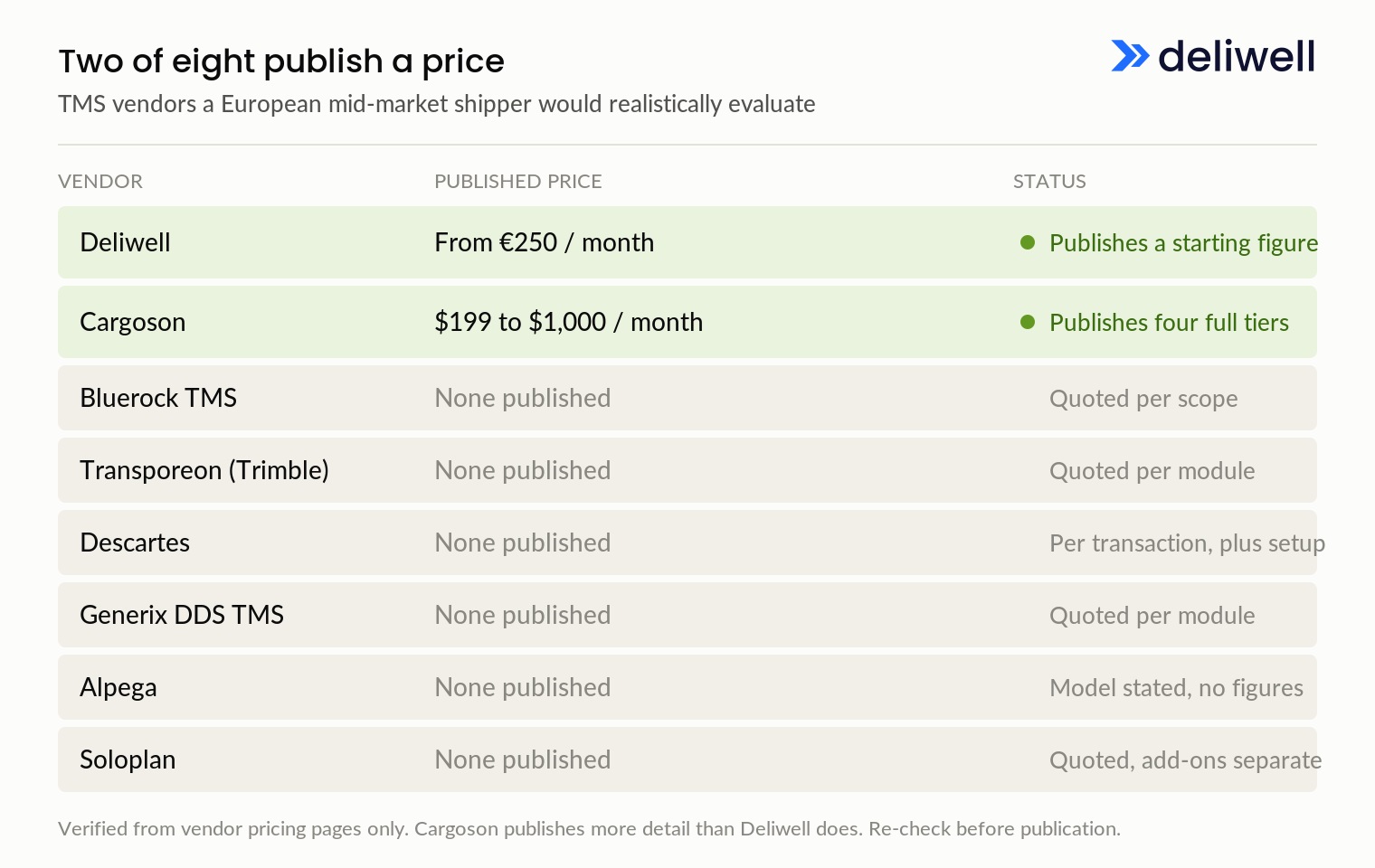
Here is what is on vendor pricing pages today. Everything below comes from the vendor's own site. Third-party estimates are handled separately later.
European TMS vendors a mid-market shipper would evaluate
Two things about that second table deserve flagging.
The Alvys figure appears only in the page's meta description, which is what shows in search results. The rendered pricing page itself carries no number anywhere in its body.
And every one of those four products is built primarily for freight brokers or carriers rather than for shippers buying road capacity. The published end of this market is not the shipper end of it.
One more caveat before anyone builds a comparison. Mixing a USD per-seat price against a EUR starting figure is not a like-for-like comparison, and exchange rate movement alone will shift a multi-year total.
Why TMS Pricing Is So Hard to Compare
TMS pricing is hard to compare because most vendors quote rather than publish, and the ones who publish are metering different things.
Quote-gating is the category norm. Six of the eight European vendors above give no figure at any point, and a buyer cannot place themselves in a budget band without entering a sales process first.
The vendors who do publish are not comparable to each other. A per-seat price and a per-load price describe different businesses. Putting them in the same spreadsheet produces a number that means nothing until you model your own volume and headcount against both.
Then there is the number that decides everything and gets withheld anyway. Tai publishes four monthly prices and attaches a monthly shipment allowance to each one. It describes overage as "Competitive Overage Pricing" and does not publish the rate. The single figure that determines what a busy quarter costs is the one missing from an otherwise transparent page.
The pattern shows up in the search results too. The page ranking second for this term is titled "TMS Software Pricing" and contains no price in its body. A 1,700-word guide ranking sixth, titled "A Comprehensive Guide to TMS Pricing", contains no dollar figure at all.
Deliwell sits partly inside this pattern and it is worth saying so. Deliwell publishes a starting figure of €250 a month and then quotes a proposal, so a buyer still needs a conversation to get their number. Cargoson publishes more pricing detail than Deliwell does, with four full tiers and the shipment and user caps attached to each. On published transparency alone, Cargoson is ahead.
The Six TMS Pricing Models
TMS pricing runs on six billing models, and which one a vendor uses changes your cost more than its headline rate does.
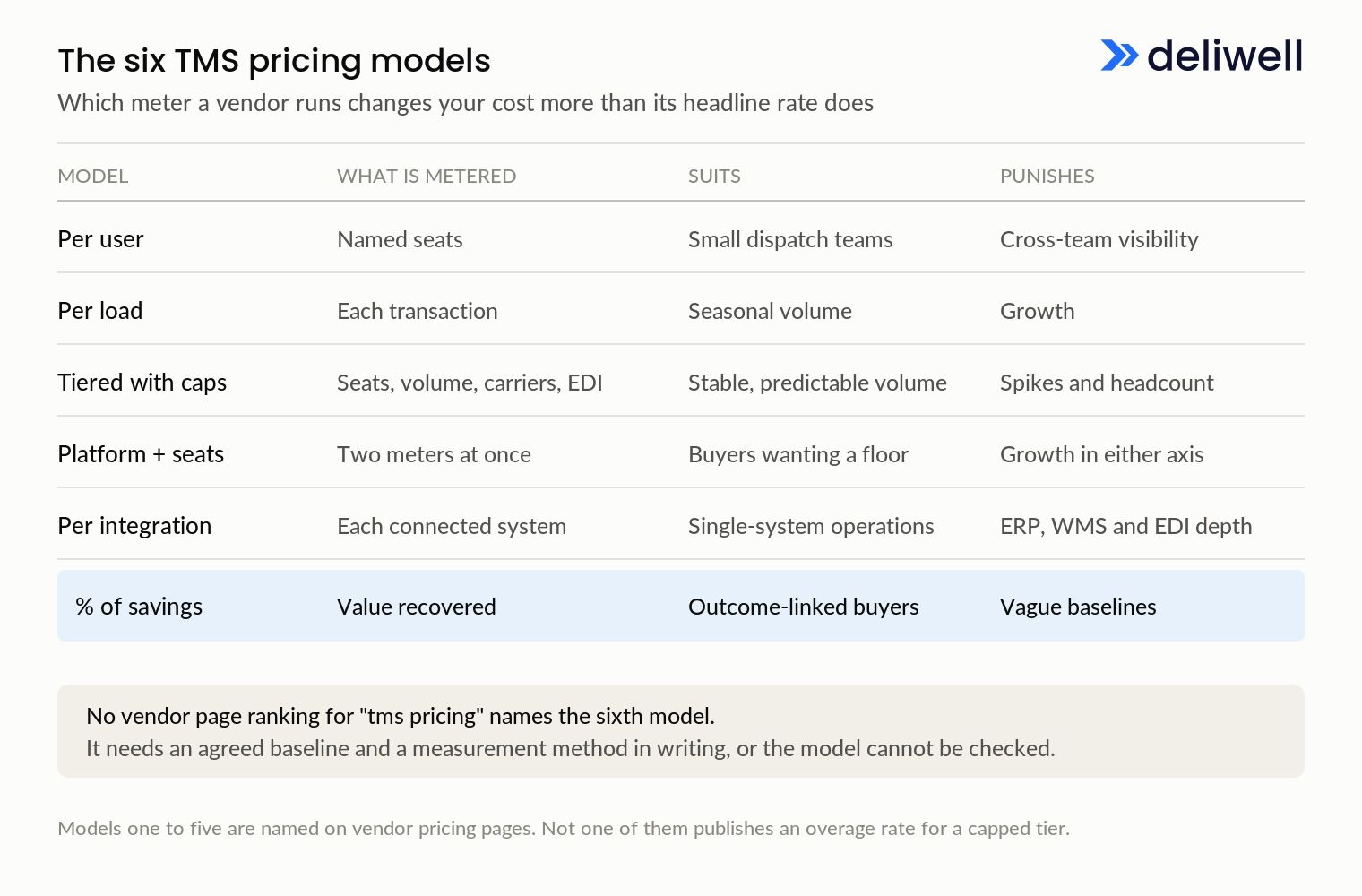
Per User
A flat price per named seat, often with unlimited transaction volume. AscendTMS is the clearest example at $69, $119 or $149 per user per month with no charge for loads, trucks or drivers.
This model suits a small dispatch team with high volume. It punishes exactly the thing that makes a TMS valuable in a mid-market business, which is giving finance, purchasing and the warehouse their own view of transport. Every department you bring onto the same data adds seats, so a per-seat meter puts a price on cross-department visibility.
Per Load or Per Shipment
A usage rate applied to each transaction. Alvys publishes $3.95 per load with unlimited users.
This suits seasonal or unpredictable volume, because the bill falls when shipping falls. It punishes growth, since the meter runs faster as the business gets bigger. Ask what counts as a load. A multi-drop route, a return leg and a cancelled booking may each be billable or not, and the definition is rarely on the pricing page.
Tiered With Capped Volume
A monthly tier price with hard capacity limits attached. Tai runs the most metered version, capping staff logins, client logins, carrier profiles, EDI connections and monthly shipments on every tier.
This gives predictable budgeting when volume is stable. Two questions decide whether it works. What is the overage rate, and which cap will you hit first? Those are not always the same cap, as the next section shows.
Platform Fee Plus Seats
A base platform charge with per-user pricing on top. Descartes Aljex publishes $350 to $2,000 or more per month on this basis.
Two meters run at once, so growth in either headcount or scope moves the bill. The published range is undivided across its three tiers, which makes it difficult to place yourself before a call.
Per Integration or Per Connection
Each connected system carries its own charge. Several vendors name this model and none publish a rate for it.
This is where a quote grows after signature. An ERP connection, a WMS connection and each EDI trading partner can be separate line items, sometimes with a setup fee and a per-transaction fee on top. AscendTMS discloses that EDI carries "low setup and transaction pricing on a per partner basis" without giving either figure.
Percentage of Identified Savings
Cost tied to the value the system finds rather than to seats or transactions. No vendor page on the first page of results for this term names this model, which is a gap in the category conversation rather than a gap in practice.
It works by agreeing a baseline, measuring what the platform recovers against it, and pricing as a share of that. It suits buyers who want cost linked to outcome. It requires an agreed baseline and a measurement method in writing, because without both the model is unfalsifiable.
The Same Operation, Six Different Bills
Run one operation through different pricing models and the annual cost varies by more than the difference between vendors.
Take a mid-market shipper moving 300 road transports a month. Eight people need daily access, four more need read-only visibility, so twelve users in total. They buy from 25 carriers and run one ERP.
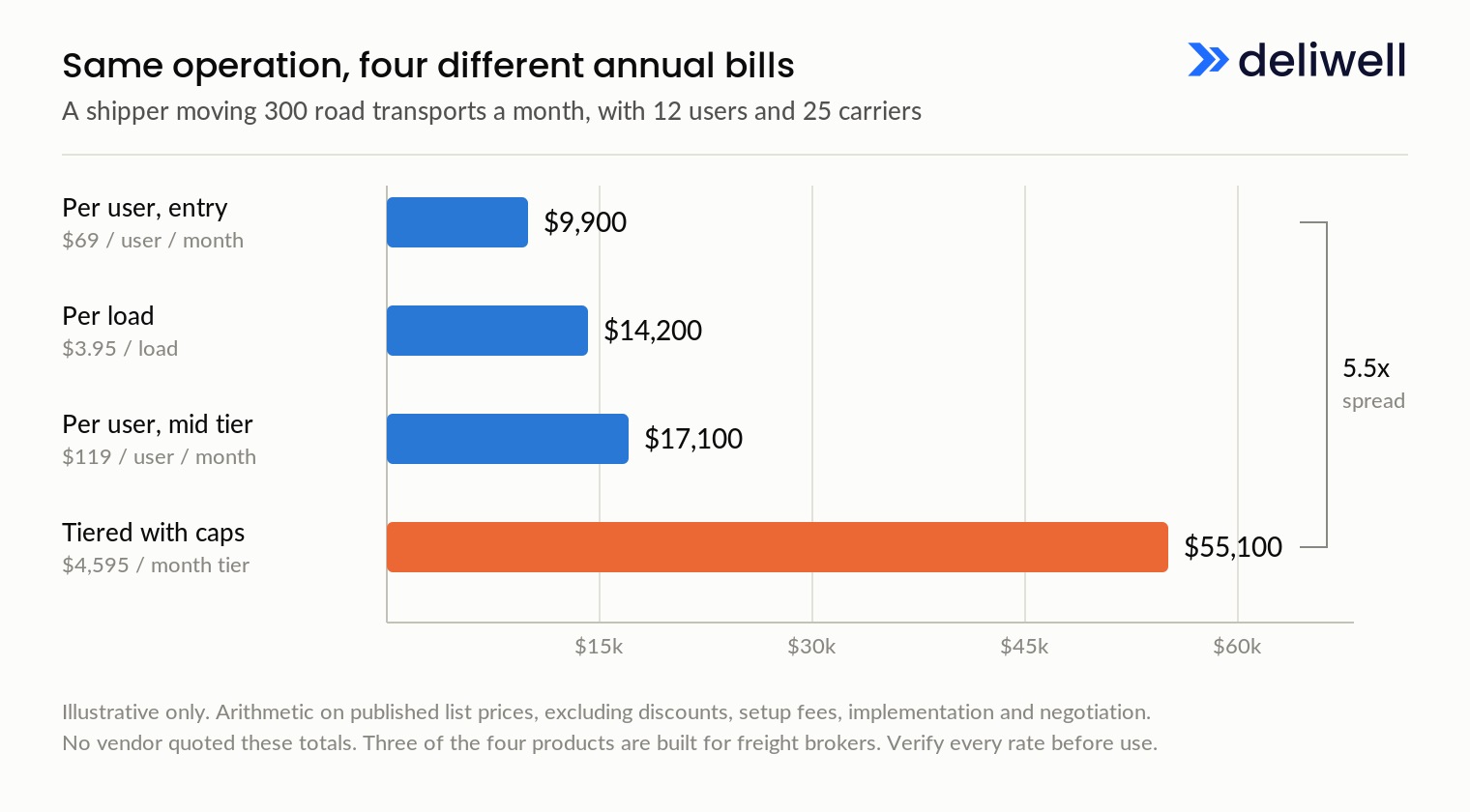
Against published list prices, that operation prices out roughly like this.
The tiered row is the interesting one. At 300 shipments a month, the tier with a 600-shipment allowance would be plenty on volume. Its staff login cap is six, and this operation needs twelve. So the seat cap forces a jump of two tiers and the price moves from $2,465 to $4,595 a month.
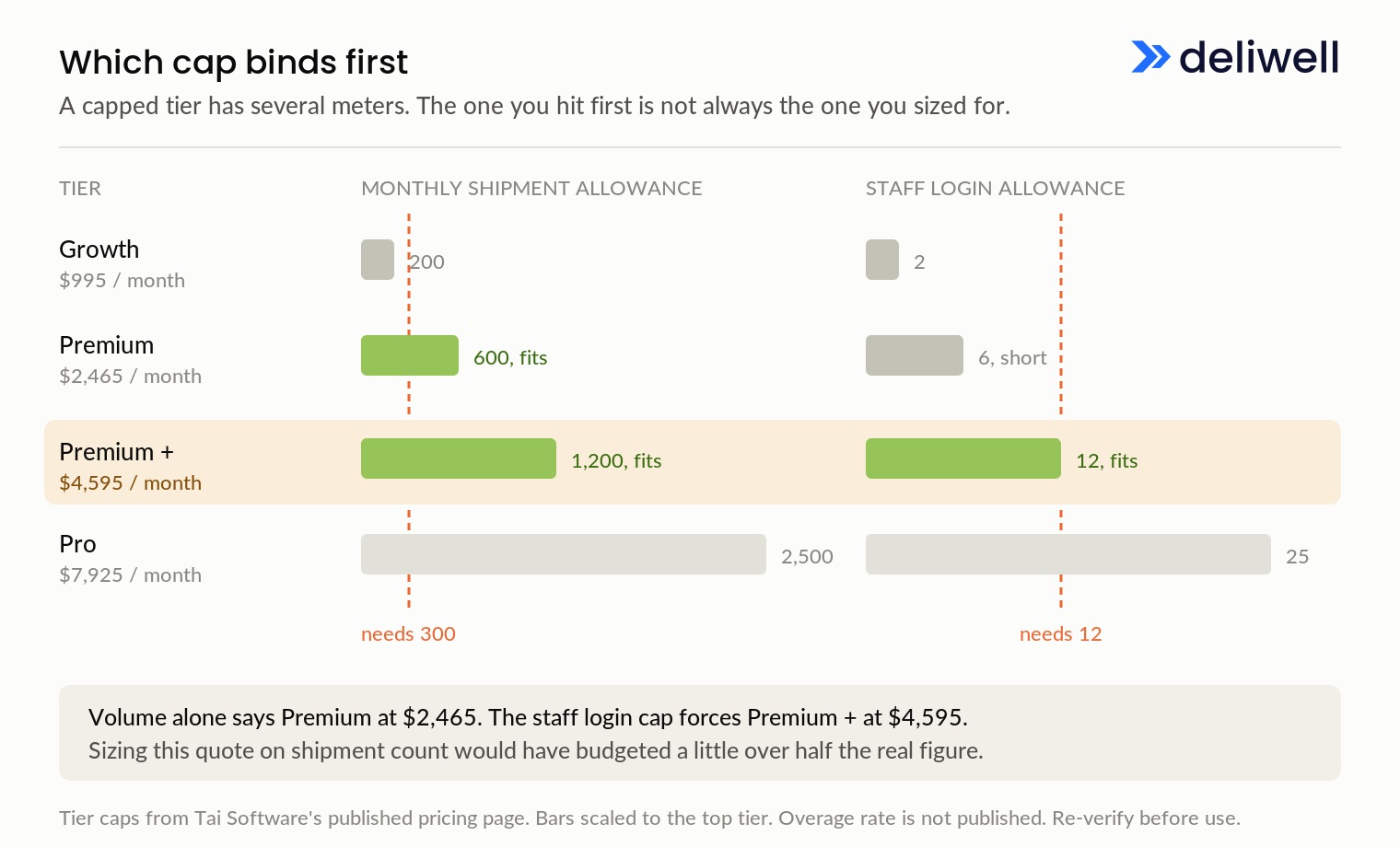
The binding constraint was headcount, not volume. A buyer who sized that quote on shipment count alone would have budgeted less than half of what they would pay.
The savings-based model cannot be placed on this table at all, because its cost depends on the leakage the system identifies rather than on seats or shipments. That is a genuine difference in kind rather than a better number.
Read this as illustration only. Those totals are arithmetic on published list prices. They ignore discounts, annual prepayment, setup fees, implementation, integration charges and negotiation. No vendor quoted any of them. Three of the four products are built for freight brokers, so a shipper's real quote would differ. Re-check every rate before using any of this in a business case.
The point is the spread and the sensitivity. Same operation, roughly five and a half times the cost depending on which meter runs.
What Sits Outside the Subscription
The subscription is one line in a TMS budget, and the lines around it are often larger.
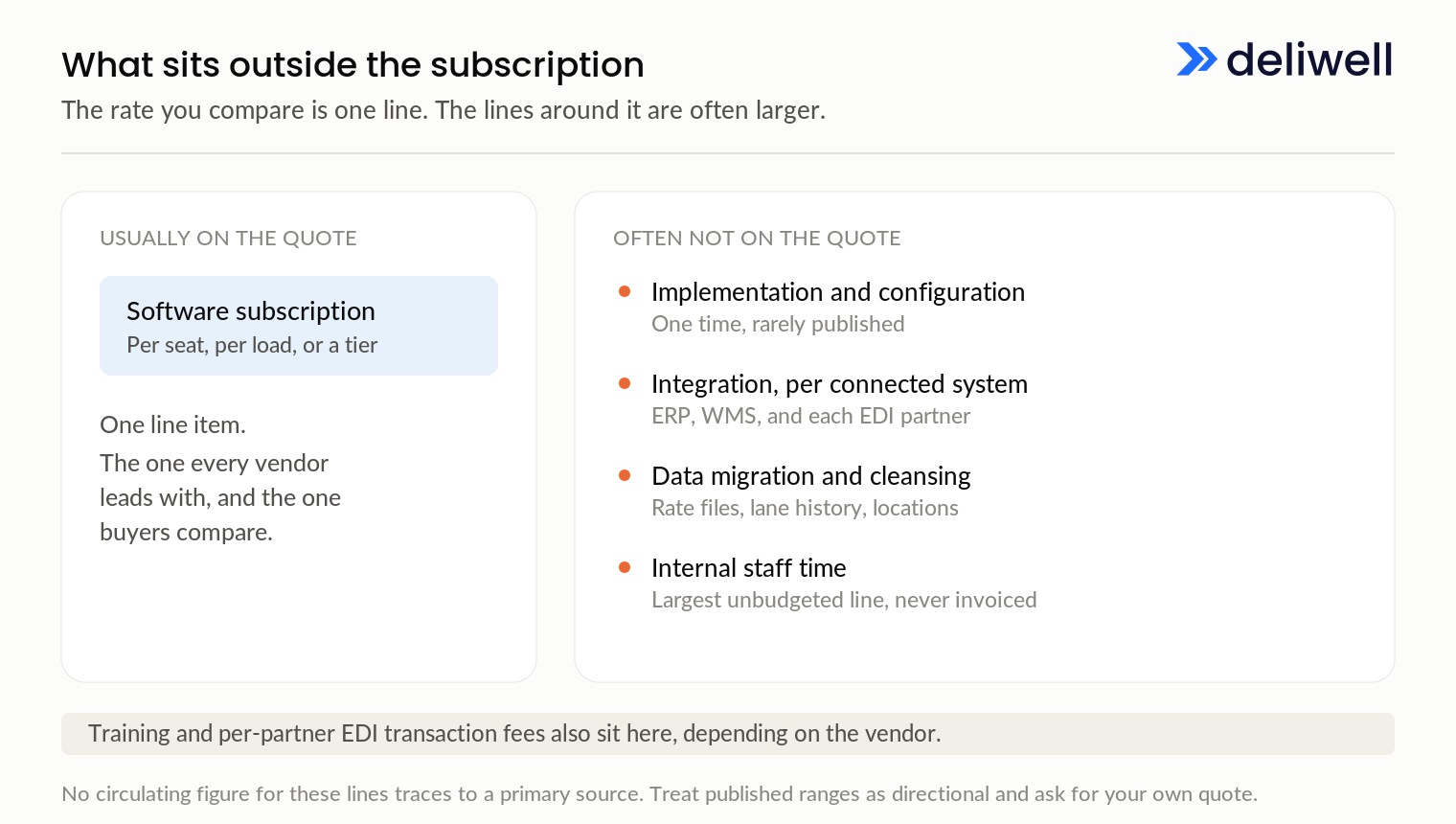
Expect to price these separately:
- One-time implementation and configuration. Almost always a separate fee, and rarely published.
- Integration professional services, per connected system. Circulating category estimates put custom API work, mapping and testing at $5,000 to $25,000 or more per integration. That figure is an unverified third-party estimate published by a non-TMS vendor, so treat it as directional.
- Data migration and cleansing. Carrier rate files, lane history and location records. Usually your own staff time rather than an invoice.
- Training, sometimes included and sometimes tiered by support level.
- Internal staff time. The largest unbudgeted line in most projects, and the one that never appears on a quote.
- Per-partner EDI setup and transaction fees, where the model charges by connection.
On perpetual on-premise licences, annual maintenance is commonly cited at 15 to 20% of the initial licence cost. That figure appears identically on two competitor pages with no primary source behind it, so it is a category convention rather than a verified benchmark.
What EU Shippers Should Price That Most Guides Skip
European shippers carry cost lines in a TMS budget that North American pricing guides do not cover.
None of the six transportation pages ranking for this term mentions the euro, Europe, or any EU regulation. The regulatory cost references that do appear are US fuel tax reporting and US carrier registration.
Three items belong in a European pricing conversation:
e-Transport filing. Romanian entities obtain a UIT code before goods move, under rules ANAF administers. The pricing question is whether the platform files directly or whether you buy a second tool alongside it.
e-CMR. Digital consignment notes under the UNECE protocol. Several platforms generate a CMR document without capturing an authenticated signature, and the two are priced differently. Ask which one you are buying.
e-FTI readiness. Regulation (EU) 2020/1056 has applied in partial form since 21 August 2024 and reaches full application on 9 July 2027, when Member State authorities must accept regulatory information through certified eFTI platforms. The regulation places the obligation on authorities to accept and gives businesses the option to use it. Check your own position against the regulation text and your advisers.
For each of the three, the question is the same and it is a pricing question rather than a feature question. Is it in the subscription, or is it a module?
How to Get a Usable TMS Quote
A usable TMS quote names the meter, the caps, the overage rate and every one-time fee before you compare it to anything.
Six things to ask in writing:
- What is the meter, and what happens when I exceed it? Get the overage rate as a number, not as an adjective.
- What counts as a load or a shipment for billing? Multi-drop routes, return legs and cancellations all need a ruling.
- Which modules sit outside the base subscription? Ask specifically about compliance features, carrier portals and reporting.
- What is the one-time implementation fee, and what does it include?
- Is each ERP, WMS or EDI connection priced separately? Ask for the per-connection rate.
- Who onboards the carriers, and is it billable?
Then do the thing almost nobody does. Give every vendor on your shortlist the same scenario, using your real monthly volume, your real user count including read-only access, and your real carrier count. Ask each to quote that. A quote built on your numbers is the only version of TMS pricing that is comparable across vendors.
How Deliwell Prices
Deliwell is a road-freight TMS for mid-market European shippers running 50 to +5000 transports a month. Pricing starts from a published figure and is scoped against the savings the platform identifies.
Starting at €250/month. Contact Deliwell for a custom pricing proposal tailored to your needs.
Your proposal is built around your operation (volume, modules and integrations) and agreed before you sign. The conversation starts from how your transport runs today, not from a seat count, and for most mid-market shippers the cost visibility alone covers the subscription many times over.
What matters more than the rate is which side of the meter each capability sits on. With Deliwell, these are in the standard subscription rather than metered separately:
- e-CMR generation, signing and archiving.
- Compliance updates. When ANAF changes the e-Transport rules, the update arrives with the subscription instead of as a change request.
- Carrier onboarding. Carriers join through a token with no sign-up and nothing to install, and Deliwell runs the onboarding.
- Up to 1,000 product lines per UIT, on every tier.
Terms are an annual minimum for new customers, with no month-to-month option. Multi-year agreements with fixed pricing are available for enterprise. A one-time implementation fee covers setup, configuration and integration.
Two honest limits. Deliwell publishes a starting figure rather than a full tier list, so you still need a conversation to reach your number. And special transport, meaning heavy, oversized and hazmat freight, is an add-on module rather than part of the core platform.
Deliwell is also the wrong purchase under 50 shipments a month, where the savings do not cover the subscription. The same applies with five or more new GPS providers, where integration work grows faster than the value it returns, for complex air and sea costing which Deliwell handles on an all-in basis only, and for specialised freight.
Deliwell works with +100 mid-market shippers, including Stihl, Sonepar and Frigoglass.
Deliwell runs a 3-week proof of concept on one route cluster, carrier group or business unit, measuring cost delta against your current baseline. Book a demo
FAQ
How much does a TMS cost?
Published TMS pricing runs from $69 per user per month at the entry end to $7,925 per month for a mid-tier plan with capacity caps, with one vendor publishing $3.95 per load. Most vendors publish nothing and quote instead. Every figure depends on the billing model, so a rate is not comparable across vendors until you model your own volume and headcount against it.
Why do TMS vendors not publish pricing?
Quote-gating lets a vendor price against the size and complexity of each deal, and most of the category works that way. Of eight TMS vendors a European mid-market shipper would evaluate, two publish a figure. Deliwell publishes a €250 per month starting point and then scopes a proposal, so it is partly inside that pattern too.
What is the most common TMS pricing model?
Per user and per shipment are the two most common. Beyond those, the category uses tiered plans with capped volume, a platform fee plus per-seat charges, per-integration pricing for each connected system, and pricing as a percentage of identified savings.
Is per-load or per-user pricing better for a shipper?
It depends on volume variability and how many people need access. Per-load pricing falls when shipping falls, which suits seasonal operations, and rises with growth. Per-user pricing is predictable at stable headcount but charges for every department you bring onto the same transport data.
What hidden costs come with a TMS?
One-time implementation, integration work for each connected ERP or WMS, data migration and cleansing, training, per-partner EDI setup and transaction fees, and internal staff time. Internal time is usually the largest of these and the only one that never appears on a quote.
How much does TMS software cost for a mid-market European shipper?
Very few vendors serving this segment publish a figure. Deliwell starts at €250 per month with a proposal scoped to the operation, and Cargoson publishes four tiers from $199 per month billed annually. For the remaining vendors, expect a quote-based process and ask for it against your own volume, user count and carrier count.
Case studies


Sonepar Romania centralises transport reporting and cost control with Deliwell



Inteva gains full transport visibility and eliminates manual work with Deliwell



Hamilton Central Europe reduced transports costs by 15% by replacing their old TMS with Deliwell
