
SAF-T (D406) for Logistics Operations: What Transport Data Romania Now Wants
Finance files the D406. The carrier invoices, freight costs and stock transfers inside it were created in your logistics office, and ANAF can now hold them up against e-Factura and e-Transport.

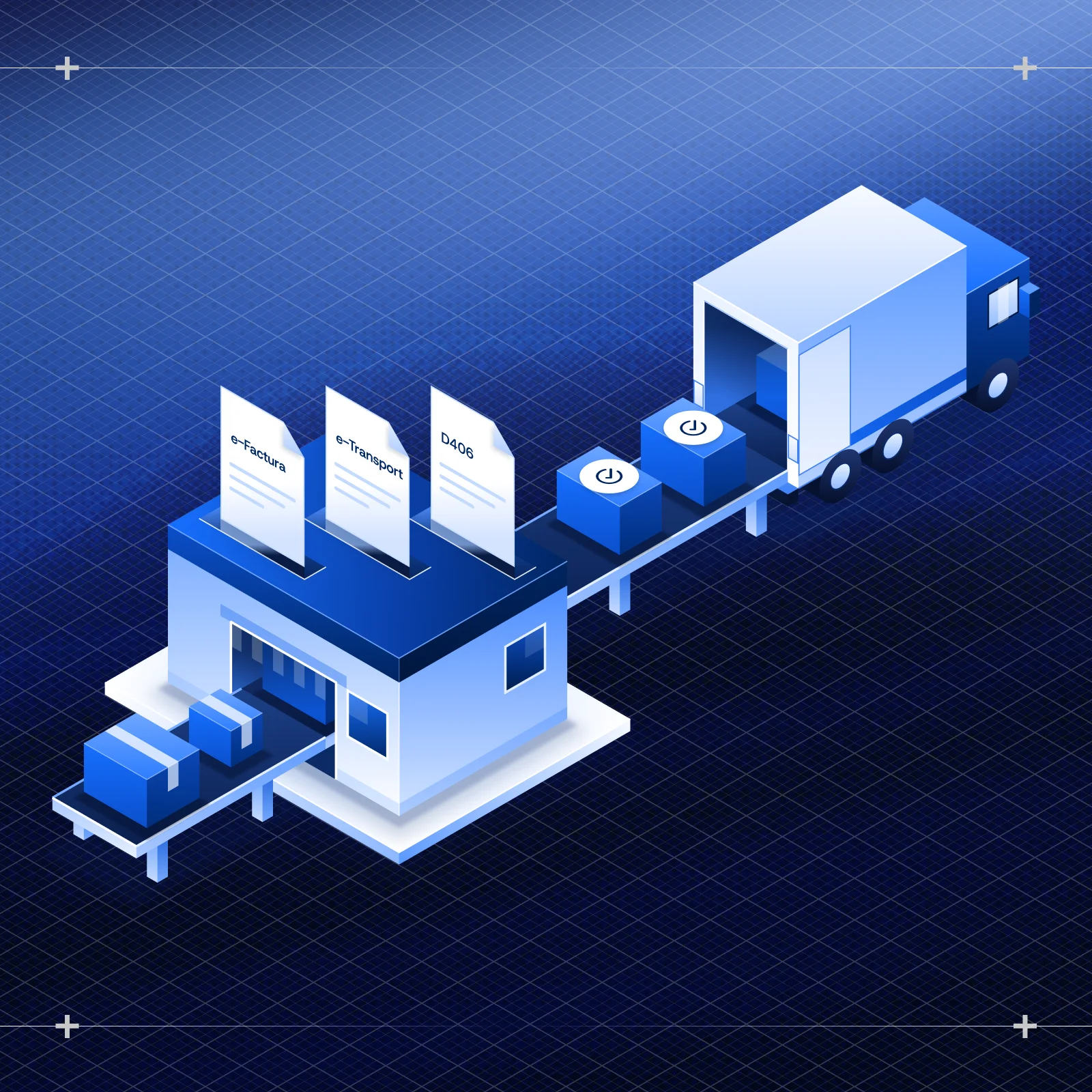
Bring structure, visibility, and compliance to your transport operations


Summary
A practical guide to SAF-T (D406) for the people who run transport at Romanian shippers. It covers what the D406 file is and its legal basis, who has to file it and since when, the three filing rhythms and the fines, and where transport data lands in the file – carrier invoices, freight cost bookings, payments, product data, stock movements and owned trucks. It also explains how D406 lines up with e-Factura and e-Transport/UIT, six habits that get transport data ready, and where a TMS fits next to the ERP that files the declaration.
Every Romanian company that keeps double-entry accounts now files D406, the SAF-T declaration ANAF introduced in 2022. Small taxpayers joined on 1 January 2025, and their grace periods ran out during that year. For most mid-market shippers, 2026 is the first year where the file is routine and the fines apply in full.
Most D406 guidance is written for accountants. This guide is for the people who run transport, because a large share of what ends up in the file starts in the logistics office. Carrier invoices, freight costs, product data and stock transfers between warehouses all feed it. When that data still lives in an Excel file and an inbox, the declaration is only as accurate as the last copy-paste.
TL;DR
- What is D406? D406 is Romania's SAF-T file (Fișierul standard de control fiscal), an XML export of your accounting records submitted to ANAF.
- Who files it? Large taxpayers since 2022, medium since 2023, small taxpayers and VAT-registered non-residents since 1 January 2025.
- When to file D406? Monthly or quarterly, matching your VAT period, by the last calendar day of the following month. Assets are filed once a year. Stocks are filed only when ANAF asks, with at least 30 days to respond.
- Fines. 1,000 to 5,000 lei for late filing, and 500 to 1,500 lei for an incorrect or incomplete file.
- Transport data inside it. Carrier invoices, freight cost bookings, payments to carriers, product and unit-of-measure data, and, on request, stock movements between locations.
- Who owns what. Your ERP produces the file. Your logistics team decides whether the transport data behind it is right.
What Is SAF-T (D406) in Romania?

D406 is the informative declaration through which Romanian companies send their accounting data to ANAF in the SAF-T format. SAF-T (Standard Audit File for Tax) is an OECD standard for handing ledger data to a tax authority in a structured way.
The legal basis is article 59^1 of the Tax Procedure Code (Law 207/2015). The content, deadlines and taxpayer categories are set by ANAF Order 1783/2021, which has been amended several times since.
Your accounting or ERP system generates the XML. ANAF's DUKIntegrator validator checks it, and you submit the declaration as a PDF with the XML attached, signed with a qualified electronic certificate, through the ANAF portal. A signed file can be up to 500 MB. Anything larger is split into segments.
The file has four blocks:
- Header: company and reporting period.
- MasterFiles: chart of accounts, customers, suppliers, products, tax codes, units of measure.
- GeneralLedgerEntries: the journal.
- SourceDocuments: sales invoices, purchase invoices and payments, plus stock movements and asset transactions in their own declarations.
Who Has to File D406, and Since When?
Every Romanian legal entity with double-entry accounting is now in scope, along with non-residents registered for VAT in Romania.
DETAILED COMPARISON 2026
D406 obligation by taxpayer category
| Taxpayer category | D406 obligation since |
|---|---|
| Large taxpayers | 1 January 2022 |
| Medium taxpayers | 1 January 2023 |
| Small taxpayers | 1 January 2025 |
| Non-residents registered for VAT in Romania | 1 January 2025 |
Each wave got a grace period for its first returns, six months for the first monthly report and three months for the first quarterly one. Those windows closed in 2025, so every category now files on standard deadlines.
Some entities stay outside D406, including public institutions, NGOs and other non-profits that keep single-entry accounts, and sole traders (PFA, II, IF). If your group runs a Romanian VAT registration without a local company, check who files D406 for it. The obligation has applied to that registration since 2025.
When Is the D406 Deadline?
D406 runs on three rhythms, depending on which part of the file you are sending.
- Monthly or quarterly D406. General ledger, invoices and payments, due by the last calendar day of the month after the reporting period. The period follows your VAT period. Companies without a VAT registration file quarterly.
- D406 Assets. Once a year, by the deadline for the annual financial statements. For small taxpayers, the first one covered 2025 and fell due in 2026.
- D406 Stocks. Only when ANAF requests it, within a deadline ANAF sets that cannot be shorter than 30 calendar days from the request.
When a deadline falls on a weekend or public holiday, it moves to the next working day. The April 2026 return, for example, was due on 2 June 2026, because 31 May was a Sunday and 1 June a public holiday.
Filing late costs 1,000 to 5,000 lei. Filing an incorrect or incomplete file costs 500 to 1,500 lei. Errors you find later are fixed with a rectifying declaration for the same period.
Where Does Transport Data Sit in the D406 File?
D406 has no section called "transport". Transport data runs through the ordinary accounting sections, which is why logistics teams tend to treat SAF-T as a finance topic. Finance submits the file, and much of what it reports was created in logistics.
DETAILED COMPARISON 2026
Where transport data lands in D406
| What your transport operation creates | Where it lands in D406 | How often it is reported |
|---|---|---|
| Carrier invoices (freight, surcharges, waiting time) | PurchaseInvoices, plus the carrier's supplier record in MasterFiles | Monthly or quarterly |
| Freight cost bookings | GeneralLedgerEntries | Monthly or quarterly |
| Freight charged to your customers | SalesInvoices | Monthly or quarterly |
| Payments to carriers and forwarders | Payments | Monthly or quarterly |
| Product codes and units of measure | MasterFiles (Products, UOM table) | Monthly or quarterly |
| Stock movements between warehouses, sites and customers | MovementOfGoods and PhysicalStock, with movement type, ship-from and ship-to | On ANAF request |
| Trucks and trailers you own | Assets and AssetTransactions | Annually |
Three of these deserve a closer look.
Carrier Invoices Carry Most of the Transport Data
Every carrier invoice becomes a purchase invoice record, with the carrier's tax ID, the amounts and the VAT treatment. Freight invoices are hard to book cleanly because the price often moves after the order is placed. Waiting time, an extra stop, a fuel surcharge or a replacement truck all change the final amount.
If the invoice is booked without a check against the transport order, the ledger records whatever the carrier billed. The correction then arrives weeks later as a credit note, which becomes one more record in a later D406 period.
Freight Costs Need a Consistent Home in the Ledger
SAF-T maps your ledger to the ANAF chart of accounts. Outbound freight is typically booked to account 624 (transport of goods and personnel). Inbound freight can be included in the purchase cost of the goods instead.
Both treatments are valid. What matters is that the same kind of shipment is booked the same way every month, and that finance can trace any freight line back to a transport order when asked.
Stock Movements Come With Locations Attached
The stocks declaration only arrives when ANAF asks for it. When it does, you have at least 30 days to produce balances and movements per storage location, each with a movement type from ANAF's nomenclature and ship-from and ship-to details.
Transfers between your own warehouses are part of that picture. If the goods are on the high-fiscal-risk list, those same transfers may already need a UIT code in e-Transport, so the two records describe the same truck.
How Does D406 Connect to e-Factura and e-Transport?
Romania now collects three views of the same shipment. e-Factura holds the invoice. e-Transport holds the declared road movement, for high-fiscal-risk goods moved domestically and for international movements of goods. D406 holds the ledger that records the invoice and the payment.
Under the 2025 ANAF e-Transport guide, the declaration sits with the Romanian side of the movement. The UIT code does not need to appear on the transport document, but it must reach the carrier, directly or through the transport organiser, before the vehicle moves. The carrier makes it available to the driver, who presents it with the transport documents on request.
Each system has its own rules and its own deadline. Together they give ANAF three records to compare for one delivery, which means a quantity, a date or a partner that differs between them is easier to spot than it used to be. A file can pass validation and still disagree with the invoice and the UIT for the same delivery. Most of that consistency is decided at the transport order.
How Do You Get Transport Data Ready for D406?
Six habits cover most of the transport side.
- Check carrier invoices before booking. Compare each one against the transport order, the agreed rate and the accepted surcharges, so the ledger records the price you agreed to.
- Keep one reference per transport. Link the order, the CMR or e-CMR, the UIT where one applies, and the carrier invoice, so a ledger line can be traced back to a delivery.
- Agree freight accounts with finance. Decide where inbound and outbound freight are booked and keep it stable from month to month.
- Clean up carrier master data. Keep one supplier record per carrier with the correct tax ID, because duplicates carry straight into MasterFiles.
- Align product data. Use the same product codes and units of measure in the ERP, the warehouse and the transport documents.
- Prepare for a stocks request. Know which storage locations you report, and make sure internal transfers are recorded as movements with dates.
For many shippers, the first two habits live in Excel, email threads and a WhatsApp group with the carriers. That holds up until someone has 30 days to explain a quarter of freight costs line by line.
Still matching freight invoices in Excel? See how carrier invoices, e-CMR and the UIT sit on one transport record in Deliwell. Book a demo
Where Does a TMS Fit in SAF-T Reporting?
Your ERP or accounting system generates and files D406, and a TMS does not replace that step. A TMS improves the transport data before it reaches the ledger, so the file describes what happened on the road.
Deliwell is a transport management system for mid-market European shippers. It works with 100+ mid-market shippers and covers the full transport lifecycle in one platform, from planning and carrier allocation to documents, compliance and invoice validation. Three parts of it matter for D406.
- Invoice validation. Carrier invoices are checked against the agreed rates and the transport order before they are approved, so disputes are settled before booking.
- One record per transport. The transport order, the e-CMR, the UIT and the carrier invoice sit on the same record, which gives finance a trace from a ledger line back to the truck.
- ERP connection. Deliwell connects to ERPs over REST API and EDI, validated with SAP, Oracle, Microsoft Dynamics and Navision. It also runs standalone when there is no integration.
The same platform handles RO e-Transport with a direct ANAF API connection and e-CMR, and it integrates with the GPS providers your carriers already use, with no cap on the number of feeds.
Sonepar Romania centralised transport reporting and cost control in Deliwell and cut transport costs by 12% and operational workload by 18%. Read the case study
A TMS is a poor fit for some operations. If you run under 50 shipments a month, need complex air and sea costing (Deliwell handles it on an all-in basis only), or move specialized freight, a disciplined invoice check in a shared spreadsheet will cover most of what D406 asks of transport.
Ready before the next D406 period? Put your transport orders, documents and carrier invoices on one record. Book a demo
Free guide on this topic
20 Transport KPIs Every Logistics Team in Manufacturing & Distribution Needs to Track
The 20 KPIs that manufacturing and distribution teams use to control freight cost, service level and carrier performance.
The Ultimate e-Transport Automation Guide 2026
The 4 levels of e-Transport automation, from the ANAF portal to UIT codes issued by your own systems.

50 e-Transport questions your team keeps getting wrong
UIT codes, deadlines and fines in RO e-Transport, in plain language for declarants and transport organisers.
Case studies


Sonepar Romania centralises transport reporting and cost control with Deliwell



Inteva gains full transport visibility and eliminates manual work with Deliwell



Hamilton Central Europe reduced transports costs by 15% by replacing their old TMS with Deliwell

FAQ
What is ANAF SAF-T?
ANAF SAF-T is Romania's Standard Audit File for Tax, submitted as the informative declaration D406. It is an XML export of a company's accounting records, including the general ledger, invoices, payments, and on request stocks and assets. It gives ANAF the company's books in one structured file for review.
Who has to submit D406?
Romanian legal entities with double-entry accounting and non-residents registered for VAT in Romania. Large taxpayers have filed since 2022, medium since 2023, and small taxpayers and non-residents since 1 January 2025. Public institutions, NGOs and other non-profits that keep single-entry accounts, and sole traders such as PFA, II and IF are outside the obligation.
What is the D406 deadline in 2026?
The monthly or quarterly D406 is due by the last calendar day of the month after the reporting period, moved to the next working day when that falls on a weekend or holiday. The assets declaration is due with the annual financial statements. The stocks declaration is due only on request, within at least 30 days.
What are the fines for not submitting D406?
Late filing is fined 1,000 to 5,000 lei, and an incorrect or incomplete file 500 to 1,500 lei. The grace periods for newly obliged taxpayers ended in 2025, so the fines now apply to every category.
How do you submit D406?
Your accounting or ERP system generates the XML file, which you check with ANAF's DUKIntegrator validator. The declaration is then submitted as a PDF with the XML attached, signed with a qualified electronic certificate, through the ANAF portal. Files over 500 MB are split into segments.
Does D406 include transport data?
Yes, through the regular accounting sections. Carrier invoices appear as purchase invoices, freight costs as ledger entries, and payments to carriers in the payments section. Stock movements between locations, with ship-from and ship-to details, are reported when ANAF requests the stocks declaration.
Is D406 the same as e-Transport?
No. e-Transport declares individual road movements of goods and issues a UIT code before the truck leaves. D406 reports accounting data after the period closes. The two can describe the same shipment, so the data behind them should match.