
6 Best Transporeon Alternatives For Your Use Case In 2026
Ranked by buyer fit, scope, time-to-value, and compliance — so you can find the one that fits your use case, not just the biggest name.

Bring structure, visibility, and compliance to your transport operations


Summary
Transporeon fits global enterprise shippers with 10,000+ monthly loads, but outside that profile the 6–18 month rollouts, procurement-led design, and thin CEE compliance (like Romanian e-Transport/UIT) push many buyers elsewhere. We ranked six alternatives by buyer fit, scope, time-to-value, and compliance: Deliwell (mid-market EU shippers needing a full TMS with native compliance and a go-live in weeks), project44 (enterprise visibility), Shippeo (automotive visibility), CargoWise (forwarders/3PLs), SAP TM (SAP S/4HANA enterprises), and Alpega (freight tendering). The takeaway: visibility and forwarder tools often get miscategorized as alternatives, so co-existence beats replacement, and the most underserved segment, mid-market EU shippers with a RO/CEE entity, is exactly who Deliwell was built for.
If you're comparing Transporeon alternatives, you've likely hit one of three walls: the rollout takes 6 to 18 months, the platform is built around enterprise procurement rather than daily execution, or your local team can't operate it and has quietly gone back to Excel.
This article compares and ranks six Transporeon alternatives and tells you which one fits your specific situation.
TL;DR – What's the best Transporeon Alternative For Your Use Case?
- Deliwell: Best for mid-market EU shippers needing a full TMS with native EU compliance and a go-live in weeks.
- project44: Best for enterprises that already have a TMS and need real-time multi-modal visibility on top.
- Shippeo: Best for European automotive shippers needing multi-modal visibility.
- CargoWise: Best for freight forwarders and 3PLs, not shippers.
- SAP TM: Best for large enterprises already running SAP S/4HANA.
- Alpega Group: Best for shippers whose primary need is freight tender and a carrier exchange.
If you're a mid-market EU shipper that needs more than Excel but can't justify the cost and complexity of an enterprise TMS, and you want full transport management with EU compliance built in and a go-live measured in weeks, Deliwell is the right Transporeon alternative for you. Book a free call.
Best Transporeon Alternatives – Side-by-side comparison
Why shippers look for Transporeon alternatives
Transporeon, acquired by Trimble for €1.88B in 2023, sits at the top of the European TMS market. Its carrier network is the largest on the continent, while the dock scheduling, freight procurement, and sourcing modules are robust. For the right buyer, the platform can work well.
The question is whether you're the right buyer, and if Transporeon's product fits your specific use case. There are three patterns that explain why shippers across different segments look for Transporeon alternatives:
Procurement-led design doesn't fit every team
Transporeon's center of gravity is the carrier network, the tender, the marketplace. That fits a global enterprise shipper with a dedicated procurement team, 10,000+ monthly loads, and the IT resources to integrate the platform deeply into their stack.
Plenty of shippers don't work that way. Some are operations-led, where daily execution (planning, allocation, document handling, invoicing) matters more than procurement strategy. Some are freight forwarders working on behalf of clients, with a completely different workflow center. Some need visibility on shipments routed through carriers they've already chosen, nothing more. A platform designed around the wrong center of gravity will always feel awkward.
Implementation complexity
Standard rollouts take 6 to 18 months. Public reviews on Gartner and Capterra mention the same issues: complex UI, steep learning curve, the need to build standard reports from scratch. One logistics manager described it as "too complex" in a Gartner review.
API gateway configuration alone can run around €100k before any workflow goes live. For an enterprise shipper with a dedicated TMS rollout team, that's a manageable line item. For a smaller team or a faster timeline, it's a blocker.
Native EU regulatory depth
Transporeon's Digital Transport Documents product covers eCMR and the broader EU eFTI framework (full application July 9, 2027). What it doesn't cover natively is country-specific compliance: Romanian e-Transport with UIT codes (mandatory through ANAF since 2024), Hungarian NAV invoicing, Polish KSeF, and others.
A global platform prioritizes its largest markets and the EU-wide regulations that apply across the EU. CEE country-specific rules sit at the periphery. For shippers with Romanian or CEE operations, especially those headquartered there, that periphery is the workflow they need most.
If any of those three patterns sound familiar, here's what the realistic alternatives look like.
How we evaluated these alternatives
Four criteria:
- Buyer fit – Is the product built for the shipper, the freight forwarder, or the carrier? These are different products that often get lumped together.
- Scope – Full TMS covering planning, allocation, execution, tracking, invoicing? Or visibility only? Or marketplace only?
- Time-to-value – How long from contract to a working transport order. Weeks for some, quarters for others.
- Regional compliance – Native coverage of RO e-Transport, e-CMR, e-FTI, and CEE-specific rules.
Scoring is based on public review data (Gartner, G2, Capterra), vendor documentation, and 40+ TMS evaluations we've sat through with prospects.
Deliwell: Best Transporeon Alternative for Mid-Market EU Shippers

Deliwell is a cloud TMS for European mid-size and enterprise shippers. It replaces spreadsheets, email threads, and manual portal uploads with one platform covering the full transport lifecycle: order creation, allocation, tracking, e-CMR, invoicing, KPIs, and more.
It is built for shippers. Compliance comes built in, so when ANAF or the EU changes the rules, the platform updates on its own. Nobody on your team has to track legislation or file a ticket to stay current. Most enterprise tools charge extra for that and hand the work back to you.
Who should use Deliwell?
Mid-sized industrial, retail, or wholesale shippers. Typically 200 to 2,000 employees, 50 to 5000 transports a month, 200+ partners. Often part of a multinational group with a Romanian or CEE entity. Primarily road freight (FTL, LTL, courier).
If you want enterprise-grade operational depth without the enterprise-grade implementation pain, then Deliwell is the right fit for you.
See if Deliwell fits your operation — book a quick call and we'll walk you through it.
Deliwell's strengths
- Speed to value – Standard go-live in 1 to 2 weeks. 4 to 6 weeks with full ERP integration. First transport order created within 30 minutes of access.
- Native EU compliance – RO e-Transport, e-CMR, and 2027 e-FTI-ready functionality included in the subscription.
- Cross-department design – Connects sales, purchasing, warehouse, finance, dispatch, and logistics on the same data. Most TMS platforms connect only logistics to carriers.
- Fixed, transparent pricing – Deliwell pricing is fixed, starting at €250/month and scaling with your transport volume — delivered as an all-in-one SaaS subscription with no hidden IT costs. Book a call for a pricing proposal tailored to your operation.
- Built with operators – Customers across industrial, retail, and wholesale specifically name operator-credible product decisions as a reason they chose Deliwell.
Where Deliwell falls short
- Road-first – FTL, LTL, and courier integrations (DHL, TNT, UPS, DPD) are core. Air, sea, and rail are supported but secondary. Heavy ocean or air freight operations should look elsewhere.
- EU-only – No US market plans currently. Multinational groups with significant US operations need a separate North American solution.
- Wrong fit below 50 shipments/month – At that volume, Excel is still a better choice.
Pricing
Deliwell pricing is fixed, starting at €250/month and scaling with your transport volume — delivered as an all-in-one SaaS subscription with no hidden IT costs. Contact Deliwell for a pricing proposal tailored to your operation.
project44: Best Transporeon Alternative for Enterprise Real-Time Visibility
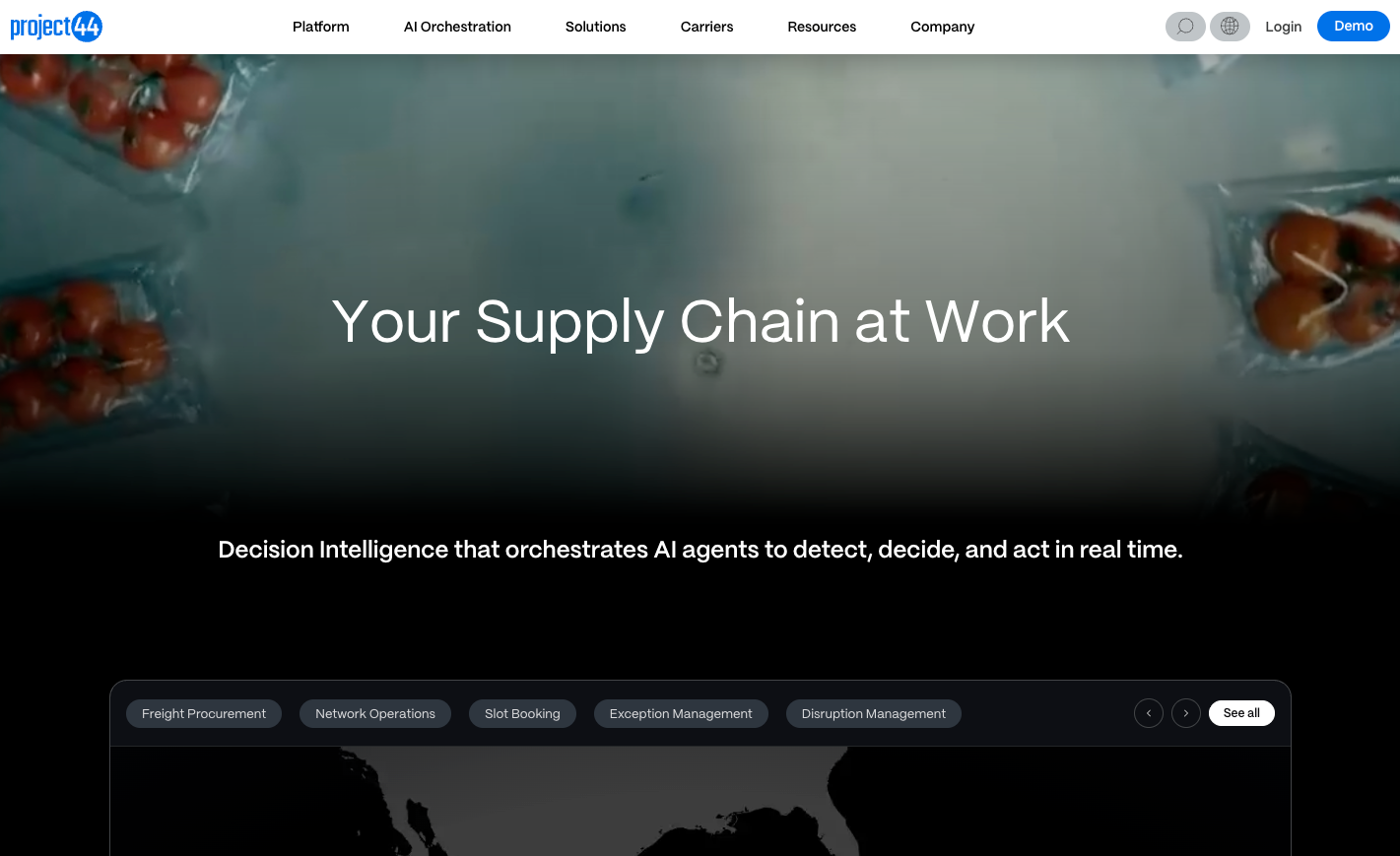
project44 tracks where your freight is, in real time. It connects to carrier telematics and your existing systems, then turns those raw location feeds into live ETAs and delay alerts across road, ocean, air, and rail.
That's the core of the product. It doesn't plan a shipment, allocate it to a carrier, or handle the invoice, because it's a tracking layer that runs on top of a TMS you already have.
Who should use project44?
Large enterprises that already run a TMS, whether SAP TM, Manhattan, or something in-house, and want real-time tracking on top.
The reasoning is in the mechanics. project44 adds a visibility layer to a TMS rather than replacing one, so the planning and execution system has to already be in place for it to be worth anything.
Its value also scales with complexity. When a supply chain runs long, multi-modal, and global, a container stuck at port or a late ocean leg carries real downstream cost, and learning about it early is worth paying for.
That's why it lands in CPG, retail, and global manufacturing, and why a shipper moving trucks around Europe rarely needs it.
Strengths
- The largest carrier network for real-time visibility, with 259,000+ active carriers integrated.
- Real-time ETAs across road, ocean, air, and rail.
- Strong API depth and developer ecosystem.
Where it falls short
- Visibility only – It tells you where your shipment is. It doesn't help you plan it, allocate it to cost centers, or audit the invoice.
- Enterprise pricing and complexity. Field sales motion, multi-month implementation, enterprise-quote pricing.
- Co-existence is often the better answer. Deliwell integrates with project44 directly. Many groups run both.
Pricing
Project44 doesn't publish pricing. Expect an enterprise sales process and a quote that scales with the amount of freight you track through the platform.
Shippeo: Best Transporeon Alternative for Automotive Multi-Modal Visibility
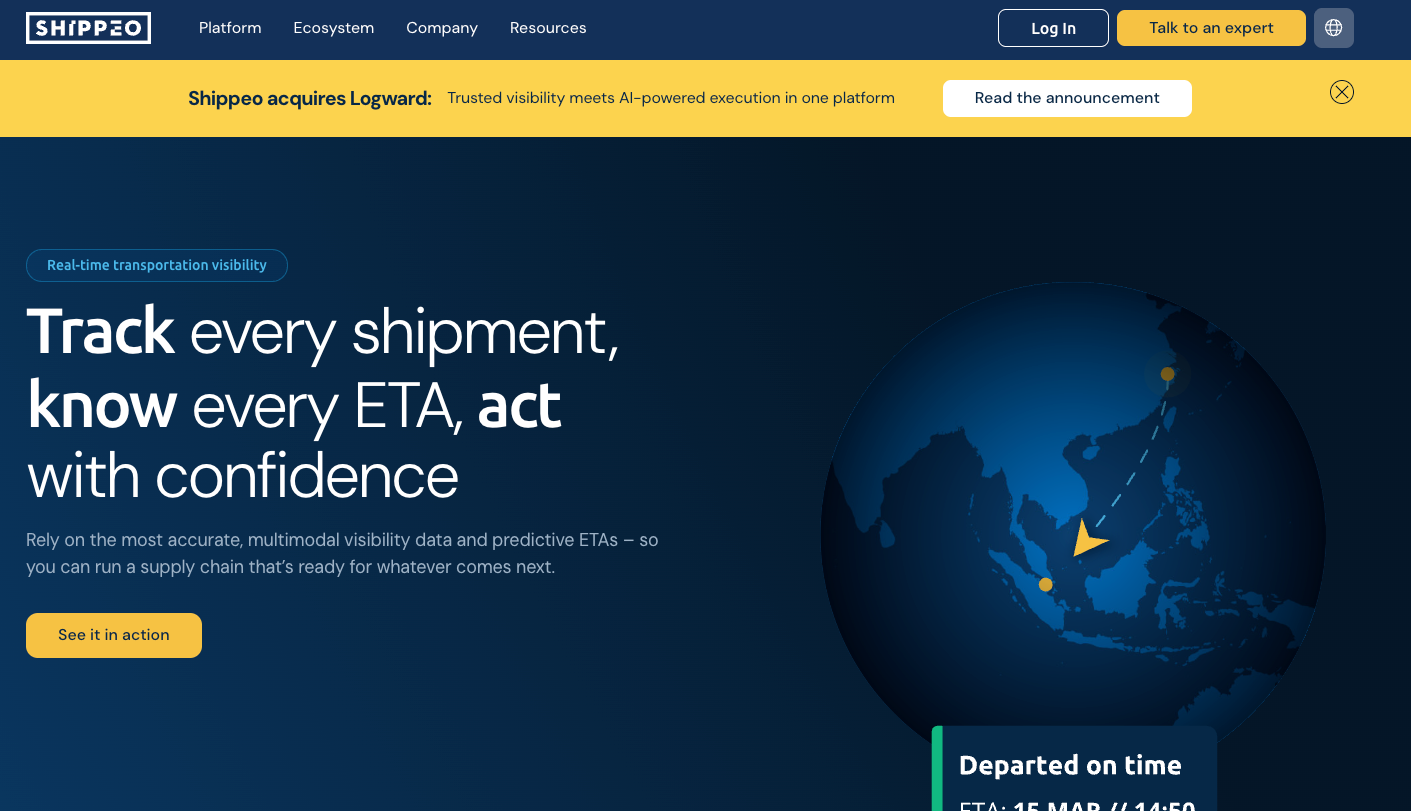
Shippeo does the same core job as project44. It tracks freight in real time and turns carrier location feeds into predictive ETAs and delay alerts across road, ocean, air, and rail.
The difference is in the focus. Shippeo built its product and its carrier network around European automotive, so it reads the rhythms of OEM and tier-1 supply chains more closely than a general-purpose tracker.
The boundary is the same as project44, though. It tracks shipments without planning, allocating them to cost centers, or auditing the invoice, so it sits on top of a TMS rather than replacing one.
Who should use Shippeo?
Shippeo is the best for European automotive shippers and OEMs that need visibility across tier-1 and tier-2 supplier networks.
The reasoning is the cost of a surprise. Automotive runs on just-in-time (JIT) and just-in-sequence (JIS), so a late part doesn't just arrive late; it can halt a production line, and a stopped line burns money fast.
Early warning of a delay is worth far more in that world than shaving a few percentage points off freight costs. Shippeo fits because its network and ETAs are tuned to the carriers and lanes that automotive supply chains actually use, so its coverage is more reliable than a general tracker would provide.
Strengths
- Automotive industry expertise. Some automotive manufacturers have standardized on Shippeo.
- Multi-modal coverage across road, ocean, air, and rail.
- Strong European carrier network.
Where it falls short
- Visibility only – It tracks shipments but doesn't plan, allocate to cost centers, audit the invoice, or handle compliance, so a shipper needing operations still needs a TMS underneath.
- Limited CEE compliance depth – Built for the largest European markets first, with Romanian, Hungarian, and Polish rules sitting at the edges.
- Co-existence is the usual outcome – Shippers needing both visibility and operations run Shippeo alongside another platform.
Pricing
Shippeo doesn't publish pricing. It's an enterprise sale, quoted per deployment, with cost that scales with how much freight you track.
CargoWise: Best Transporeon Alternative for Freight Forwarders and 3PLs

CargoWise runs the business of a freight forwarder. It handles the full operation on one system: booking and managing multi-modal shipments for clients, filing customs declarations across borders, tracking containers, and billing the customers whose freight is being moved.
WiseTech Global built it to be deep across all of that, and it is. For a forwarder, customs broker, or 3PL, that depth is the whole point.
The catch is who the depth serves. CargoWise is built around moving someone else's freight, so the workflows assume a forwarder's business, and a shipper inherits a lot of machinery they'll never touch.
Who should use CargoWise?
CargoWise is the best for freight forwarders, customs brokers, and 3PLs running multi-modal international logistics, especially where customs and trade compliance sit at the center of the work.
The reasoning is that their whole business is moving freight for clients. Customs filing, multi-leg international routing, and client billing aren't side features for a forwarder, they're the core job, and CargoWise is built around exactly that.
A shipper owns the goods and needs them moved. They aren't brokering customs for clients or invoicing customers for freight, so most of CargoWise's depth turns into weight they carry without using.
Strengths
- Built for freight forwarders specifically, and it shows in the workflow depth.
- Extensive customs and trade compliance functionality.
- Global presence and a mature partner ecosystem.
Where it falls short
- Wrong buyer for a shipper – Companies that own their goods repeatedly find CargoWise over-engineered, because the product is built for the company moving someone else's freight.
- Long implementations – Rollouts of 6 to 12 months or more are standard.
- Rising cost – Pricing trends high and recent changes have pushed it higher for many forwarders.
CargoWise is an excellent choice for a forwarder. The trap is the shipper who tries it because Transporeon felt too complex, then ends up on a platform built for an entirely different business.
Pricing
CargoWise doesn't publish pricing and sells directly through WiseTech. In late 2025, it shifted most customers to a per-transaction model called Value Packs, which several forwarders reported had increased their costs.
SAP TM: Best Transporeon Alternative for Enterprises on SAP S/4HANA
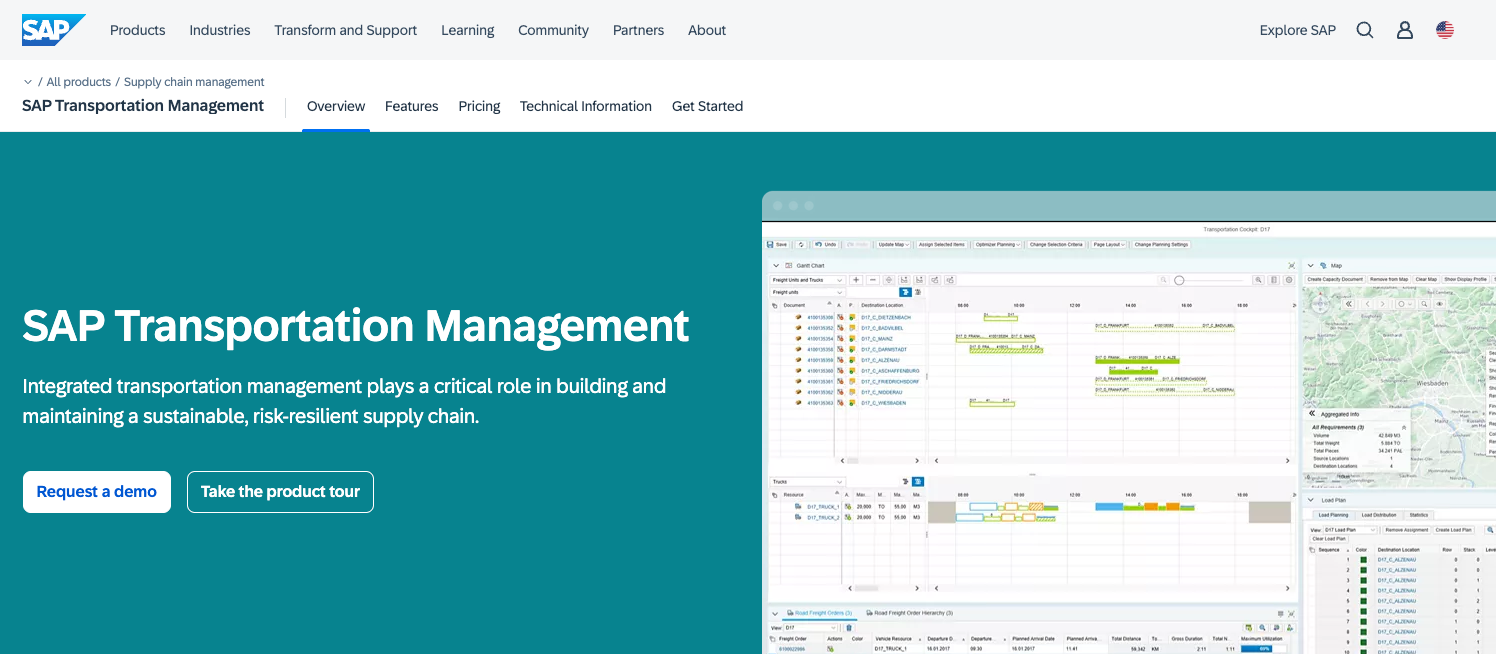
SAP TM is the transportation module inside SAP's software suite. It plans shipments, tenders them to carriers, tracks execution, and settles the freight bill, all on the same data backbone as the rest of SAP.
That last part is the entire reason it exists. If your company already runs SAP S/4HANA, order and delivery data flows straight into transport, with no connector to build and no second system to reconcile.
Outside an SAP environment, that advantage disappears, and you're left with a heavy, expensive TMS competing against tools built to do the job on their own.
Who should use SAP TM?
SAP TM is the best for large enterprises already running SAP S/4HANA, where keeping transport on the same stack as everything else matters more than implementation speed or cost.
The reasoning is that the whole value of SAP TM is the native integration. On an existing SAP backbone, the data flows without a connector and your IT and procurement teams already know the vendor.
Take that away and the math stops working. A company that isn't on SAP carries the cost and the long rollout without the one payoff that justifies them, which is why a purpose-built TMS almost always wins outside the SAP world.
Strengths
- Native S/4HANA integration. If you already live in SAP, this is the path of least resistance for data consistency.
- Enterprise-grade depth for global multi-modal operations.
- SAP's global presence and partner ecosystem.
Where it falls short
- Limited CEE compliance depth – Romanian e-Transport, Hungarian NAV invoicing, and Polish KSeF aren't priorities on a global ERP roadmap.
- Long implementations – Twelve to eighteen months or more is normal, and rollouts often outlast the procurement teams that signed them.
- Wrong fit for mid-market – It's designed for enterprises with serious IT and process maturity, and a team of five to ten logistics staff will struggle to operate it.
Pricing
SAP TM has no public list price. It's quoted as part of a broader SAP licensing deal, so the transport module's cost usually folds into a larger enterprise agreement rather than standing on its own.
Alpega Group: Best Transporeon Alternative for Freight Tender and Carrier Exchange
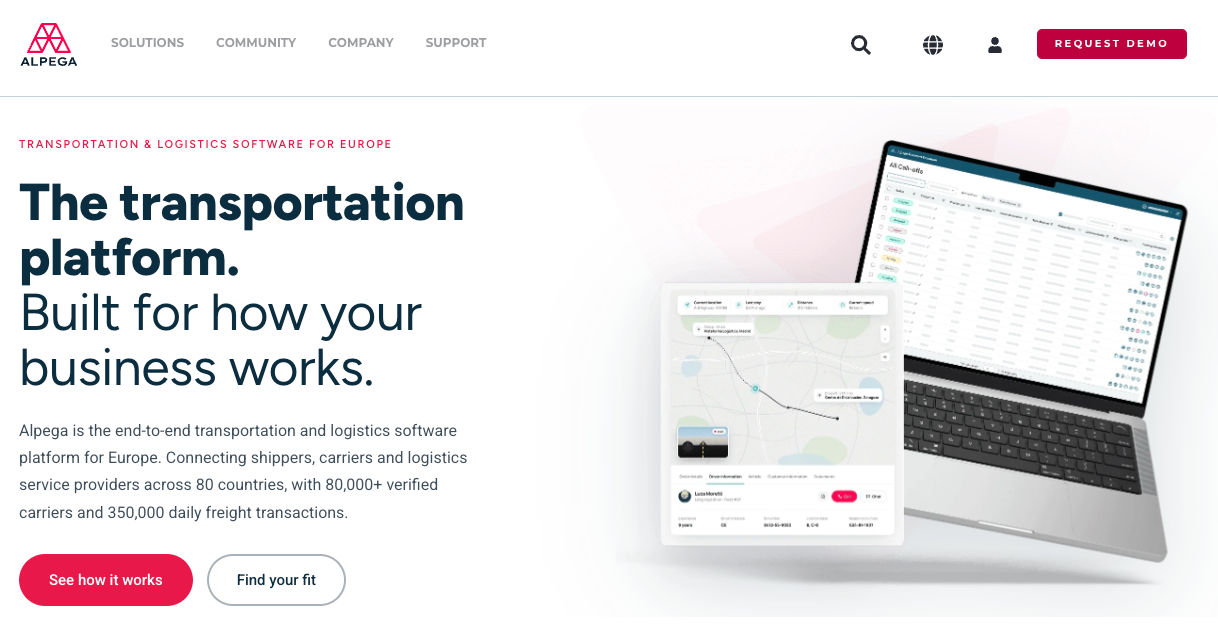
Alpega is a group of freight platforms stitched together under one roof. The two parts that matter are its procurement tool (TenderEasy, for running carrier tenders) and its freight exchanges (Teleroute and Wtransnet, two of Europe's largest load boards).
Put together, they answer one question well: who moves this load, and at what price. You can lock in rates through a structured tender or find spot capacity on the exchange, all in one place.
The operational side is thinner. Alpega also sells TMS products (Transwide and inet), but the suite was assembled through acquisitions, so the day-to-day execution layer doesn't run as cleanly as a platform built as a single piece.
Who should use Alpega?
Shippers whose biggest headache is procurement rather than daily operations, the kind of organization where the transport decision starts with "which carrier, at what rate."
The reasoning is alignment. Alpega is built around sourcing capacity and locking in rates, so if you tender freight each year and lean on the spot market for overflow, its depth sits exactly where you need it.
If your real pain is the daily routine instead — the planning, the documents, auditing invoices and allocating to cost centers — the suite has less to offer, and a purpose-built operational TMS will serve you better.
Strengths
- Mature freight exchange. Teleroute and Wtransnet have deep European carrier coverage.
- Strong tender management through TenderEasy.
- A recognized brand inside European procurement teams.
Where it falls short
- Light on operations. Planning, allocation, document workflow, invoicing, and KPI reporting are all thinner than in a full TMS.
- Pulled across buyer types. The platform serves shippers, carriers, and forwarders simultaneously, diluting the depth of shipper-specific workflows.
- Generic compliance. Regulatory handling isn't built around country-specific rules, as in Romanian e-Transport.
Pricing
Alpega doesn't publish pricing and sells through a direct team. Cost depends on which pieces you take, since a freight-exchange subscription and a full tender-plus-TMS deployment sit at very different price points.
How to choose the best Transporeon alternative for you: a quick decision tree
- Freight forwarder or 3PL? CargoWise.
- Global enterprise already on SAP S/4HANA? SAP TM.
- Already have a TMS and need real-time visibility on top? project44 (general) or Shippeo (automotive).
- Main pain is freight procurement and tendering, not operations? Alpega.
- Mid-market EU shipper running 50 to 5000 transports a month, with a RO/CEE entity, full TMS need, go-live in weeks? Deliwell. Book a free demo call today.
Bottom Line
- Transporeon fits global enterprise shippers with procurement-led organizations and 10,000+ monthly loads. For other shipper profiles, it's not the right fit.
- Visibility platforms (project44, Shippeo) and forwarder TMS (CargoWise) are often miscategorized as Transporeon alternatives. They solve different problems and serve different buyers. Co-existence is often the right answer, not replacement.
- SAP-house enterprises rarely benefit from a third-party TMS evaluation. SAP TM is the path of least resistance, even if implementation is long.
- Mid-market EU shippers running 50 to 5000 transports a month, particularly with CEE operations, sit in the most underserved segment of the European TMS market. Deliwell was built specifically for this profile.
- Native EU regulatory compliance (RO e-Transport, e-CMR, 2027 e-FTI) is a real moat for CEE-headquartered groups, regardless of company size.
If you're a mid-market EU shipper that needs more than Excel but can't justify the cost and complexity of an enterprise TMS, and you want full transport management with EU compliance built in and a go-live measured in weeks, Deliwell is the right tool for you. Book a free call.
FAQ
How much does Transporeon cost?
Volume-based pricing tied to number of shipments. Public review data places entry-level pricing at $1,000+ per month for the smallest deployments. Most real implementations run significantly higher once procurement, visibility, and integration modules are added. No published list price.
How long does it take to implement a TMS?
Depends on the platform. Enterprise TMS (Transporeon, SAP TM, CargoWise) typically takes 6 to 18+ months. Mid-market platforms like Deliwell go live in 1 to 2 weeks for a standard setup, 4 to 6 weeks with full ERP integration.
Is Transporeon worth it for a mid-market shipper?
For shippers moving 10,000+ transports a month with global procurement teams, yes. For mid-market shippers running 50 to 5000 transports a month, the implementation cost (around €100k for the API gateway, 6 to 18 month rollout) usually outweighs the operational benefit. The local team typically falls back to Excel anyway.
Is Deliwell a Transporeon competitor?
They serve different shipper segments. Transporeon serves global enterprise shippers with marketplace-scale carrier procurement needs. Deliwell serves mid-market EU shippers needing a full operational TMS with native EU compliance and fast go-live. They overlap when a Transporeon group-level customer's local entity needs something usable for the actual day-to-day.
Which Transporeon alternative supports Romanian e-Transport (UIT)?
Deliwell has native RO e-Transport / UIT generation, validation, and ANAF integration built into the subscription. Transporeon's Digital Transport Documents product handles eCMR and EU-wide eFTI compliance, but Romanian UIT specifically typically requires custom configuration or a third-party connector.
Case studies


Sonepar Romania centralises transport reporting and cost control with Deliwell



Inteva gains full transport visibility and eliminates manual work with Deliwell



Hamilton Central Europe reduced transports costs by 28% by replacing their old TMS with Deliwell
