
Freight Visibility: The 7 Things Mid-Market Shippers Need
The planner needs to know whether the parts will land before the 14:00 shift, and the carrier has four trucks and no telematics. Freight visibility is supposed to replace the phone call that follows.

Bring structure, visibility, and compliance to your transport operations


Summary
A practical guide to freight visibility for mid-market shippers running road freight in Europe. It defines the term and explains why a long tail of small carriers makes it harder at this size. It then sets out the seven requirements that matter, from status coverage of every carrier and an ETA you can plan against to inbound linked to the purchase order, documents and cost on the shipment, and one record for every department. The guide also covers what you can skip, a demo checklist, when a dedicated visibility platform is the right purchase, and how Deliwell handles it.
It's 7:40 and the production planner wants to know whether the components ordered from a supplier in Hungary will land before the 14:00 shift. Purchasing has the purchase order. The supplier says the goods left on Tuesday. The carrier runs four trucks and has no telematics, so someone picks up the phone.
That call is what freight visibility is supposed to replace. The trouble is that most of what's written about freight visibility assumes a global network, an ocean container and an enterprise platform budget. A shipper moving 50 to 5,000 road transports a month needs something smaller and more specific, and it helps to know exactly what before you sit through a single demo.
Key Takeaways
- Freight visibility is knowing where each shipment is, when it will arrive, and whether its documents and cost are in order, without having to ask anyone.
- For mid-market road freight, the hard part is carrier coverage. Most European hauliers are small, and a visibility tool is only as good as its worst-connected carrier.
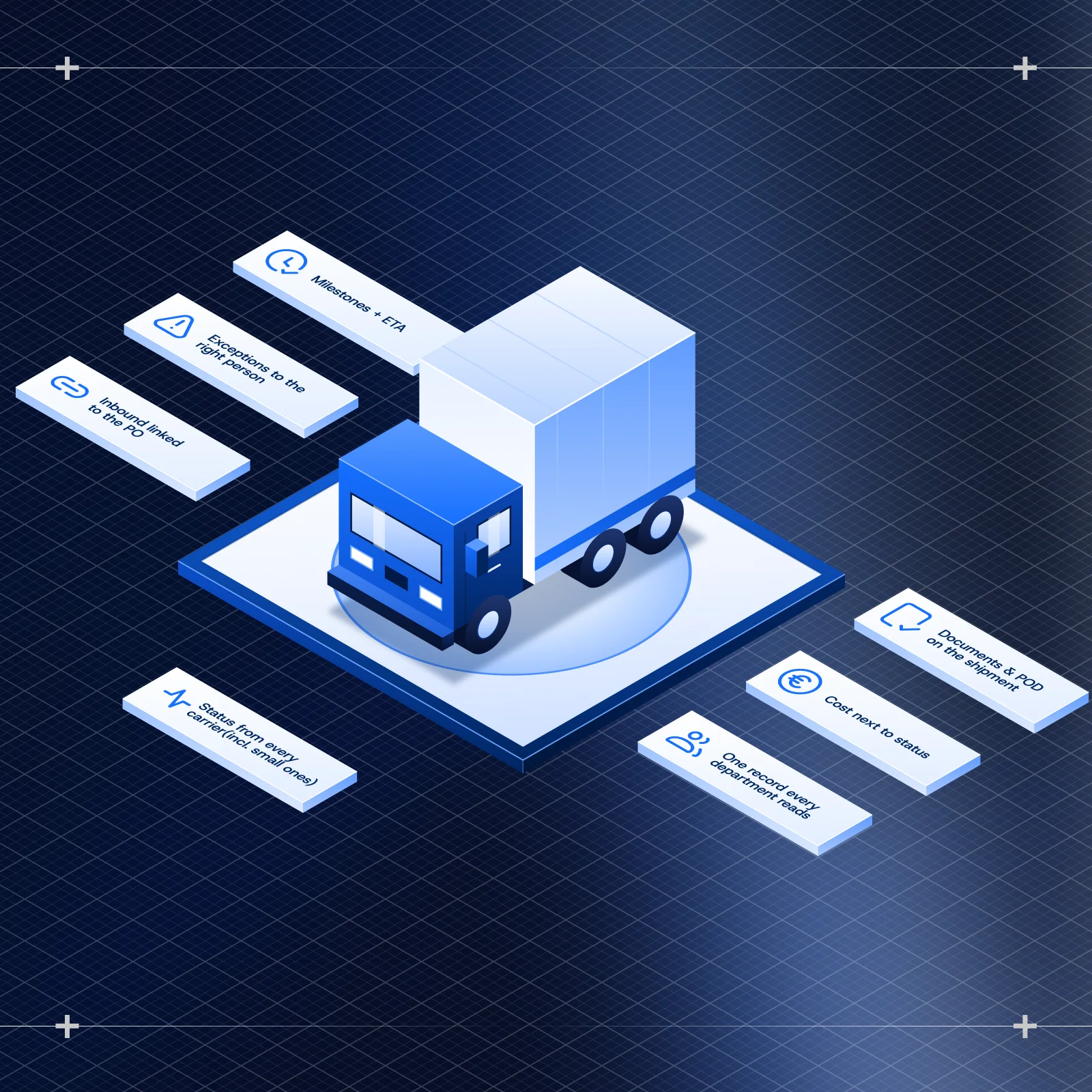
- The seven requirements: status from every carrier, milestones with an ETA, exceptions that reach the right person, inbound linked to the PO, documents on the shipment, cost next to status, and one record every department reads.
- A dedicated visibility platform makes sense for global multimodal networks. Most road-first mid-market shippers get more from a TMS where visibility comes out of running the transport.
What Is Freight Visibility?
Freight visibility is the ability to see the status, location, expected arrival and paperwork of every shipment you've booked, as it moves, from a single place. It covers inbound and outbound freight, and it should tell you about a problem before your customer or your production line does.
Freight visibility is one slice of supply chain visibility. Supply chain visibility also covers supplier mapping and inventory across sites. Freight visibility is about the transport itself: the truck, the load, the documents and the money attached to them.
Gartner tracks the dedicated software category as real-time transportation visibility platforms. Buying one of those is one way to get freight visibility. Running your transports in a TMS that records every status change is another.
Why Is Freight Visibility Harder for Mid-Market Shippers?
Mid-market shippers work with a long tail of small carriers, and small carriers are the hardest to connect.
The European Commission's 2014 report on the road transport market counted around 600,000 haulage companies in the EU, with 80% employing fewer than 10 people. The figure dates from 2014, so treat it as an order of magnitude. Most mid-market carrier bases still mix a few large groups with dozens of owner-operators.
A large hauler will share a telematics feed. An owner-operator with four trucks usually won't, and won't install your software either. So any approach that depends on carriers integrating with you leaves gaps exactly where delays tend to start.
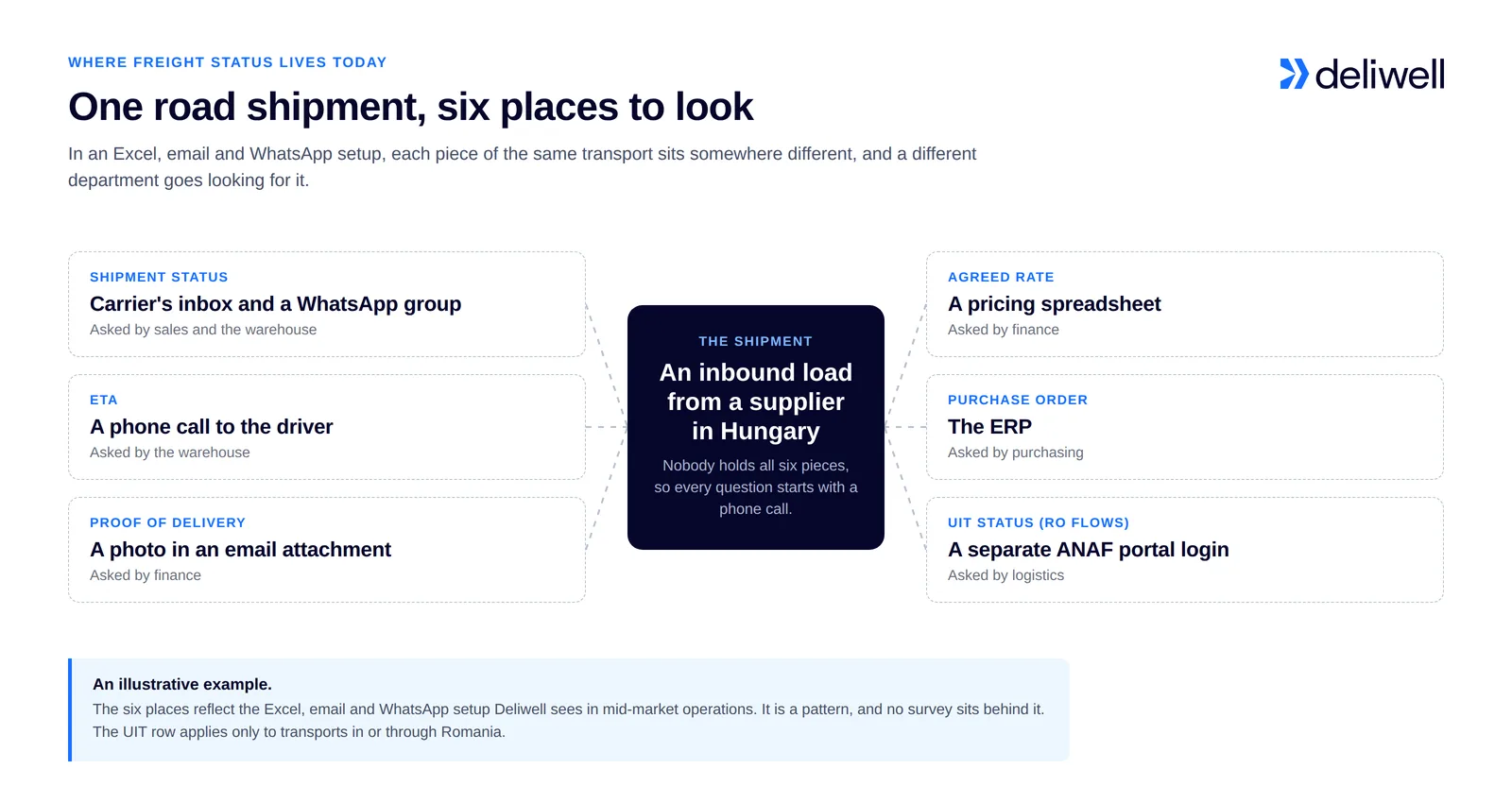
Then there's the starting point. In most mid-market operations, freight status lives in Excel, email and WhatsApp, with ERP exports filling in the order data. No one owns the full picture because six departments touch a transport, and each holds a different piece. Deliwell calls this the transport black hole.
What Do Mid-Market Shippers Need From Freight Visibility?
There are seven, and each one maps to a question somebody in your business asks every week.
1. Status From Every Carrier, Including the Small Ones
Coverage comes first, because a visibility tool that works for most of your carriers still leaves you phoning the rest.
What you want is several ways for status to come in: telematics or API feeds for carriers who have them, a driver app for those who'll use one, and a browser link for everyone else. The link is what lets a dispatcher at a small haulier confirm pickup and delivery without creating an account or installing anything.
Headline carrier-network numbers matter less than coverage on your lanes. Ask for the percentage of your own carrier list a vendor can reach in the first month.
2. Milestones and an ETA You Can Plan Against
A dot on a map is less useful than it looks. Planners work from milestones: accepted, loaded, departed, arrived, delivered. Each one should carry a timestamp and a history, so you can see when the status changed and who changed it.
On top of that you need an ETA that moves when the truck does. A predicted arrival that updates from traffic and route deviations lets the warehouse move the dock slot at 10:00, while there's still time to reassign the team.
3. Exceptions That Reach the Right Person
Nobody watches a tracking screen all day, so visibility has to come to people. The requirement is an alert when something drifts: a truck off its expected route, an ETA past the delivery window, a pickup that never got confirmed.
The alert also has to reach the person who can act on it. A late inbound delivery matters to purchasing and the warehouse. A late outbound matters to sales. One shared inbox for every alert recreates the problem you were trying to fix.
4. Inbound Shipments Linked to the Purchase Order
Most freight visibility content is about outbound deliveries to customers. For manufacturers, the painful gap is often inbound.
Purchasing issues the order and loses sight of the goods the moment they leave the supplier's dock. If the inbound transport isn't linked to the PO, nobody sees a supplier delay until the warehouse calls to say the line is short. Linking the two lets purchasing see the carrier, the ETA and any exception against its own order number, hours before it turns into a production problem.
5. Documents and Proof of Delivery on the Shipment
A delivery isn't finished until the paperwork is. Freight visibility should include whether the signed CMR or e-CMR, the delivery note and the proof of delivery exist, and it should attach them to the shipment they belong to.
The practical test is finance. When an invoice arrives, can someone open the transport and see the signed document in one click? If the answer involves searching a mailbox, you can see the truck but you can't see the delivery.
For shippers moving goods in or through Romania, compliance status belongs here too. Under ANAF's 2025 e-Transport guide, the Romanian side obtains the UIT code for e-Transport/UIT and gets it to the carrier before the vehicle moves, so its filing and validation status should sit on the same record as the shipment.
6. Cost Next to Status
Transport cost is where freight visibility pays for itself, and it rarely comes up in freight visibility guides.
The requirement is simple to state. Every shipment carries its agreed or quoted rate, and the carrier invoice gets checked against it before payment. Put that next to the status and you can see, route by route, whether what you paid matches what you planned. Without it, cost overruns surface at month-end, in a spreadsheet, when it's too late to query them.
7. One Record Every Department Can Read
The last requirement ties the other six together. Sales, purchasing, the warehouse, finance and logistics should all read the same shipment record, each with a view that shows what their role needs.
Role-based views are what stop the phone calls. When the sales coordinator can check a delivery without asking dispatch, dispatch stops fielding the call. When the warehouse sees tomorrow's inbound schedule updated live, trucks stop turning up unannounced at the gate.
What Can a Mid-Market Shipper Skip?
Some features look impressive in a demo and do little for a road-first operation at this size.
Continuous live tracking of every truck. A GPS position every few minutes sounds good, but milestone updates plus a reliable ETA answer nearly every planning question. Continuous tracking also depends on carriers sharing a live feed, which the long tail often won't do.
Ocean and air container tracking. If your freight is mostly road, you're paying for modes you don't use. The road leg of an intermodal flow is covered by the requirements above.
A control tower layered on top of spreadsheets. A dashboard that reads from the same fragmented sources gives you a neater view of the same gaps. Fix where the data lives first.
The biggest carrier network number. A platform connected to hundreds of thousands of carriers worldwide may still reach few of the small hauliers on your lanes. Coverage of your own carrier list is the number to ask for.
How Do You Check a Freight Visibility Tool Against These Requirements?
Take this table into the demo. Each row is a question to ask and what a good answer sounds like.
DETAILED COMPARISON 2026
7 freight visibility requirements: what to ask in a demo
| Requirement | Question to ask | A good answer |
|---|---|---|
| Carrier coverage | How does a four-truck carrier with no telematics send status? | A browser link or driver app that works without a carrier account or an install, with onboarding handled by the vendor |
| Milestones and ETA | What milestones are recorded, and what moves the ETA? | Timestamped status history per shipment, ETA adjusted from traffic and route deviations |
| Exceptions | Who gets alerted, and when? | Alerts by role on route deviation and ETA breach, configurable per flow |
| Inbound | Can purchasing see an inbound transport against its PO? | Inbound and outbound in one view, linked to the order |
| Documents | Where does the signed CMR or POD end up? | Attached to the shipment, available to finance, e-CMR generated in-platform |
| Cost | Is the invoice checked against the agreed rate? | Automatic match, discrepancies flagged before payment |
| One record | What does sales see compared with finance? | Role-based views on the same data |
| Time to value | How long until the first live shipment? | A first transport within the first day, go-live in days, ERP integration scoped separately |
When Is a Dedicated Visibility Platform the Right Choice?
A dedicated visibility platform is the right purchase when you run a large multimodal network and need one operating picture across ocean, air, rail and road.
project44 covers ocean, air, rail, truckload, parcel and last mile. Shippeo describes itself as a multimodal visibility provider covering road, rail, sea and air. FourKites positions its platform around AI agents working across carriers, facilities and suppliers. All three are built for shippers with the scale and the carrier-integration budget that multimodal coverage requires.
Some shippers need both. When a group mandates project44 for cross-entity reporting, the Romanian or Polish subsidiary still has to plan, allocate and document its own road transports somewhere. Deliwell integrates with project44, so orders created in Deliwell flow into the group's visibility layer.
If your freight is mostly road, your carriers are mostly small, and the gaps are in documents, cost and cross-team handoffs, a transport management system usually covers more of the seven requirements than a visibility layer does. Our guide to choosing a TMS walks through that decision.
How Does Deliwell Handle Freight Visibility?
Deliwell is a road-freight TMS for mid-market European shippers, and freight visibility comes out of running the transport in it. Every order, from creation to delivery, lives in one record that the whole business reads.
Carriers receive each order by email with a link that opens the order page directly. From there they accept or reject it, move the status through picked up, in transit and delivered, and upload the CMR. There's no carrier account to create and nothing to install, and Deliwell runs the carrier onboarding. Drivers who use the iOS or Android app confirm pickup and delivery with a GPS timestamp, capture a signature and add photos as proof of delivery.
Each order and each shipment keeps a full status history. Predictive ETA adjusts arrival times from traffic and route deviations. Anomaly detection flags shipments drifting from their expected route or timing, and status-triggered notifications alert the responsible team, plus your customers if you switch that on.
Inbound and outbound transports sit in the same view, so purchasing can follow a supplier delivery without asking dispatch. The e-CMR is generated and signed in the platform. For Romanian flows, the UIT is generated from the transport order data and filed directly with ANAF through an API integration, with its status shown on the shipment. Carrier invoices are matched against the agreed rate, and discrepancies are flagged before payment.
Customers typically report less manual work in planning and validation and less time spent on finance reconciliation, though the size of the gain depends on the starting point. The first transport request can go out on the day the account is set up, and a standard go-live is measured in days. ERP integration with SAP, Oracle, Microsoft Dynamics or Navision adds time, and that's scoped during implementation.
Deliwell works with 100+ mid-market shippers, including Stihl, Sonepar and Frigoglass.
Where Deliwell is the wrong fit. Deliwell doesn't suit operations under 50 shipments a month, where the savings don't cover the subscription. GPS isn't one of the limits: Deliwell integrates with the GPS providers your carriers already use, with no cap on the number of feeds. Complex air and sea costing is handled on an all-in basis only, as the road leg and last mile of intermodal flows, and specialized freight isn't covered.
Driver GPS is scoped to the active shipment and stops when delivery closes. Deliwell made that choice for driver privacy, so if you need continuous vehicle monitoring, you'll need your carriers' own telematics.
Pricing: Deliwell pricing is fixed, starting at €250/month and scaling with your transport volume — delivered as an all-in-one SaaS subscription with no hidden IT costs. Contact Deliwell for a pricing proposal tailored to your operation.
See your own lanes in one record. Deliwell runs a proof of concept on a route cluster, carrier group or business unit, and measures time saved per transport, document error rate and cost delta against your current baseline. Book a demo
Free guide on this topic
20 Transport KPIs Every Logistics Team in Manufacturing & Distribution Needs to Track
The 20 KPIs that manufacturing and distribution teams use to control freight cost, service level and carrier performance.
The Ultimate e-Transport Automation Guide 2026
The 4 levels of e-Transport automation, from the ANAF portal to UIT codes issued by your own systems.

50 e-Transport questions your team keeps getting wrong
UIT codes, deadlines and fines in RO e-Transport, in plain language for declarants and transport organisers.
Case studies


Sonepar Romania centralises transport reporting and cost control with Deliwell



Inteva gains full transport visibility and eliminates manual work with Deliwell



Hamilton Central Europe reduced transports costs by 15% by replacing their old TMS with Deliwell

FAQ
What is freight visibility?
Freight visibility is the ability to see where each shipment is, when it will arrive, and whether its documents and cost are in order, from one place and without asking anyone. It covers inbound and outbound transports and should flag problems before they reach a customer or a production line.
How does freight visibility work?
Status comes in from carriers through telematics or API feeds, driver apps, or a web link the carrier's dispatcher uses to update milestones. The system records each milestone with a timestamp, recalculates the ETA, and sends an alert when a shipment drifts from plan. For small carriers without telematics, the web link is usually what makes coverage possible.
What is the difference between freight visibility and supply chain visibility?
Supply chain visibility is the wider term. It includes supplier mapping, inventory across sites and transport. Freight visibility is the transport slice: the shipment's status, location, ETA, documents and cost.
Do mid-market shippers need a freight visibility platform?
Often a TMS covers the need better, because visibility comes out of running the transport in one record, alongside documents, cost and compliance. A dedicated visibility platform makes sense for large multimodal networks with ocean and air freight across many carriers and regions.
Is real-time freight visibility possible with small carriers?
For most carriers, yes. Small hauliers rarely share a live telematics feed, but most will update milestones through a browser link or a driver app when it's free and needs no install. Milestone updates plus a predicted ETA answer most planning questions, even without continuous GPS tracking.